Get Full Government Meeting Transcripts, Videos, & Alerts Forever!
Get email alerts on the City Budget topic
No spam. Unsubscribe anytime.
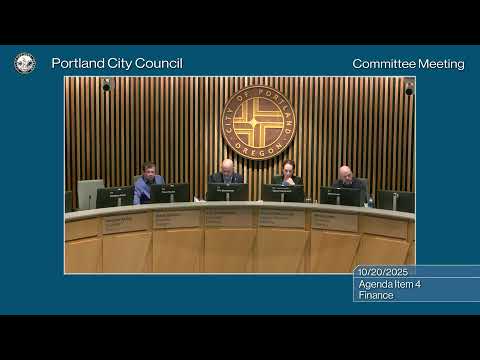
Portland finance committee delays vote on fall technical adjustment ordinance after lengthy questions on encumbrances and Prosper Portland billings
Summary
The Portland City Council Finance Committee on Monday postponed action on the fall technical adjustment ordinance, a package of budget “true‑ups” that reconciles audited ending fund balances from fiscal 2024–25 with beginning balances in 2025–26, after extended questions about encumbrance carryovers, a $4.2 million bill involving Prosper Portland and a roughly $14.7 million general fund deficit.
The Portland City Council Finance Committee on Monday postponed action on the fall technical adjustment ordinance, a package of budget “true‑ups” that reconciles audited ending fund balances from fiscal 2024–25 with beginning balances in 2025–26, after extended questions about encumbrance carryovers, revenue shortfalls and several high‑profile line items.
The ordinance would reconcile last year’s audited ending fund balances with the beginning balances in the new budget year and make a series of technical and policy decisions to appropriate one‑time and carryover amounts. Councilors said they wanted more time to review six major encumbrance carryovers—including a $4.2 million correction tied to Prosper Portland—and to discuss the package at a full‑council work session scheduled later in the week.
Budget Director Ruth Levine and Anthony Locke, supplemental budget coordinator in the City Budget Office, outlined the TAO as a largely technical exercise to “true up” beginning fund balances and to clear encumbrances that fell to balance at fiscal year end. Levine said the primary driver of the TAO is reconciling differences between forecasted and actual revenue—most notably a $12.7 million shortfall in business license tax receipts—and budget underspending partly caused by encumbrances and multi‑year projects. “The main purpose of the fall TAO is to reconcile the beginning budgeted beginning fund balances with the audited ending fund balance of the prior fiscal year,” Levine said.
Locke explained the encumbrance carryover process: bureaus submit requests for funds that were committed by purchase order in the prior fiscal year but not paid before June 30. The City Budget Office vets those requests to confirm the purchase order was open in the prior year and that the requested carryover matches prior underspending. The office recommended $18.4 million in encumbrance carryovers and roughly $1 million in policy carryovers, producing about $19.5 million in recommended carryovers overall. Locke said “no bureau is requesting more than their previous year underspending.”
Several councilors pressed staff on specific items. Councilor Loretta Smith (District 1), who had signed up for public testimony, asked the committee to postpone adoption and send the TAO to the full council for more review, citing late distribution of seven exhibits and a summary memo that she said arrived on Thursday. Smith asked why Prosper Portland was being assigned $4.2 million in encumbrance carryover and whether that represented unpaid invoices from prior years.
Locke and Levine described the Prosper Portland amount as the legacy of an invoicing and appropriation‑limit issue: some costs submitted to Prosper were misallocated across funds in prior years and were not fully corrected until this summer. Anthony Locke said the $4.2 million is a multiyear issue that “makes them whole for that work that didn't get paid for last fiscal year.” Levine added the cash associated with those prior obligations fell to ending fund balance and must be legally re‑appropriated via the TAO for the bureaus to spend it this year.
Committee members sought more granularity and legal clarity. Councilor Green asked whether not approving encumbrance carryovers would force programs to reduce services or terminate contracts; Levine and Locke said some contracts could be at risk but stopped short of saying all would automatically terminate. Councilors also pressed for clearer separation between items that were planned within the adopted budget (for example, a public‑safety policy set‑aside labeled Green‑13) and items that represent unplanned demands that have emerged since the adopted budget.
Budget staff identified key general fund decision points inside the TAO: recommended returns to the general fund that reduce the deficit and several draws on the general fund including $2.2 million for the public safety policy set‑aside (Green‑13), $450,000 for a disparity study, $3.25 million to reimburse the insurance and claims fund, and $226,000 drawn from an identified refund. Staff said adopting all TAO recommendations as drafted would leave about $6.8 million in contingency in the general fund, including a required $3 million of unrestricted contingency per administrative financial policy.
Councilor Lynn Felton, who testified in support of Councilor Smith’s proposal for targeted investments in Gateway and Parkrose, pressed the committee to ensure that any carryover decisions support on‑the‑ground programs in East Portland. Several councilors asked for a deeper line‑by‑line review at the full council work session. The committee’s discussion also touched on the city health fund, a multiyear plan to rebuild reserves (roughly $10 million annually citywide, about $4.5 million of which would be the general fund share), and questions about how built‑in compensation set‑asides and reserve prefunding would affect the next fiscal year.
After the presentation and sustained questioning, Chair Zimmerman said the committee would postpone action on the TAO and return the ordinance after the scheduled full‑council work session. “I’m going to postpone action on this item and bring it back at our next finance committee,” Zimmerman said, noting staff and council calendars might allow an earlier special meeting; the chair mentioned the currently scheduled next finance committee meeting on Nov. 10 but left the final date open pending coordination.
Discussion vs. decision: the committee did not take a final vote to adopt any TAO items; staff will provide additional briefings and a full‑council work session before the item returns to finance. Councilors asked for more documentation on the Prosper Portland invoicing issue, detailed line items for the largest carryovers, and a clearer split on items that were part of the adopted budget versus new requests or emergent costs.
What happens next: the City Budget Office will provide more detailed answers and documentation at the full‑council work session later in the week; the TAO will return to finance for action after that meeting.
Ending note: committee members repeatedly asked staff to separate policy set‑asides the council previously approved (for example, Green‑13) from ad hoc requests or late fiscal‑year commitments so members can judge which carryovers simply enable previously approved work and which represent new or discretionary decisions.