Get Full Government Meeting Transcripts, Videos, & Alerts Forever!
City presents sewer flow tracking, warns growth could push plant near permit limits; design-build plan would take years to add capacity
Summary
Engineering staff showed current and wet-weather flow figures and how proposed development would affect capacity; design-build team outlined a multi-year timeline and funding challenges for a planned plant expansion.
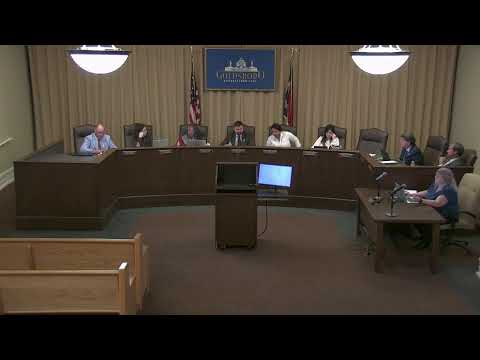
City engineering staff and the design-build team updated the Goldsboro City Council Oct. 20 on sewer flow tracking, near-term development that will add daily flow, and a design-build approach to expand wastewater treatment capacity.
Jonathan (engineering staff) told the council the treatment plant was handling roughly 7,360,000 gallons per day at the time of his call to the plant and that the city’s standard planning figure for new residential development in flow-tracking spreadsheets is 75 gallons per day per bedroom. He presented a list of proposed and approved developments that together represent about 2,519 dwelling units and estimated those projects would add approximately 192,000 gallons per day to the system.
Using those numbers, Jonathan said the system would be at about 68.9% of a commonly referenced 14,200,000-gallon figure. He displayed wet-weather scenarios that raised the treated flow to 80%–97% of capacity depending on rainfall — in a particularly wet year the combined load would approach 97.2% of the 14,200,000 figure. Jonathan said the city’s current permit configuration allows a pathway to 17.6 million gallons per day but that reaching thresholds (the presenter called out the “80%” and “90%” benchmarks) requires steps with the state: reaching 80% triggers a required plan to the state describing how the city will respond, and reaching 90% requires permit submittals and final plans for expansion.
Council members asked how many of the listed subdivisions were likely to be built and how quickly; staff said many are in preliminary stages while some have approved site plans and are effectively “turnkey” when a developer is secured.
Colin Beck of Hazen, representing the Crowder–Hazen design-build team, presented the consultant schedule and next steps for a proposed plant expansion. He summarized the planned sequence and timing: survey and geotechnical work and a basis-of-design report would take roughly a year; advancing design to about 75% and permitting would take roughly 18 months; a guaranteed maximum price development and approval step would take about six months; and construction would take about three years. Beck summarized: “from the time of notice to proceed on the basis of design report will take about 6 years.”
Beck and city staff also described the project’s funding context. The design-build consultants and staff are pursuing low-interest Clean Water State Revolving Fund (CWSRF) assistance through the North Carolina Department of Environmental Quality; Hazen said the city had applied multiple times and that awards are competitive. City staff said a basis-of-design task has a proposed cost of about $1.9 million and that staff propose to fund that phase from utility reserves to move the project forward.
Why it matters: rapid…
Already have an account? Log in
Subscribe to keep reading
Unlock the rest of this article — and every article on Citizen Portal.
- Unlimited articles
- AI-powered breakdowns of topics, speakers, decisions, and budgets
- Instant alerts when your location has a new meeting
- Follow topics and more locations
- 1,000 AI Insights / month, plus AI Chat