Get Full Government Meeting Transcripts, Videos, & Alerts Forever!
Get email alerts on the Infrastructure And Utilities topic
No spam. Unsubscribe anytime.
City presents sewer flow tracking, warns growth could push plant near permit limits; design-build plan would take years to add capacity
Summary
Engineering staff showed current and wet-weather flow figures and how proposed development would affect capacity; design-build team outlined a multi-year timeline and funding challenges for a planned plant expansion.
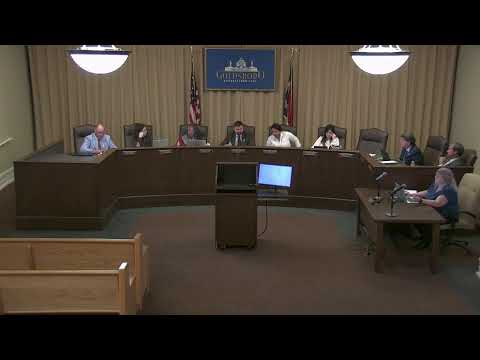
City engineering staff and the design-build team updated the Goldsboro City Council Oct. 20 on sewer flow tracking, near-term development that will add daily flow, and a design-build approach to expand wastewater treatment capacity.
Jonathan (engineering staff) told the council the treatment plant was handling roughly 7,360,000 gallons per day at the time of his call to the plant and that the city’s standard planning figure for new residential development in flow-tracking spreadsheets is 75 gallons per day per bedroom. He presented a list of proposed and approved developments that together represent about 2,519 dwelling units and estimated those projects would add approximately 192,000 gallons per day to the system.
Using those numbers, Jonathan said the system would be at about 68.9% of a commonly referenced 14,200,000-gallon figure. He displayed wet-weather scenarios that raised the treated flow to 80%–97% of capacity depending on rainfall — in a particularly wet year the combined load would approach 97.2% of the 14,200,000 figure. Jonathan said the city’s current permit configuration allows a pathway to 17.6 million gallons per day but that reaching thresholds (the presenter called out the “80%” and “90%” benchmarks) requires steps with the state: reaching 80% triggers a required plan to the state describing how the city will respond, and reaching 90% requires permit submittals and final plans for expansion.
Council members asked how many of the listed subdivisions were likely to be built and how quickly; staff said many are in preliminary stages while some have approved site plans and are effectively “turnkey” when a developer is secured.
Colin Beck of Hazen, representing the Crowder–Hazen design-build team, presented the consultant schedule and next steps for a proposed plant expansion. He summarized the planned sequence and timing: survey and geotechnical work and a basis-of-design report would take roughly a year; advancing design to about 75% and permitting would take roughly 18 months; a guaranteed maximum price development and approval step would take about six months; and construction would take about three years. Beck summarized: “from the time of notice to proceed on the basis of design report will take about 6 years.”
Beck and city staff also described the project’s funding context. The design-build consultants and staff are pursuing low-interest Clean Water State Revolving Fund (CWSRF) assistance through the North Carolina Department of Environmental Quality; Hazen said the city had applied multiple times and that awards are competitive. City staff said a basis-of-design task has a proposed cost of about $1.9 million and that staff propose to fund that phase from utility reserves to move the project forward.
Why it matters: rapid residential and commercial growth increases treated flows and can force engineering and permitting steps that require capital planning. A multi-year design-build expansion will not immediately add capacity — the team projected roughly six years from the start of detailed design to finished additional capacity — so interim actions such as inflow-and-infiltration (I&I) reduction and staged design are part of the city’s near-term work.
What’s next: staff will continue flow-tracking, pursue permitting dialogue with the state when required, proceed with the basis-of-design procurement if council authorizes funding for that phase, and continue seeking CWSRF and other funding while advancing I&I and system improvements.
Speakers quoted and on record for this item: Jonathan (engineering staff) — presented flow-tracking figures and scenarios. (first referenced 01:15:52–01:16:20) Colin Beck, Design-build consultant (Hazen/Crowder) — presented schedule and funding assistance outlook. (first referenced 01:25:54–01:26:05) Bert (public utilities staff) — participated in discussion of operations and meter projects. (first referenced 01:25:00–01:25:12) Matt Livingston, City Manager — clarified funding/reserve plan and next agenda timing. (first referenced 01:33:15–01:33:40)
Authorities referenced (as described in the meeting): { "type":"other","name":"North Carolina Department of Environmental Quality (DEQ) Clean Water State Revolving Fund (CWSRF)","referenced_by":["wastewater-plant-capacity-flow-tracking-and-expansion-plan"] }
Clarifying details: { "category":"current_treated_flow","detail":"Plant treated flow reported at time of presentation","value":"7360000","units":"gallons per day","approximate":true,"source_speaker":"Jonathan" } { "category":"design_capacity_reference","detail":"Planning reference used in flow-tracking spreadsheet","value":"14200000","units":"gallons per day","approximate":false,"source_speaker":"Jonathan" } { "category":"development_added_flow","detail":"Estimated additional flow from proposed residential units (2,519 units) using 75 gpd/bedroom assumption","value":"192000","units":"gallons per day","approximate":true,"source_speaker":"Jonathan" } { "category":"basis_of_design_cost","detail":"Proposed cost to complete basis-of-design milestone","value":"1900000","units":"USD","approximate":true,"source_speaker":"Matt Livingston/Colin Beck" } { "category":"expansion_timeline","detail":"Design-build schedule from basis of design NTP to construction completion (approx.)","value":"6","units":"years","approximate":true,"source_speaker":"Colin Beck" }
Community relevance: geographies:["Goldsboro service area","Seymour Johnson AFB bulk wastewater service area"] funding_sources:["City utility reserves","CWSRF loans","potential regional partnerships"] impact_groups:["residential neighborhoods served by city sewer","future commercial or industrial customers seeking served capacity"]
Meeting context: engagement_level:{"speakers_count":4,"duration_minutes":60,"items_count":1} implementation_risk:"high" history:[{"date":"2022-02-01","note":"Planned expansion discussion and prior design work referenced."}]
searchable_tags:["wastewater","flow-tracking","design-build","Hazen","Crowder","CWSRF"]
provenance:{"transcript_segments":[{"block_id":"3752.27","local_start":0,"local_end":72,"evidence_excerpt":"Good evening, mayor and council. How are y'all doing? ... sewer flow tracking happens after a project is going through TRC ... the 2 numbers I want you to look at are e and h.","tc_start":"01:02:32","tc_end":"01:03:12","reason_code":"topicintro"},{"block_id":"4754.435","local_start":0,"local_end":68,"evidence_excerpt":"There, council. Good evening. Hope everybody's doing well. So, Bert, thanks for the introduction. It's good to see everybody again.","tc_start":"01:19:14","tc_end":"01:20:22","reason_code":"topicfinish"}]}
salience:{"overall":0.86,"overall_justification":"Infrastructure capacity affects growth and economic development; multi-year capital plan and funding are required.","impact_scope":"local","impact_scope_justification":"Affects city sewer service area and future development approvals.","attention_level":"high","attention_level_justification":"Staff presented current metrics showing potential approach to capacity thresholds in wet weather."},
topics:[{"name":"infrastructure-and-utilities","justification":"Article focuses on wastewater capacity, planning and funding for plant expansion.","scoring":{"topic_relevance":0.98,"depth_score":0.88,"opinionatedness":0.03,"controversy":0.25,"civic_salience":0.85,"impactfulness":0.82,"geo_relevance":1.00}}],
speakers:[{"name":"Jonathan","role_title":"Engineering staff (flow tracking presenter)","affiliation_type":"government","affiliation_name":"City of Goldsboro Engineering","first_reference":{"timecode":"01:15:52","transcript_line_range":[1,4]}},{"name":"Colin Beck","role_title":"Design-build consultant, Hazen (representing Crowder–Hazen)","affiliation_type":"business","affiliation_name":"Hazen/Crowder design-build team","first_reference":{"timecode":"01:25:54","transcript_line_range":[1,3]}},{"name":"Bert","role_title":"Public utilities staff (operations)","affiliation_type":"government","affiliation_name":"City of Goldsboro Utilities","first_reference":{"timecode":"01:25:00","transcript_line_range":[1,2]}},{"name":"Matt Livingston","role_title":"City Manager","affiliation_type":"government","affiliation_name":"City of Goldsboro","first_reference":{"timecode":"01:33:15","transcript_line_range":[1,2]}}],
authorities:[{"type":"other","name":"North Carolina Department of Environmental Quality — Clean Water State Revolving Fund (CWSRF)","citation":"described by design-build consultant and staff","referenced_by":["wastewater-plant-capacity-flow-tracking-and-expansion-plan"]}],
actions:[],
discussion_decision:{"discussion_points":["Current plant flows and wet-weather scenarios","Projected flows from proposed developments","80% and 90% capacity benchmarks and state notification/permit requirements","Basis-of-design and multi-year design-build timeline"],"directions":["Proceed with basis-of-design and geotechnical work if council authorizes funding; continue I&I and system improvements","Seek funding assistance via CWSRF and pursue cooperative regionalization points where applicable"],"decisions":[]},
clarifying_details:[{"category":"current_treated_flow","detail":"Plant treated flow reported at time of presentation","value":"7360000","units":"gallons/day","approximate":true,"source_speaker":"Jonathan"},{"category":"planning_capacity","detail":"Reference capacity used in flow tracking","value":"14200000","units":"gallons/day","approximate":false,"source_speaker":"Jonathan"},{"category":"basis_of_design_cost","detail":"Proposed basis-of-design cost for next phase","value":"1900000","units":"USD","approximate":true,"source_speaker":"Matt Livingston/Colin Beck"}],
proper_names:[{"name":"Hazen","type":"business"},{"name":"Crowder","type":"business"},{"name":"City of Goldsboro Wastewater Treatment Plant","type":"facility"}],
community_relevance:{"geographies":["Goldsboro service area","Seymour Johnson AFB service connection"],"funding_sources":["city utility reserves","CWSRF"],"impact_groups":["existing ratepayers","future development customers"]},
meeting_context:{"engagement_level":{"speakers_count":4,"duration_minutes":60,"items_count":1},"implementation_risk":"high","history":[{"date":"2022-02-01","note":"Earlier discussions about plant expansion and planning referenced by staff."}]},
searchable_tags:["wastewater","flow-tracking","CWSRF","design-build","Hazen"],
provenance:{"transcript_segments":[{"block_id":"3752.27","local_start":0,"local_end":140,"evidence_excerpt":"Good evening, mayor and council. How are y'all doing? ... sewer flow tracking happens after a project is going through TRC, our technical review committee, our site plan review.","global_start":3752,"global_end":3792,"tc_start":"01:02:32","tc_end":"01:03:12","reason_code":"topicintro"},{"block_id":"4823.62","local_start":0,"local_end":160,"evidence_excerpt":"The next milestone would be basis of design, survey, and geotech. That will take about a year... from the time of notice to proceed on the basis of design report will take about 6 years.","global_start":4823,"global_end":4879,"tc_start":"01:20:23","tc_end":"01:21:19","reason_code":"topicfinish"}] }