Get Full Government Meeting Transcripts, Videos, & Alerts Forever!
Get email alerts on the Pedestrian Crosswalk Policy topic
No spam. Unsubscribe anytime.
Public Works reviews unattended crosswalk policy; staff stresses refuge, sight lines and warrants
Summary
Public Works staff reviewed Bangor's unattended crosswalk policy adopted in 2016, explaining criteria such as pedestrian refuge, sight distance, pedestrian counts and 80th-percentile speed that determine whether a crosswalk or a beacon is warranted.
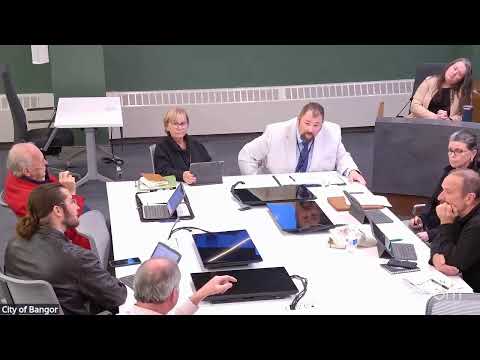
City staff reviewed the city's unattended crosswalk policy during the Infrastructure Committee meeting on Oct. 20 and outlined the technical and warrant-based criteria the city uses to evaluate midblock crossings.
Steve Smith, interim director of public works, said the policy (enacted in 2016) sets minimum criteria including the availability of a pedestrian refuge or safe landing on both sides, adequate sight distance for the posted speed limit, pedestrian volumes (staff said they typically look for about 20 pedestrians during the peak hour), spacing considerations and the 80th percentile speed check. Smith told the committee, "if there is no sidewalk and refuge on either side, you just can't put a crosswalk."
Staff also described higher-visibility treatments such as pedestrian-activated rapid-flash beacons, raised crosswalks and emerging technologies (in-ground lighting and pole-follow lights that illuminate the pedestrian path). Smith cautioned that some of those treatments are more costly and that the state Department of Transportation must be involved when signal or intersection projects are funded or modified. He said the DOT is evaluating warrants for signals and that the city has worked with DOT to replace some unwarranted signals and add beacons where appropriate.
The policy includes a resident-request process: residents may ask the city engineer for a study; if staff and first responders (EMS, police) support the location, the city can install a crosswalk or beacon; if staff do not support it, residents may bring the request to the full council for further consideration.
Why it matters: the city's criteria affect where pedestrians can cross safely and which midblock crossings receive higher-visibility treatment. The policy balances pedestrian access with safety and sight-distance requirements and must coordinate with state DOT rules on signals and funding.
Committee members discussed public education and the common misconception that pressing a midblock beacon removes all responsibility for checking for traffic. Smith suggested coordinating public service announcements with the state to remind pedestrians to verify that oncoming drivers see them before crossing.
No formal action was taken; staff said they will continue to apply the 2016 policy and respond to resident requests through the city engineer's study process.