Get Full Government Meeting Transcripts, Videos, & Alerts Forever!
Get email alerts on the Annexation topic
No spam. Unsubscribe anytime.
Port Richey planning board opens annexation push, targets enclaves and commercial corridor
Summary
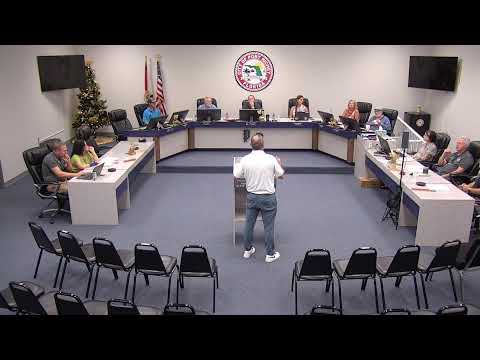
At a Sept. 9 Planning & Zoning meeting Port Richey staff and board members agreed to pursue voluntary annexation outreach focused on enclave parcels and commercial properties along U.S. 19, directing staff to prepare data, draft mailings and a public workshop.
Port Richey City officials and Planning & Zoning board members discussed a planned annexation outreach campaign at a Sept. 9 board meeting, directing staff to prepare targeted mailings, data on tax and utility impacts, and a public workshop to solicit voluntary annexation from nearby unincorporated properties.
City Manager Mike Carballa, who told the board he has been on the job about 100 days, presented the approach and a draft outreach letter staff produced. Carballa said annexation could “round out the city” and address gaps he described as “Swiss cheese” patterns of city limits, adding that voluntary annexation could increase the city’s tax base and simplify emergency response and code enforcement. He said he estimated “hundreds, if not, over a thousand properties that would make sense” to consider, though he said staff is still compiling exact figures.
The board and staff discussed a mix of incentives and barriers. A board member recounted a recent attempt to annex a commercial body shop where the owner was ready to proceed but faced a prohibitive cost to connect to the city’s water and sewer—“cost prohibitive, like 20,000 or $30,000” to tie in, according to the discussion. Veronica (city staff) told the board that Community Redevelopment Area (CRA) dollars and resiliency funding could be used to offset some hookup costs for eligible properties. City Attorney Nancy Meyer advised that, in many cases, proposed annexations must be developed or improved to qualify under current interpretations and that statutory procedures can vary depending on parcel count and whether the annexation is voluntary or nonvoluntary.
Board members and staff agreed on a stepwise, targeted approach: prioritize enclaves (properties surrounded by city limits) and commercial parcels along U.S. 19 as “low-hanging fruit,” develop an apples-to-apples comparison of current county costs versus projected city costs for sample properties, identify which properties already have water/sewer connections, and prepare a tailored mailing and an in-person outreach strategy for businesses. Several participants urged making the case with concrete, local data—response-time statistics, permit processing times, and line-item comparisons of services and fees—rather than broad assertions.
Participants discussed legal and political constraints. Staff reported having discussed annexation with Pasco County planning staff, who indicated the county would likely cooperate in many cases where properties abut city-owned parcels. Board members cautioned against hostile or forced annexation because of the potential for negative publicity and community backlash; instead they emphasized selling voluntary annexation and staging incentives such as phased tax treatments or temporary tax discounts to ease transition.
The board directed staff to refine the draft letter, pull tax and utility data for a preliminary set of roughly 60 candidate parcels, identify which properties have septic or sewer connections, and to prepare a workshop/open house (to include department heads) as the next step. Staff indicated they would try to produce a working letter and data within about a month and aim to schedule an outreach workshop before the holidays. Planning staff noted some analytical tasks—mapping parcels, estimating hookup costs, and computing millage impacts—would require coordination with finance and utilities.
Votes at the meeting included routine approval of prior minutes. The board recorded consensus direction to staff to proceed with the annexation outreach described above; staff indicated they will return with more concrete numbers and a proposed timeline for phased annexations.
Ending
City staff will assemble the targeted mailing list, cost comparisons and a workshop plan for a future meeting. The board emphasized a measured, data-driven campaign that starts with commercial parcels and enclaves and seeks voluntary annexation before pursuing any nonvoluntary steps.