Get Full Government Meeting Transcripts, Videos, & Alerts Forever!
Planning commission recommends board certify EIR, approves permits for Coyote Creek agrivoltaic project despite unavoidable oak, scenic and tribal impacts
Summary
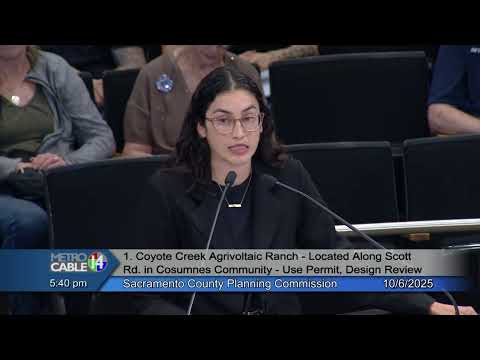
The Sacramento County Planning Commission on Oct. 6 recommended that the Board of Supervisors certify the final environmental impact report and approve entitlements for the Coyote Creek Agrivoltaic Ranch, a utility‑scale solar proposal on Barton Ranch along Scott Road, after hours of testimony and public comment.
The Sacramento County Planning Commission on Oct. 6 recommended that the Board of Supervisors certify the final environmental impact report (EIR) and approve entitlements for the Coyote Creek Agrivoltaic Ranch project, a utility‑scale solar and battery facility proposed on the Barton Ranch along Scott Road south of White Rock Road.
The unanimous recommendation — taken after roughly 42 public speakers and several hours of staff, applicant and public testimony — would send two resolutions to the Board: one to certify the final EIR and adopt CEQA findings and a mitigation monitoring and reporting program, and a second to recommend issuance of a use permit and special development permits and to find substantial compliance with countywide design guidelines.
The project as presented by county staff would construct a roughly 200‑megawatt solar photovoltaic facility with on‑site energy storage and associated substation and generation tie line on a property that staff described as approximately 2,700 acres overall, with roughly 1,357 acres proposed for solar development. Kimber Gutierrez, principal planner with County Planning, said the facility would have a planned operational life of 35 years and include a decommissioning and site restoration plan. “The project is proposed to be decommissioned at the end of its operational life, and a decommissioning and site restoration plan is included as part of the proposed project,” Gutierrez said in her presentation.
Why it matters: county staff found most impacts could be mitigated but identified three significant and unavoidable effects remaining after mitigation: loss of oak woodland canopy, visual/aesthetic impacts (including views from Prairie City State Vehicular Recreation Area), and impacts to tribal cultural resources within the Tosa‑wen tribal landscape. Staff prepared CEQA findings of fact and a statement of overriding considerations concluding that the public benefits — including local renewable energy…
Already have an account? Log in
Subscribe to keep reading
Unlock the rest of this article — and every article on Citizen Portal.
- Unlimited articles
- AI-powered breakdowns of topics, speakers, decisions, and budgets
- Instant alerts when your location has a new meeting
- Follow topics and more locations
- 1,000 AI Insights / month, plus AI Chat