Get Full Government Meeting Transcripts, Videos, & Alerts Forever!
Get email alerts on the Land Use Permits topic
No spam. Unsubscribe anytime.
Planning commission recommends new land use review ordinance requiring review for structures over 480 sq. ft.; staff says 5-day turnaround is feasible
Summary
The Matanuska-Susitna Borough Planning Commission on Oct. 20 adopted Resolution 25-20, recommending repeal of the borough's mandatory land use permit and adoption of a land use review for structures over 480 square feet with a five-day turnaround.
The Matanuska-Susitna Borough Planning Commission on Oct. 20 voted to adopt Resolution 25-20, recommending the assembly repeal the existing mandatory land use permit in MSB 17.02 and replace it with MSB 17.07, a land use review that would require review of proposed structures larger than 480 square feet and provide a five-day turnaround with fee refund if the deadline is missed.
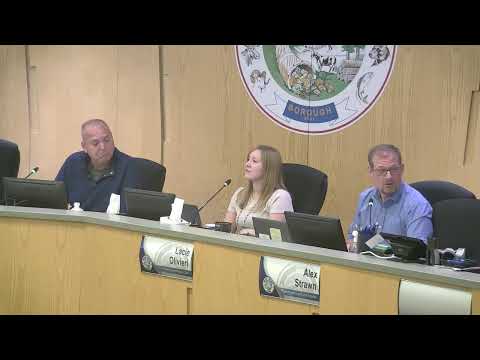
Alex Strachan, planning and land use director, described the ordinance as resembling the borough's original 2007 mandatory land use permit. He said the 2007 rule prompted 300to500 applications per year, but the code was narrowed in 2011 to require permits only within 75 feet of a water body, reducing applications to about half a dozen per year. "This ordinance ... would require any structure over 480 square feet to submit a site plan and allow the borough to review setbacks, flood zones and other restrictions," Strachan said. He added the proposed review would be administrative, with a five-day target turnaround and a refund of fees if the borough did not meet that turnaround.
Commissioners asked whether the permit center could absorb a potential increase of several hundred applications annually. Strachan said his permitting staff estimated most reviews would take approximately five minutes each using aerial imagery and existing data; they would not require a site visit. He said the department recently adopted a new permitting system and expects increased efficiency.
Commissioner McCabe asked what would happen if the borough missed the five-day deadline. Strachan said the fee would be refunded but the borough would still be required to complete the review.
Commissioner McCabe asked about revenue potential; using a hypothetical $50 application fee and an assumed 300 new permits, he estimated roughly $15,000 in additional revenue.
Public comment came from Rod Hansen of the North Lakes Community Council, who voiced support for the ordinance but urged several additions and clarifications: he suggested the land use review process be applicable to developers and subdivision proposals (Strachan later clarified it would not apply to subdivision review), that applicants be asked to state the intended uses of proposed structures (single-family, multifamily, commercial) to help planning and public works anticipate impacts, and that the borough consider requiring a basic traffic-impact analysis for some proposals. Hansen also suggested including marijuana businesses in the list of activities referenced under intent and applicability.
Strachan responded that the proposed ordinance applies to construction of individual structures over 480 square feet and would not change subdivision procedures. He reiterated that traffic impact analyses are already required for very large uses that generate substantial traffic and that those studies typically cost "tens of thousands of dollars." He also noted other code sections already include mandated time frames for administrative review (for example, a 15-day time frame for multifamily review from a complete application and a 30-day rule for certain administrative permits).
Commissioner Scoggin moved adoption of Resolution 25-20; Commissioner McCabe seconded. The motion carried without objection; the record shows the resolution was adopted by unanimous consent.
If adopted by the assembly, the ordinance would reintroduce a short administrative check intended to identify compliance issues early and reduce downstream compliance cases, according to Strachan.