Get Full Government Meeting Transcripts, Videos, & Alerts Forever!
Get email alerts on the Land Use topic
No spam. Unsubscribe anytime.
Oregon City commission reviews quasi‑judicial land‑use procedures, conflicts and evidentiary rules
Summary
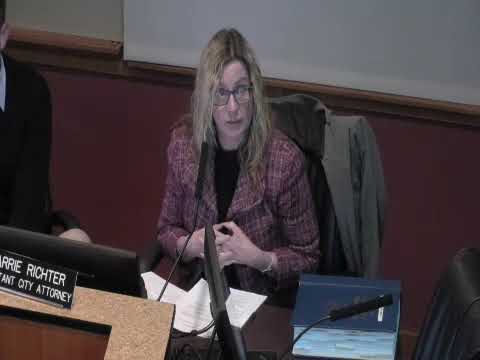
Assistant City Attorney Carrie Richter led a Feb. 12 work session briefing on quasi‑judicial land‑use proceedings, covering decision types, ex parte disclosures, the record and the standards local officials must follow when acting as judges in land‑use appeals.
Assistant City Attorney Carrie Richter briefed the Oregon City Commission on Feb. 12 about the legal standards and procedures that apply when the commission hears quasi‑judicial land‑use matters.
Richter told the commission that “these decisions, you are sitting as a judge,” and that distinguishing quasi‑judicial reviews from legislative policy work is central: commissioners must evaluate whether an application meets applicable standards, not make new policy in the hearing. She explained the local categories of land‑use review (Type 1 through Type 4), saying Type 1 are ‘‘clear and objective’’ ministerial decisions while Type 2–4 include limited‑discretion and fully quasi‑judicial matters such as conditional use permits, variances, site plans, plan amendments and zoning map changes.
Richter summarized how the record and appeal rules differ by type: some appeals are de novo, meaning new issues may be raised, while many Type 3 appeals to the commission are limited to issues previously raised before the planning commission. She warned that failure to raise an issue at the appropriate stage can bar later review before the Land Use Board of Appeals.
The attorney emphasized ex parte disclosures and evidence handling. Commissioners must disclose contacts or information gathered outside the hearing — from a conversation, social media or a newspaper article — so the public and parties can respond. Richter said, “if you read a newspaper article or a blog post … and it influences your decision, that undermines the propriety of the decision.” She urged commissioners to provide any external material to staff so it becomes part of the public record.
On the substance of defensible decisions, Richter noted three common bases for a successful LUBA challenge: interpreting ambiguous criteria, making adequate factual findings that show how the record satisfies those criteria, and relying on substantial evidence. She advised commissioners to lean on staff and, when new testimony arises, to continue the record and return with written findings.
Richter also outlined ethical limits: actual bias is rare but disqualifying when a decision maker has a fixed predisposition that would prevent impartiality. Financial conflicts (pecuniary benefits to a commissioner or close family member) require recusal. She reviewed attorney–client privilege in the municipal context, explaining that privilege protects confidential legal advice given to Oregon City as the client but not facts, and that privileged materials must be safeguarded to avoid accidental disclosure.
Commissioners asked practical questions about reopening records, when new issues may be raised, the role of personal experience versus expert testimony (for example, traffic observations), and how to translate engineering terms like vehicle/capacity (v/c) into findings. Richter and staff said engineering analyses and expert counts typically form the baseline for findings, with commissioners weighing credibility where two experts differ.
The training concluded with a reminder that legislative land‑use actions (code changes, long‑range plans) are handled differently from quasi‑judicial review and encourage broader community outreach prior to adoption.