Get Full Government Meeting Transcripts, Videos, & Alerts Forever!
Get email alerts on the Special Education Review topic
No spam. Unsubscribe anytime.
Independent review urges systemwide changes to special-education practices in Barre Unified Union School District #97
Summary
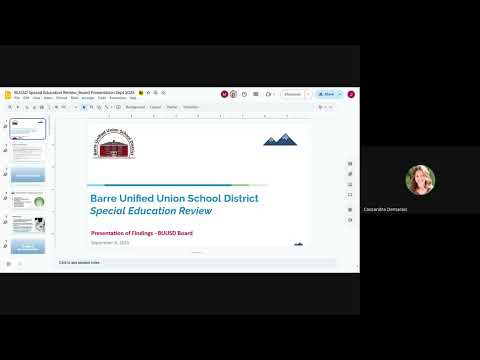
At a school-board meeting, Dr. Megan Roy presented an independent review of special-education practice in Barre Unified Union School District #97 and recommended systemwide changes aimed at improving classroom instruction, tightening evaluation timelines and aligning staffing and intervention models.
At a school-board meeting, Dr. Megan Roy presented an independent review of special-education practice in Barre Unified Union School District #97 and recommended systemwide changes aimed at improving classroom instruction, tightening evaluation timelines and aligning staffing and intervention models.
The review, commissioned by the district and delivered to the board by Roy with District Director Melody Frank in the room, found the district’s combined counts of students with Individualized Education Programs (IEPs), 504 plans and education-support-team (EST) plans were substantially above typical benchmarks and pointed to weaknesses in the district’s multi-tiered system of supports (MTSS). Roy told the board the review was “proactive” and intended to provide an outside, bird’s-eye assessment of district systems.
That finding matters because the report shows about 43 percent of students across the district were recorded as needing some level of additional support (EST, 504 or IEP) at the time of the review — a level Roy said is considerably higher than state and national norms and that signals the district can improve general-education capacity so fewer students require specialized services.
Roy recommended the district focus on four evidence-based priorities: stronger collaboration between general-education and special-education staff, more consistent multi-tiered interventions and progress monitoring, clearer service-delivery models for special-education caseloads, and targeted work on intensive needs and alternative-program entrance/exit criteria. She told the board that many of the report’s recommendations are already familiar to district staff and that the district has “pockets of excellence” it can scale.
District leaders described work already under way in each recommended area. Melody Frank summarized actions the district has taken or planned: creation of a district evaluation team to improve timeliness and quality of assessments; a new MTSS coordinator and use of the Panorama platform to collect social-emotional learning (SEL) data; reworked school schedules to protect core-instruction time while adding designated service blocks so IEP services are scheduled and documented; and a yearlong professional-development plan for special-education teachers, paraprofessionals and related-service staff. Frank said the district has prioritized LETRS (a structured literacy training) for pre-K–8 teachers and special educators, and is expanding paraeducator training and behavioral supports.
Frank also addressed state monitoring results. The Vermont Agency of Education (AOE) had conducted monitoring and identified prior shortcomings in evaluation timelines and transition-planning documentation (Indicator 11 and Indicator 13 in the monitoring process). Frank said the AOE’s due-diligence review found no evidence that the district was currently out of compliance for the alleged violations being examined but that targeted monitoring remained necessary to confirm improvements. The district has scheduled weekly evaluation-team meetings and supervisory checkpoints intended to eliminate late evaluation and review dates.
Board members asked for clarifications about practical implications. Roy said improving MTSS begins with giving classroom teachers clear, common assessments and intervention tools so they can identify and address underperformance before referral to special education; that, she said, will reduce the number of students who need IEPs as an outcome of long-term unmet needs in general education. Board members also pressed for specifics about how to measure progress; Roy and Frank pointed to Panorama SEL surveys, planned progress-monitoring protocols and district continuous-improvement plans tied to the recommendations.
Roy and Frank said the district will host a public community forum to discuss the review and next steps; Frank said the forum is scheduled for Wednesday, Oct. 22 (location to be announced). Board members and administrators said they will publish more detailed materials and timelines before that event so families and staff can follow proposed changes and monitoring outcomes.
The presentation ended without a formal board vote on policy; board members thanked Roy and Frank and asked for follow-up information about milestones and measures for the board to track.
Ending: District leaders said the review gives a roadmap for multi-year work. The board scheduled further informational outreach and said the October community forum will be the next public opportunity to hear specifics and ask questions about implementation and progress metrics.