
Mountlake Terrace council reopens oversight discussion after resident outcry over Flock camera contract
Get AI-powered insights, summaries, and transcripts
Subscribe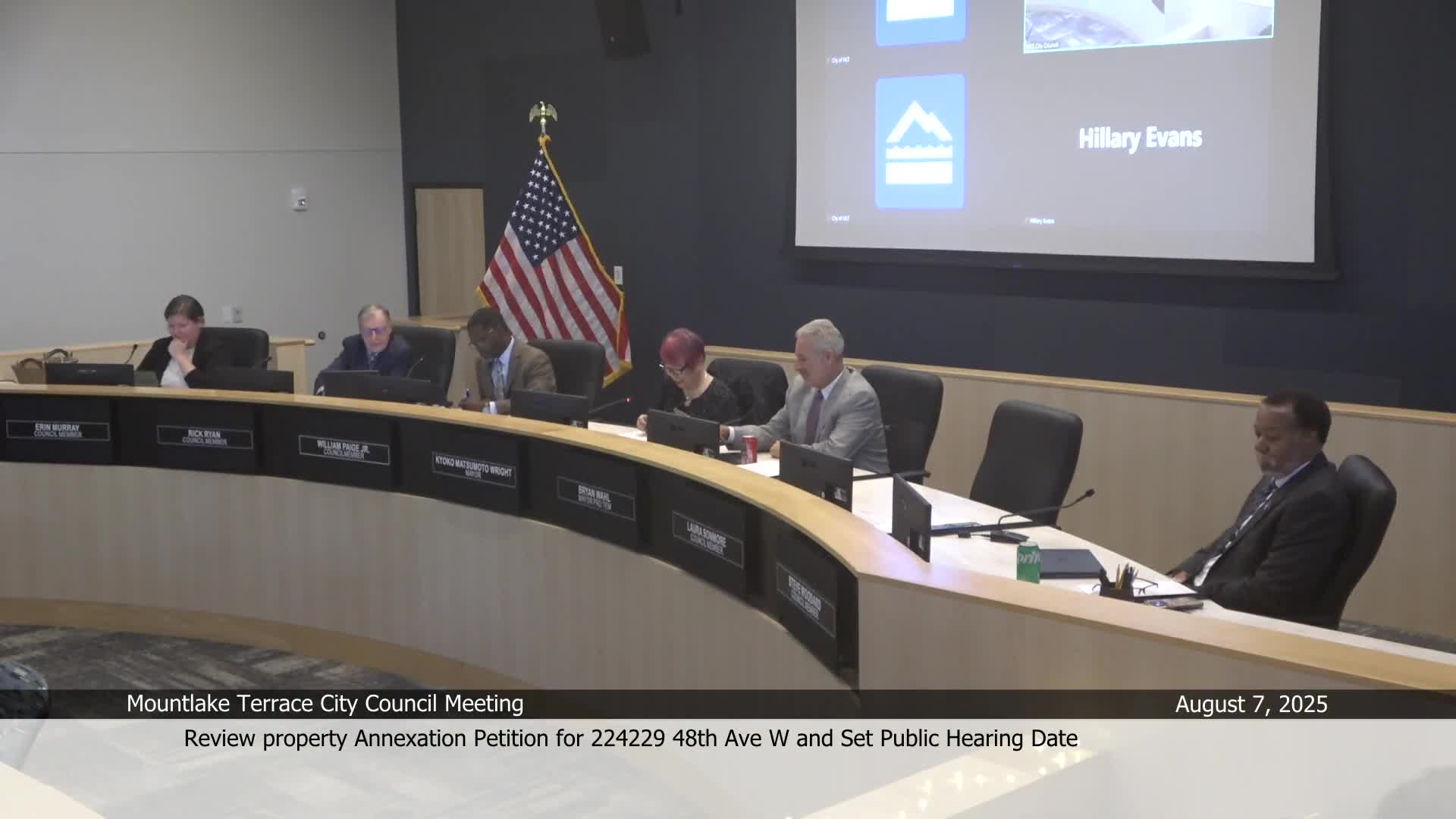
Summary
Mountlake Terrace councilors on Aug. 7 reopened oversight discussion of the city’s Flock Camera Systems contract after multiple residents urged canceling the system or imposing independent safeguards.
Mountlake Terrace councilors on Aug. 7 took an extended public discussion and direction from residents about the city’s contract with Flock Camera Systems and next steps for oversight, transparency and data protections.
City Manager Jeff Knighton summarized staff work analyzing oversight models after the council approved the contract with Flock on June 5. He said staff researched oversight approaches used elsewhere and identified five models; two that the city could use are a subcommittee of the existing Diversity, Equity and Inclusion Commission (DEIC) or reconstituting the city’s community policing advisory board. Knighton said the advisory board still exists in code but was effectively inactive and would need staffing, appointments and possibly ordinance action to change its status.
The meeting drew more than a dozen public commenters on Flock. Speakers urged the council to cancel the contract or, at minimum, create independent oversight, tighten contract language that allows Flock to disclose footage to third parties and law enforcement, and establish measurable performance metrics to judge the trial. Concerns raised by residents included broad data retention and sharing, potential access by federal agencies such as ICE, the company’s marketing claims and historical controversies over Flock’s practices, and the risk that new capabilities (for example, facial or other recognition) could be adopted later.
Several residents asked for explicit metrics to define a successful trial and for contractual limits on Flock’s discretion to share data with agencies. Public commenters repeated that the company’s marketing figures had been disputed and asked that any renewal be tied to city-defined performance measures rather than vendor-selected metrics.
Council members and staff discussed four primary workstreams: 1) reconstitute or create an oversight body (options discussed included reinstating the community policing advisory board or a DEIC subcommittee), 2) strengthen the city’s memorandum(s) of understanding (MOUs) with external agencies that could access data, 3) update police policy language (policy cited in the meeting as “6.17”) governing authorized uses, audits and enforcement, and 4) draft a council value statement or resolution that clarifies city expectations about data use and third‑party access. Several council members urged that the oversight body include training and membership criteria and that staff incorporate suggested guardrails collected from residents.
Mayor Matsumoto Wright and multiple council members said they heard the community’s concerns and supported preparing concrete proposals. Council directed staff to draft updated MOU language and policy revisions, prepare options for an oversight body (including membership, training and duties), and convert the mayor’s previously published value statement into a formal resolution for council consideration. Staff said MOUs are an administrative implementation of council policy and that they will thread suggested edits into MOU drafts while respecting the administrative role of the city manager in finalizing agreements.
No ordinance or policy was rescinded at the meeting and no final vote to cancel the Flock contract was taken. Instead, the council agreed to return with specific proposals and timelines so the body and the public could review recommended safeguards, audit and reporting mechanisms, and proposed oversight membership and training requirements before any contract renewal or further implementation actions. Council also directed that public audit transparency and reporting be part of the policy and MOU revisions.
Public commenters and several council members urged a rapid timetable for staff work; staff said it would present draft language and options for council review and that the council would schedule the next steps publicly.