
Commission approves master and operating agreements for 241–91 express connector; TCA to fund project
Get AI-powered insights, summaries, and transcripts
Subscribe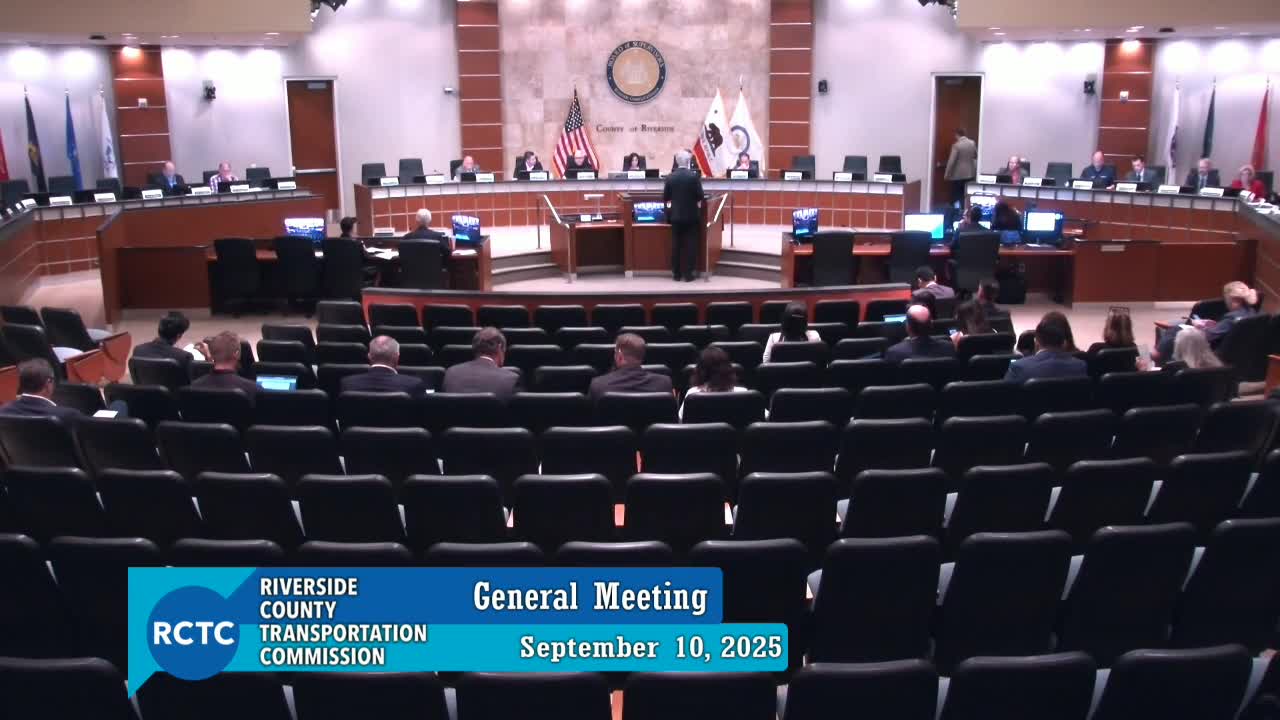
Summary
The Riverside County Transportation Commission approved master and operating agreements for a $524 million single-lane-per-direction tolled connector between the 241 and 91 express lanes, with Transportation Corridor Agencies (TCA) funding the project and agreeing to reimburse RCTC for specified costs and closure fees.
The Riverside County Transportation Commission approved the master and operating agreements for the 241–91 Express Connector project, a tolled single-lane-per-direction connector between the 241 toll facility and the 91 express lanes. Transportation Corridor Agencies (TCA) will fully fund the $524,000,000 project, and TCA agreed to reimburse RCTC for certain prior costs and to pay closure fees and other operational expenses identified in the agreements.
David Thomas, Toll Project Delivery Director, presented the agreements and described the connector, related capacity additions on the 91 eastbound express lanes and the overlapping ECOP eastbound-lane project. "This project constructs a direct connector. It's a single lane in each direction between the 241 toll facility and the 91 express lanes in the median. This is a separate tolled facility, so the connector itself will have its own tolled price," Thomas said.
Thomas told commissioners the project is intended to reduce long queues on the 241 (up to four miles in peak periods), reduce weaving on the 91, and produce corridor travel-time and air-quality benefits. The presentation outlined two related projects: the eastbound lane addition (the "ELC" change order that added capacity on the 91 eastbound for about $7.4 million) and the ECOP eastbound lane-addition project at the county line; both interact with the connector's design and schedule.
Key agreement terms presented include: TCA will pay closure fees to OCTA and RCTC for 91 express-lane closures related to connector construction; TCA will reimburse RCTC for consultant and operational costs associated with eastbound McKinley and joint operations; TCA agreed to contribute toward future projects addressing local cut-through traffic near the Green River Road interchange in Corona; the connector will use and reimburse the joint 91 traffic operations center in Anaheim; and the agencies will provide joint customer messaging.
A governance team is established in the operating agreement to monitor performance and to implement "progressive demand management." Thomas described the demand-management toolbox: dynamic pricing (primary tool), a toll-connector meter on the connector, temporary changes to occupancy rules (HOV2 or HOV3), and as last-resort measures restricting connector use to buses or vanpools. The agreements set monitoring criteria and operational thresholds for a critical zone (where the connector ties into the 91) and the East End of the 91:
- Connector design capacity: 1,500 vehicles per hour; governance tools will limit throughput to lower thresholds as needed. - Critical-zone operational criteria include maintaining ~60 mph speed, a maximum 100-vehicle queue on the connector (to prevent backup to the 241), and a maximum of 200 vehicles per hour egressing at the county line to limit general-purpose-lane impacts. - A "super peak" condition is defined as when eastbound McKinley tolls exceed 25% over baseline, density reaches roughly 23 vehicles per lane per hour (approx. 3,000 vehicles/hour in two express lanes), speeds drop below 65 mph or queues exceed 0.5 mile; under that condition the connector will be limited to 370 vehicles per hour and progressive demand-management tools will be used.
Modeling presented by staff projects baseline eastbound tolls around $20 by 2030 for the corridor (an increase from roughly $9 today) because ECCOP and additional capacity increase overall demand; the model forecasts limited "super peak" hours (for example, one hour on Thursdays and two hours on Fridays in 2030) when progressive demand-management tools may be required. Thomas said the operative goal is to keep the express lanes free-flowing and that the governance structure includes escalation and pilot/testing authority to adjust operational tactics.
The agreements also include betterments the connector will construct for the 91 ECOP project: a two-mile, 4-inch conduit for fiber-optic communications to connect to the traffic operations center; pavement that will serve ECOP's new lane so construction overlap is minimized; and an overhead sign widening for an estimated total of about $1,600,000 in betterment costs.
Commissioners from Corona and other cities praised the extensive modeling and the governance measures; they asked for clarity on signage and customer price disclosure. Commissioner Warren asked that signage inform motorists of likely toll costs at decision points so drivers can make informed choices. Staff replied that each decision point will display the current price and that the commission asked TCA to invest in broad public education and outreach; staff described technical constraints to showing a single combined corridor price in advance because two facilities have separate dynamic-pricing systems and there is latency in price calculations.
The commission approved the master and operating agreements and the proposed betterments after a motion and roll-call vote. Staff and partner agencies will proceed under the terms of the agreements and the governance structure to develop operational procedures, outreach, and system updates as construction and implementation progress.