
WRCOG reports faster streetlight repairs, rising vandalism and a proposed 46% SCE rate increase under review
Get AI-powered insights, summaries, and transcripts
Subscribe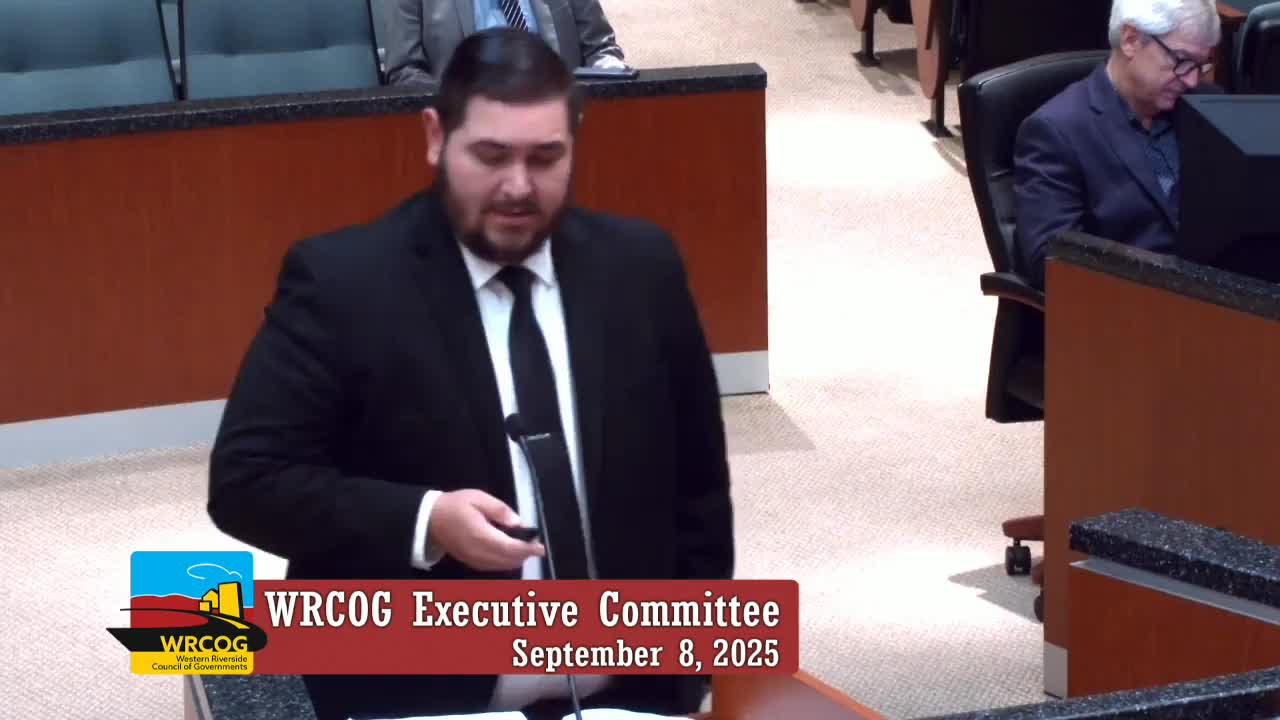
Summary
Daniel Soltero, WRCOG staff, presented the Western Riverside Council of Governments Executive Committee with the regional streetlight program annual update, reporting faster routine repair times, growing vandalism and potential large rate increases proposed by Southern California Edison.
Daniel Soltero, WRCOG staff, presented the Western Riverside Council of Governments Executive Committee with the regional streetlight program annual update, reporting faster routine repair times, growing vandalism and potential large rate increases proposed by Southern California Edison.
The update covered the program’s operations-and-maintenance work orders, response times, trends in pole knockdowns and vandalism, and statewide developments from the California Streetlight Association and the Southern California Edison general rate case.
WRCOG’s regional streetlight program began in 2014 to help member agencies manage rising streetlight costs and to assist some agencies that purchased streetlights from Southern California Edison. Soltero said the program provides ongoing operations and maintenance, project management and GIS services to participating agencies and that owning streetlights reduces facility charges and energy use compared with utility-owned lights.
Soltero told the committee the program’s annual reports show a 60% faster response time for routine operations-and-maintenance calls (from about seven days down to just under three days) and a 35% shorter replacement timeline for poles knocked down (from about 85 to 55 days). He said those gains come even as the program has seen a steep increase in vandalism incidents and more pole knockdowns, which raise extraordinary O&M costs.
The presentation noted that many vandalism incidents occur near active construction and new development and are not unique to the WRCOG subregion. Soltero said knockdowns are the most common extraordinary call type, followed by vandalism; the O&M reports supplied to agencies include maps and individual work-order details to show where trends occur and to recommend site-specific fixes, such as moving a pole a few feet back from the curb.
Soltero also summarized statewide developments reported by the California Streetlight Association (CalSLAW). He said the Southern California Edison general rate case proposes a 46% increase in streetlight energy and facilities charges. The CPUC (California Public Utilities Commission) will decide the general rate case; Soltero said a decision is expected by the end of the calendar year and that new rates, if approved, would take effect after June 2026. He added CalSLAW had negotiated caps on some proposed increases as of June 30 and that a formal CPUC decision remained pending.
On pilot programs, Soltero said an SCE pilot for smart metering nodes (metering electricity usage instead of flat-rate charging) has been abandoned and therefore is not currently available to capture additional usage-based savings.
To address vandalism, Soltero described an LA County multi-agency pilot coordinated by CalSLAW that includes law enforcement, public works and local recyclers. Possible measures include increasing penalties for copper wire theft and monitoring recyclers to detect stolen material. WRCOG will monitor the pilot for potential applicability to its member agencies.
Committee members asked program-specific questions during the discussion. Councilmember Morabito asked who decides SCE rate requests; Soltero said the CPUC will make the decision. A member representing Temecula asked why the city is not a current program participant; Soltero said Temecula initially participated but later opted out of WRCOG’s maintenance program. Commissioner Baca Santa Cruz asked about a high volume of routine calls for Hemet; Soltero said the meeting materials include an agency-level annual report with every work order and that call counts vary by system size and neighborhood age.
The committee received the report and the item was filed.