
Senate committee advances substitute to lower voter‑approval tax trigger from 3.5% to 2.5%; public‑safety carve‑outs debated
Get AI-powered insights, summaries, and transcripts
Subscribe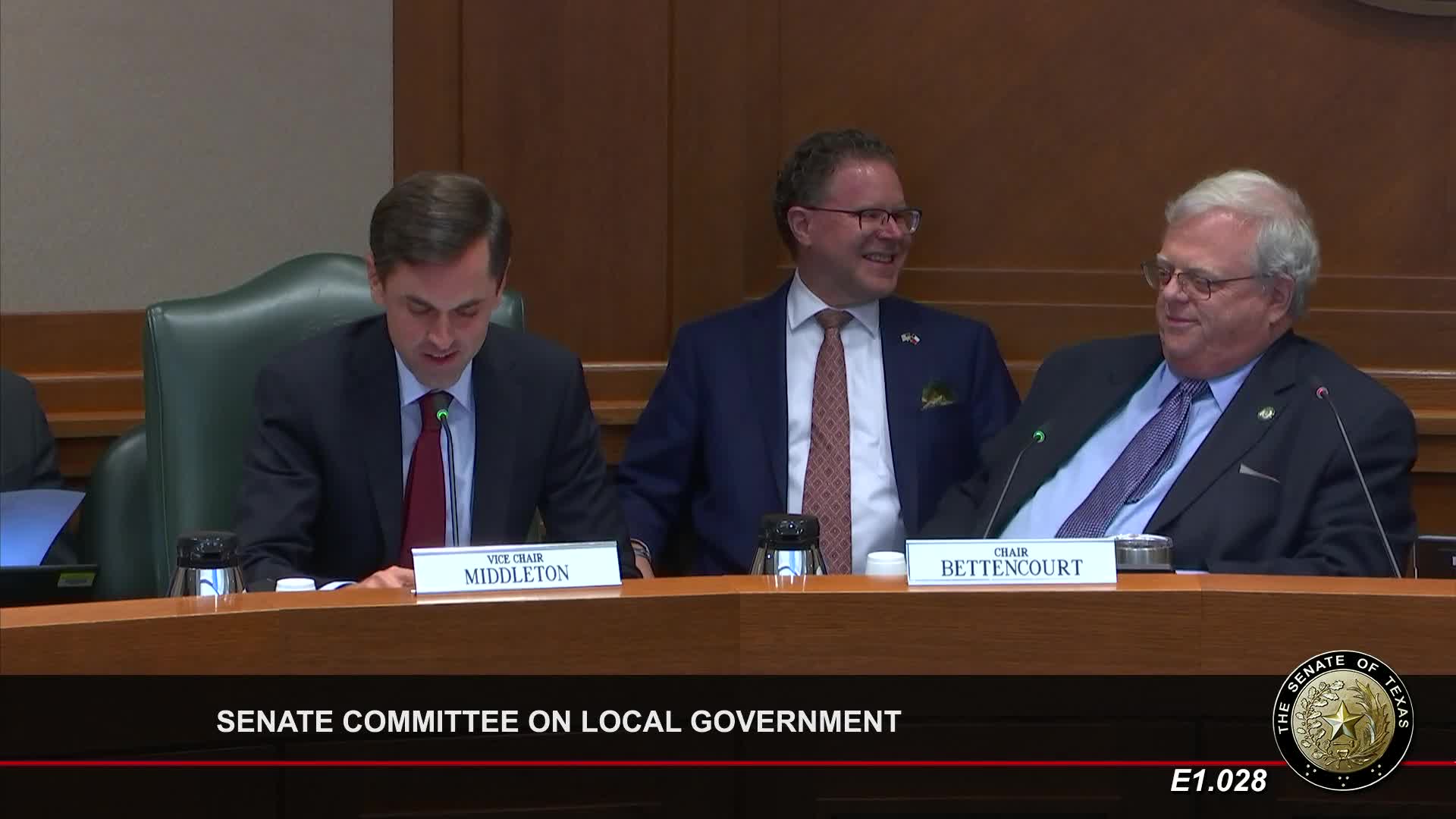
Summary
Senators on the Texas Senate Committee on Local Government on Oct. 12 advanced a committee substitute to Senate Bill 9 that would lower the voter‑approval tax‑rate threshold from 3.5% to 2.5% for most cities and counties, while keeping the higher trigger for jurisdictions under 75,000 in population.
Senators on the Texas Senate Committee on Local Government on Oct. 12 advanced a committee substitute to Senate Bill 9 that would lower the voter‑approval tax‑rate threshold (the rollback or “voter approved” rate) from 3.5% to 2.5% for most local taxing jurisdictions, while keeping the higher trigger for jurisdictions with populations under 75,000 as written in the substitute. The committee voted 4–1 to report the substitute to the full Senate with a recommendation that it pass.
The proposal and substitute were presented by Sen. Charles Bettencourt, who framed the bill as a follow‑up to the 2019 property‑tax reforms. “What Senate Bill 9 states to do is to reduce the rollback rate from 3.5 to 2.5% for certain taxing jurisdictions, primarily cities and counties,” Bettencourt told the committee, adding that the substitute preserved a 3.5% standard for jurisdictions with populations up to 75,000.
The nut graf: supporters said the change would bring more tax‑rate decisions to voters and help slow levy growth that, they say, has outpaced population and inflation. Opponents said the change would constrain local governments’ ability to fund public safety, infrastructure and services — a concern reiterated by county judges and city finance officers who testified in opposition.
Supporters from business and taxpayer groups emphasized transparency and long‑term competitiveness. Jennifer Rabe, president of the Texas Taxpayers and Research Association, told the committee that many property owners misunderstand how tax bills are determined and said SB 9 “would make a big step in the right direction by drawing more attention to tax rates by putting them on the ballot more often.” Glenn Hammer of the Texas Association of Business and James Quintero of the Texas Public Policy Foundation said a consistent, lower threshold would promote accountability and make tax outcomes easier for businesses and residents to anticipate.
Opponents pressed for carve‑outs for public safety and other locally essential services. Hays County Judge Ruben Becerra, testifying in opposition, said local officials “are closer to our constituents than anyone” and called SB 9 “an attempt to solve a problem that does not exist.” John Zegerski, a town finance official from Flower Mound, asked the committee to create an exemption for public‑safety costs, arguing that “hiring quality police officers and firefighters requires competitive salaries” and that a 2.5% cap “can't even guarantee a 2.5% pay increase a year.”
Representatives of large cities and counties described operational pressures the reduced threshold could intensify. Brady Kirk of Fort Worth and county judges from Medina and Henderson counties described rising personnel and jail costs, construction inflation and other recurring expenses. Several witnesses noted that some jurisdictions rely little or not at all on sales tax, and so cannot offset property‑tax constraints with other local revenue sources.
Some witnesses proposed compromise changes. Adam Haines of the Conference of Urban Counties suggested targeted adjustments — for example, automatic allowances in years when inflation exceeds 2.5% and explicit public‑safety exemptions similar to existing jail or hospital exemptions. Other witnesses urged clearer public communication about when a jurisdiction is asking voters to approve higher rates.
Committee action: the panel adopted the committee substitute without recorded objection, then voted on reporting the substitute to the full Senate. The clerk’s roll call on the report recorded Sen. Bettencourt — Aye; Sen. Middleton — Aye; Sen. Cook — No; Sen. Nichols — Aye; Sen. Paxton — Aye, yielding a 4–1 tally in favor of reporting the substitute.
The committee limited testimony at the start of the hearing (Sen. Middleton moved limits on testimony), heard extensive panels of witnesses for and against the measure, and closed public testimony before taking the committee votes. With the substitute reported, the measure now moves to the full Senate where senators may consider amendments — including the public‑safety relief some witnesses requested.
Ending: committee members and witnesses said they will continue discussions about narrowly tailored exemptions or other fixes to address local public‑safety and rapidly growing jurisdictions. The full Senate will receive the committee’s substitute and can take up amendments in subsequent floor action.