
Senate committee hears legal arguments over DOJ letter as mid‑decade redistricting looms
Get AI-powered insights, summaries, and transcripts
Subscribe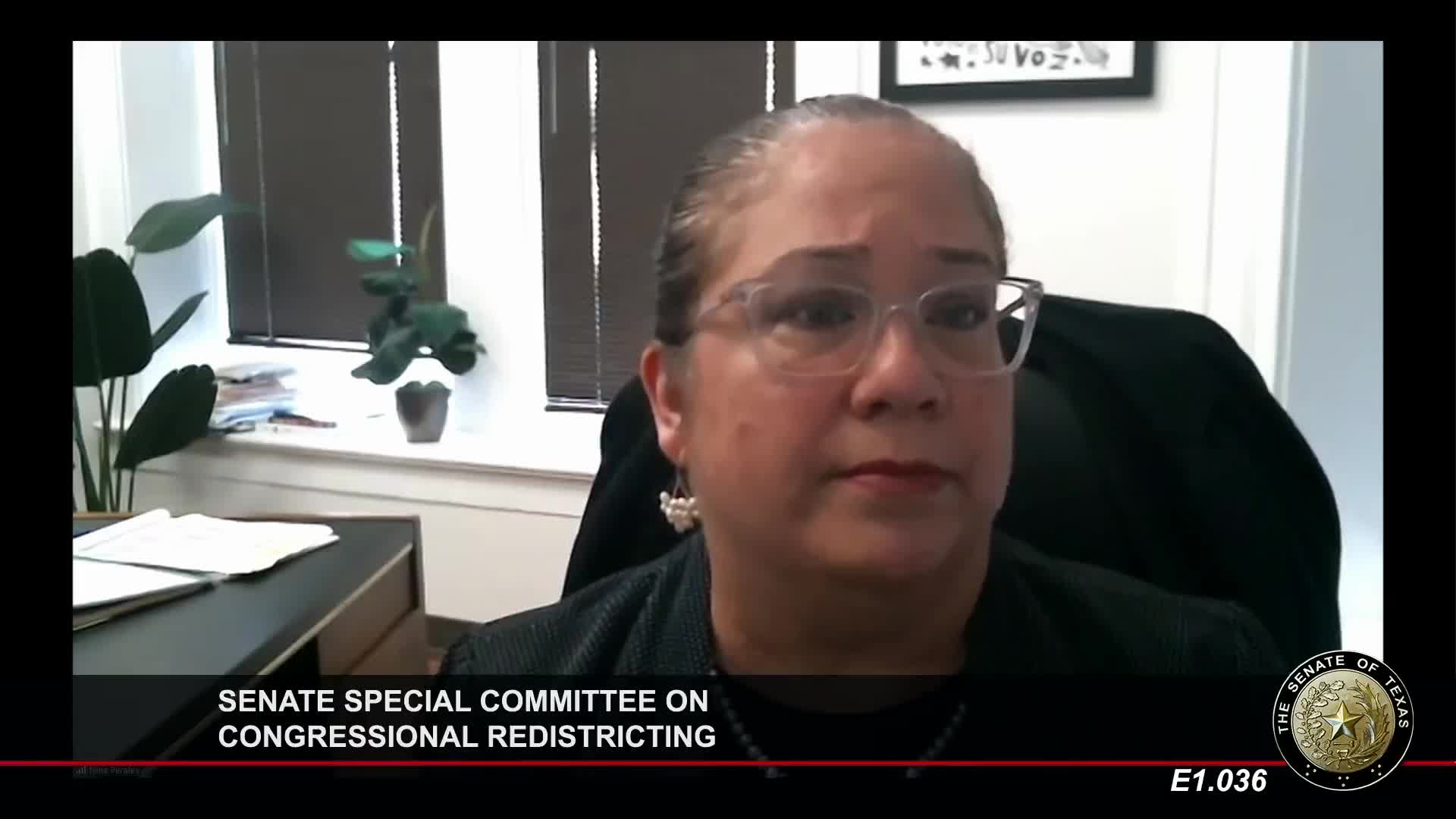
Summary
The Texas Senate special committee on congressional redistricting held a regional hearing focused on West Texas, where legal experts and advocates questioned a July 7 Department of Justice letter and urged transparent, law‑compliant mapmaking before any new congressional plan is filed.
The Senate Special Committee on Congressional Redistricting met in a video‑conference hearing focused on West Texas and heard invited legal testimony Wednesday about a July 7 Department of Justice letter raising constitutional concerns about the state's 2021 congressional map.
MALDEF Vice President of Litigation Nina Perales told the committee that the public cannot give meaningful input without seeing maps: "Without being able to see a map under consideration, the public can't tell you whether it follows traditional redistricting principles, whether it respects their communities of interest, or perhaps most importantly, whether it complies with the Voting Rights Act in the Constitution," Perales said.
The hearing assembled a mix of civil‑rights attorneys and voting‑rights advocates who urged the committee to require legal scrubs and public drafts before any map is finalized. Perales, who represented Latino voters in the federal litigation over the 2021 plans, told senators the DOJ letter misreads recent case law and urged lawmakers to ask "the necessary questions to make sure that the legislature evaluates minority population, voting patterns, and the totality of circumstances to create the districts required by law." She added, "If you are not there at the table asking the difficult questions about population, voting patterns, about, minority communities, you cannot ensure that the map will be lawful." (Nina Perales, vice president of litigation, MALDEF)
Committee members and invited witnesses debated whether the DOJ letter relies on a correct reading of Fifth Circuit precedent (Pettaway) and the Supreme Court's Allen v. Milligan guidance. Perales and other witnesses said the letter contains factual and legal errors: "If the Department of Justice had concerns and they knew how to read Pettway as well as anybody else did, they would have raised those concerns instead of dismissing all of their claims in the litigation," Perales said.
Chairman King told the committee he has asked legal counsel to provide a written clarification about the committee's authority to issue subpoenas after the regional hearings and said he would share that opinion with members once it is provided. Senator Alvarado noted she and other senators had sent follow‑up letters and asked that any subpoena consideration be held in a room that would allow public livestreaming; the chair said the committee had reserved the Betty King room for a formal meeting and that counsel is working on an opinion.
Why it matters: Committee members repeatedly told witnesses the committee cannot responsibly evaluate draft maps without a legal review and public drafts. Advocates cautioned that proceeding quickly without public review risks further litigation under the Voting Rights Act and the U.S. Constitution.
The committee did not vote on a map. The chair said any draft map filed with the committee will be made public and that senators will hold hearings on any proposed map. The committee also said it will discuss a formal motion on subpoena authority at a meeting the next day.
Ending: The committee’s next formal meeting is expected to include a legal‑opinion briefing about subpoena authority; members said publicly filed maps will trigger additional hearings and testimony. No map was filed during the West Texas regional hearing.