
Texas Senate adopts SR 5 to create congressional redistricting committee amid protests over mid‑decade plan
Get AI-powered insights, summaries, and transcripts
Subscribe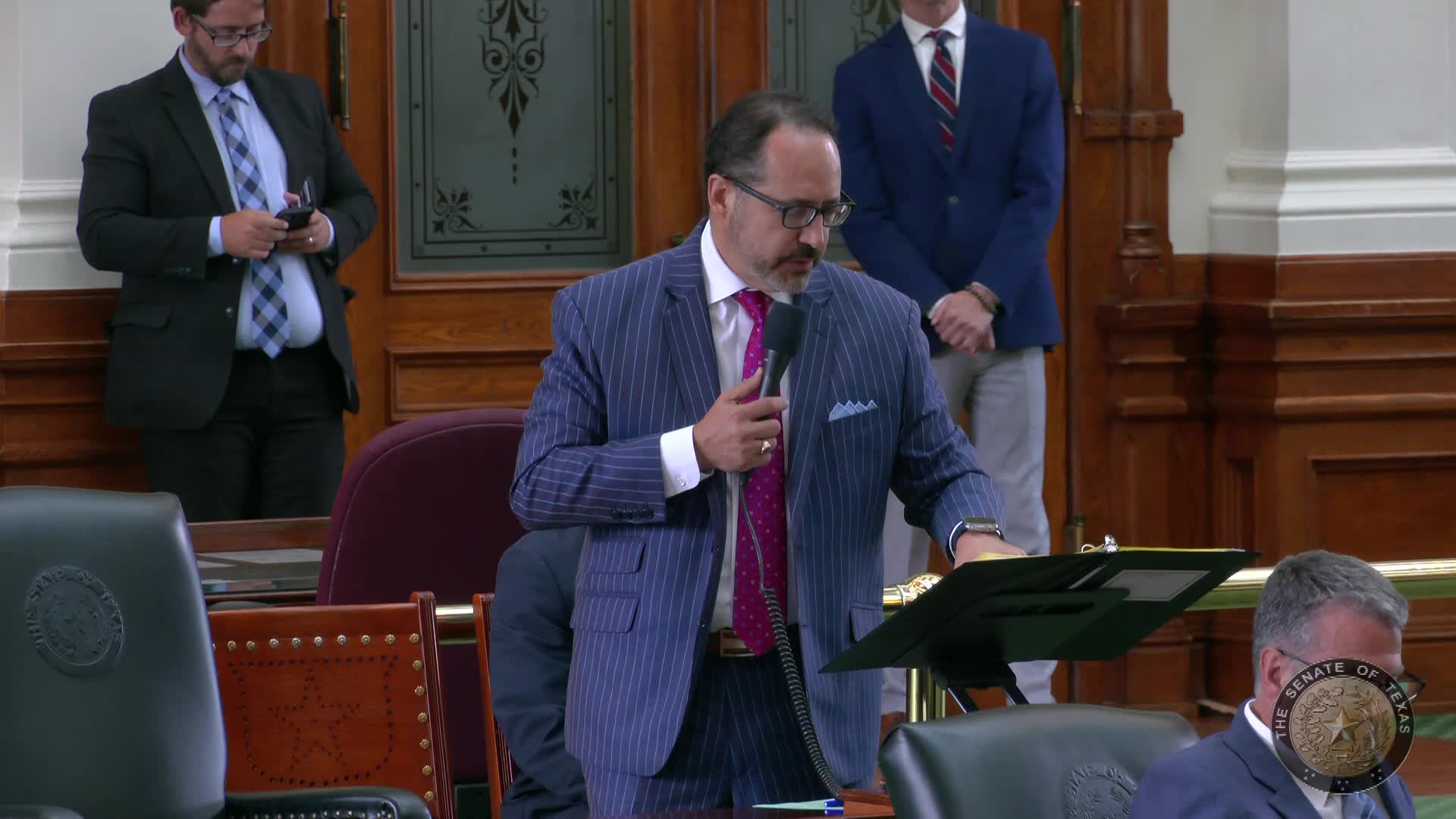
Summary
The Texas Senate on July 21 adopted Senate Resolution 5 (SR 5) to authorize a special committee and procedures for congressional redistricting, suspending rule 8.02 for immediate consideration. The vote was 19–11. Multiple amendments to expand hearings or notice failed by the same margin amid debate over a July 7 U.S. Department of Justice letter,
The Texas Senate on July 21 adopted Senate Resolution 5, establishing a Special Committee on Congressional Redistricting and procedures for regional hearings and floor amendment packets, after suspending Senate rule 8.02 to take up the measure immediately.
Senator Cedric King, the sponsor of SR 5, moved to suspend the rule and said, “All we're doing here today is trying to pass a resolution, to allow the lieutenant governor to set up the committee and then some rules for that committee to operate under.” The motion to suspend the rule passed 19–11, and final adoption of SR 5 was the same margin.
The resolution narrows the committee’s jurisdiction to congressional redistricting, authorizes regional hearings with video‑conference testimony, requires public posting (48 hours for regional hearings and bill hearings) and asks that floor amendment packets include maps and legislative council reports. King told colleagues the procedures mirror those used in 2021 and 2023 and said the intent was to “equip us for success in adopting lawful maps through a fair and transparent process.”
Democrats and some Republicans pressed for more time, more hearings and in‑person options. Senator Carol Alvarado proposed an amendment requiring five regional hearings on any congressional map under committee consideration; Senator Sarah Eckhardt offered a version calling for 12 regional hearings; Senator Royce Miles sought longer notice for regional meetings. Each amendment failed, recorded as 11 ayes and 19 nays.
Opponents repeatedly cited a July 7 letter from the U.S. Department of Justice, which the letter says raised constitutional concerns about four Texas congressional districts, as the catalyst for the governor adding redistricting to the special‑session call. Senator José Menéndez asked whether the DOJ letter was the only reason for the special session; King said the governor placed the item on the call and the resolution is a procedural step to respond.
Several senators framed the debate around access and fairness. Senator Juan Hinojosa and Senator Blanca Alvarado raised broadband access limits in rural areas; Senator Hinojosa cited a U.S. Census Bureau figure referenced in testimony that roughly 7,000,000 Texans lack broadband. Senator Judith Zaffrini, the dean of the Senate, said, “This debate is not merely about lines on a map. It is about the strength of our democracy and the trust of every Texan.”
Other speakers tied the effort to national politics. Senator Royce Miles said the move looked like “a blatant, shame, racist power grab rooted in the fear of changing demographics.” Supporters, including King, argued the process used in 2021 and 2023 succeeded in providing notice and transparency and that the portal and video testimony expand participation statewide.
After adoption, the Senate announced the Special Committee on Congressional Redistricting with Senator Cedric King as chair, Senator Brandon Creighton as vice chair, and members Senators Carol Alvarado, Juan Hinojosa Hidalgo, Nathaniel Hughes, Royce Miles, Bryan Parker, Ken Paxton and Robert Sparks. The Senate also approved several procedural motions to allow committee meetings and referred multiple bills to committees as listed in the journal.
The resolution's passage initiates a compressed timetable in which the committee will open information‑gathering hearings and accept maps and public comments through an online portal that King said has been reopened. King said he expected the first regional hearings to start Friday and pledged to make committee materials available to members as they are filed.
What the resolution does not do is adopt any map. Senators emphasized that any bill or amendment proposing a map would still be considered on its legal merits and that committee and floor procedures — including timelines for amendment packets — will govern deliberation. Opponents plan to press procedural and substantive challenges in upcoming hearings and in the courts if new plans are filed.
Votes at a glance • Motion to suspend Senate rule 8.02 to permit immediate consideration of SR 5 — Mover: Senator Cedric King; Vote: 19 ayes, 11 nays; Outcome: approved. • Floor amendment 1 (Alvarado) — Requires five regional hearings on any map under committee consideration; Vote: 11 ayes, 19 nays; Outcome: failed. • Floor amendment 2 (Eckhardt) — Requires 12 regional hearings (mirror of 2021 calendar); Vote: 11 ayes, 19 nays; Outcome: failed. • Floor amendment 3 (Miles) — Extends public posting requirement for regional meetings to 72 hours; Vote: 11 ayes, 19 nays; Outcome: failed. • Floor amendment 4 (Eckhardt) — Related posting/notice change; Vote: 11 ayes, 19 nays; Outcome: failed. • Adoption of SR 5 (adopting redistricting rules and procedures) — Mover: Senator Cedric King; Vote: 19 ayes, 11 nays; Outcome: approved. • Motion to permit State Affairs committee to meet at 9 a.m. July 22 — Vote: 19 ayes, 11 nays; Outcome: approved.
Next steps The newly constituted Special Committee on Congressional Redistricting will begin information‑gathering hearings, accept submissions through the committee portal and consider any map bills or amendments that are filed. The resolution requires public notice for hearings and calls for published amendment packets; it does not itself adopt any map. Expect additional floor votes if committee recommendations reach the full Senate.
Ending note Senators on both sides urged an orderly process; supporters said SR 5 recreates familiar procedures, while opponents said mid‑decade redistricting shortchanges public participation and threatens minority representation. The issue is likely to return to the floor and to the courts if proposed maps are filed.