Get Full Government Meeting Transcripts, Videos, & Alerts Forever!
Get email alerts on the Sanitation District topic
No spam. Unsubscribe anytime.
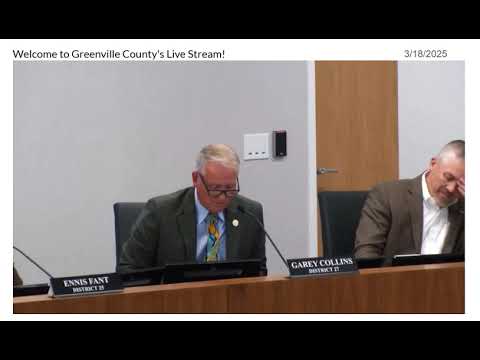
Greenville County Council refers resolution on Greater Greenville Sanitation to committee after hours of public comment
Summary
Greenville County Council on Monday introduced a resolution expressing support for the Greater Greenville Sanitation District and concern about two state bills that would dissolve or modify the district, then referred the matter to the committee of the whole for further study.
Greenville County Council on Monday introduced a resolution expressing support for the Greater Greenville Sanitation District and concern about two House bills in the South Carolina General Assembly that would dissolve or substantially change the district’s authority, then referred the item to the committee of the whole for further study.
The resolution, presented by Councilman Blunt, warned that passage of the bills could “terminate existing waste collection services to thousands of residents and businesses” and have “a disproportionate negative impact on the most financially distressed areas of the district,” language drawn from the motion text.
Why it matters: The district provides curbside waste, yard and bulk hauling for roughly 60,000 residents and employs about 114 full-time workers, presenters and dozens of public speakers said. Supporters warned that dissolving the district would interrupt service for low-income neighborhoods and people with disabilities; critics said the district’s financing and operations need reform and greater transparency.
Public comment stretched across more than two hours and included current and former sanitation employees, neighborhood leaders and business owners. Steve Cole, identified in the meeting as executive director of Greater Greenville Sanitation, described the district’s operations history and finances: “Greater Greenville currently employs ... 114 active full time employees who work hard to provide household waste, bulk waste, and yard waste services to approximately 60,000 residents,” and said the district now pays about $1,600,000 per year in tipping fees to Greenville County’s Twin Chimneys Landfill after ending an earlier contract with Republic Services.
Several speakers described personal reliance on the district’s services. Brian Chambers, training manager at Greater Greenville Sanitation, said the district “showed up” during emergency events and that privatization could reduce services such as yard-waste pickup and assistance for residents with disabilities. Bruce Wilson, a former manager and resident in a service area, said seniors on fixed incomes in parts of the county could not afford private haulers.
Other speakers urged changes rather than a blanket endorsement. David Davis and others urged reform of the district’s millage financing and more transparent procurement practices. Multiple commenters pointed to news coverage alleging questionable spending by the sanitation commission and asked for audits or clearer rules on equipment purchases and gifts.
Council reaction split. Councilman McGaughey said he would support the resolution but also pursue reforms; others, including one council member who identified concerns about the resolution’s breadth, said they could not endorse open-ended support without addressing transparency and fairness issues. Without taking a final vote on the resolution itself, the council agreed to refer the matter to the committee of the whole (a council-level review) to examine the questions raised and allow additional public input.
Action and next steps: Council voted by voice to send the resolution to the committee of the whole for further discussion; no roll-call tally was recorded on the floor. Several council members said they would engage the county’s legislative delegation and the state lawmakers who introduced the bills.
Community context: Speakers emphasized the distributional impact—many sanitation customers live in lower-income neighborhoods and rely on the district for debris and bulk pickup that private haulers often do not provide. Supporters said dissolution would also jeopardize 114 jobs. Critics focused on the district’s out-of-district operations, the millage funding mechanism and past procurement practices.
Council’s referral means the resolution will return for committee work and a future recommendation to full council; meanwhile the state bills remain pending in the General Assembly.