Get Full Government Meeting Transcripts, Videos, & Alerts Forever!
Get email alerts on the Bolt Solar Filo topic
No spam. Unsubscribe anytime.
Public raises transparency and planning‑review concerns as council approves Bolt Solar FILO
Summary
During a public hearing on Feb. 4, residents urged Greenville County Council to send the Bolt Solar fee‑in‑lieu‑of‑tax agreement to the planning commission and to publish a plain‑language summary of key terms. Council approved the FILO and a related park enlargement by voice vote after a brief debate and a withdrawn motion to hold.
Greenville County Council on Feb. 4 held a public hearing on a proposed fee‑in‑lieu‑of‑tax agreement for Bolt Solar LLC (Project Bolt) and subsequently approved the FILO and a related ordinance to enlarge a joint Anderson‑Greenville industrial business park.
Two residents spoke in opposition during the hearing, urging more public transparency and review. Audrey Pazen said attendees had not seen the full proposal and asked that the council not vote for the measure without further vetting. “You don’t know what vetting process it has gone through,” Pazen said, and she recommended sending the matter to the planning commission under the state Comprehensive Planning Enabling Act so planners could consider impacts on infrastructure and open the matter to public review.
Diane Vreeland likewise urged greater transparency and asked the council to post a plain‑language synopsis in the online agenda backup that includes key terms: the tax percentage being offered, the location of the project, the number of expected employees, and the duration of the FILO. “It would help the public if you placed on the agenda itself or in the backup online a short synopsis of the FILO being voted on so that the public does not have to read through 50 pages of legalese,” Vreeland said.
Council discussion included a short back‑and‑forth about economic and land‑use effects. One council member noted the county’s projected receipts from the agreement, saying the county would receive roughly $220,000–$221,000 per year under the FILO compared with a current property tax figure of about $800 for the parcels involved. A motion to hold the FILO for two weeks so council members could review job projections and other terms was made but later withdrawn; council then adopted the ordinance by voice vote.
The meeting transcript does not record the FILO’s full terms (percentage, exact term length, or projected job counts). Public speakers and at least one council member urged that future FILO items include a short, plain‑language summary in the agenda backup and that staff or the planning commission review land‑use impacts before final action.
What happened next The council approved the related ordinance to enlarge the multi‑county industrial park (the 2010 Park) by voice vote during the same meeting. An additional, separately listed Greenville‑Anderson park amendment later on the agenda was sent back to the finance committee for further review.
Why it matters FILO agreements can change the tax revenue profile for property and alter development incentives. Public speakers said the county should ensure that planning staff and the planning commission see developments that affect infrastructure or land use and that the public be given an accessible summary of contract terms before final votes.
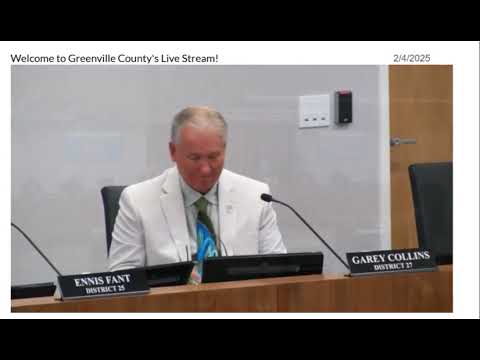
Who spoke Spokespeople recorded in the hearing were Audrey Pazen (resident) and Diane Vreeland (resident). Councilman Collins presented the public hearing on behalf of the council; county officials referenced presentations by the Greenville Area Development Corporation and the county auditor during public discussion.