Get Full Government Meeting Transcripts, Videos, & Alerts Forever!
Get email alerts on the Land Use Unified Development Ordinance topic
No spam. Unsubscribe anytime.
Upstate Forever urges wider riparian buffers, more open space and 'missing middle' housing in Greenville County UDO
Summary
Sherry Barrett, land policy director for the nonprofit Upstate Forever, told the Greenville County Communications and Governmental Affairs Committee that the county's draft Unified Development Ordinance (UDO) would limit sprawl, strengthen riparian buffers and tree protections, and expand infill and "missing middle" housing options and accessory dwelling units.
Sherry Barrett, land policy director for the nonprofit Upstate Forever, told the Greenville County Communications and Governmental Affairs Committee that the county's draft Unified Development Ordinance (UDO) would limit sprawl, strengthen riparian buffers and tree protections, and expand infill and "missing middle" housing options and accessory dwelling units.
Barrett said Upstate Forever's mission is "to protect the critical lands, waters, and unique character of the Upstate," and argued the UDO is a more intentional way to implement the Greenville County comprehensive plan than the county's current, piecemeal regulations. "If enacted, the UDO will accommodate growth in a more fiscally and environmentally responsible way," Barrett told committee members during a presentation and question-and-answer period.
Why it matters: Barrett and other advocates framed the UDO as a tool to direct growth toward areas with infrastructure and away from the county's remaining forests and farmland in the northern and southern thirds of Greenville County. The changes discussed include riparian buffer standards, new tree-preservation and open-space rules, septic and sewer coordination for subdivisions, and rules to allow duplexes, triplexes and accessory dwelling units (ADUs) in more places.
Key details from the presentation and discussion
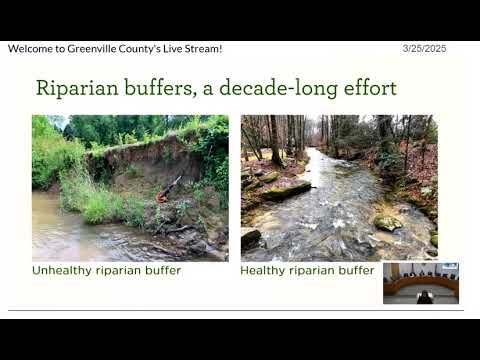
- Riparian buffers: Barrett highlighted the UDO's strengthened riparian buffer language and noted that the Reedy River Water Quality Group recommended a 100-foot buffer on most streams. She said the county currently has a 50-foot standard in many cases and that a 100-foot buffer currently applies only where a site drains more than 50 acres. Committee member Miss Seaman asked whether Upstate Forever would support a 100- to 150-foot buffer; Barrett said the stricter recommendation came from the Reedy River Water Quality Group and that Upstate Forever would be open to considering stronger buffers but directed technical questions to the organization's clean water team.
- Sunset clause: Barrett urged the committee to remove a two-year sunset clause that applies to recently adopted riparian buffer requirements, saying that buffers are among the most cost-effective means of protecting water quality.
- Open space: The UDO defines different open-space types, sets minimum sizes and requires active amenities (for example a trail or community garden) and connections between lots. Barrett said the draft requires 30% open space in unzoned sewered subdivisions; Upstate Forever recommended increasing that to 50% in unzoned areas where sewer is available to reduce sprawling development.
- Septic and sewer coordination: Barrett described UDO requirements for subdivision designs in septic areas, including identifying primary and alternative septic sites and requiring consultation with sanitary sewer providers before subdivision applications, which she said would help focus growth in sewered areas.
- Housing: Barrett described provisions to allow missing-middle housing (house-scale buildings no more than 2—2' stories with multiple units, such as duplexes and triplexes) and to expand where ADUs are permitted. She framed these changes as options for younger and aging residents who want smaller-maintenance homes in walkable neighborhoods.
Questions and concerns from committee members
- Committee member Miss Seaman asked specifics about buffer widths and whether Upstate Forever would publicly support a 100- to 150-foot buffer; Barrett said the 100-foot recommendation comes from the Reedy River Water Quality Group and that her organization's clean water team could provide more technical detail.
- Committee member Collins pressed on the riparian-buffer sunset and spoke in favor of a larger permanent buffer, saying he would like Upstate Forever to "go on the record to expand that to a 150 feet no less than." Barrett said Upstate Forever would be open to further discussion and directed technical follow-up to the clean water team.
Votes at a glance
- Approval of minutes: motion made and carried. Tally in the record: yes 2, no 0. Outcome: approved.
- Motion to adjourn: motion made and carried. Tally in the record: yes 2, no 0. Outcome: approved.
What the UDO would change and next steps
Barrett described the UDO as replacing inconsistent, antiquated language across existing ordinances and said it would adopt clearer standards for riparian buffers, tree preservation, open space and septic rules. She and committee members discussed specific numerical proposals (50-foot current buffers in some cases; 100-foot recommendation from the Reedy River group; the draft UDO's 30% open-space threshold in unzoned sewered subdivisions and Upstate Forever's request to raise that to 50%). Barrett said she and her organization have been "actively monitoring and engaged in this process since it started in 2020" and offered to provide committee members with her presentation and to have technical staff follow up on water-quality questions.
The committee did not take a formal vote on adoption of the UDO during this meeting; the item was presented and followed by questions. The committee recorded routine procedural votes to approve minutes and to adjourn.