Get Full Government Meeting Transcripts, Videos, & Alerts Forever!
Get email alerts on the Opioid Recovery Funding topic
No spam. Unsubscribe anytime.
Greenville County Council approves $4 million in opioid-settlement grants for treatment and harm-reduction programs
Summary
Council members voted to approve Greenville County’s second-year distribution of South Carolina Opioid Recovery Fund (SCORF) money, directing roughly $4 million to jail-based medication treatment, community harm-reduction and treatment providers, and local fire/EMS training and outreach.
Greenville County Council members at a Committee of the Whole meeting approved a package of South Carolina Opioid Recovery Fund (SCORF) grants totaling about $4,000,000 to continue and expand treatment, harm-reduction and outreach programs across the county.
The grant approvals follow year-one spending the county described to council: the detention center received just over $1 million, Greenville County EMS received $50,000, and the Phoenix Center and partner organizations received roughly $2 million. County staff said Greenville County currently holds about $7,000,000 in a county-specific SCORF account and that the state-level program will deliver additional annual payments over the coming years.
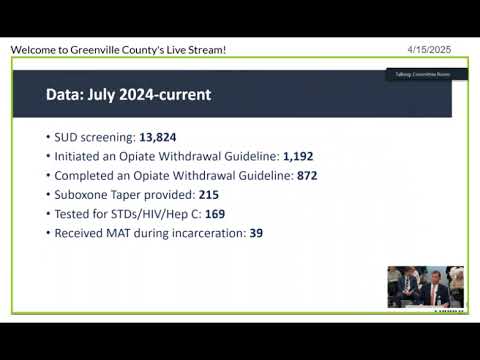
The funding package funded several continuing and expanded efforts. Dr. Israel Hollister, director for the detention center program, said the jail’s medicated assisted treatment (MAT) work has moved from pilot to routine practice. "What began as like a mere idea is now a fully implemented program at the detention center," Hollister said, and he described a case in which a pregnant woman started on buprenorphine (Suboxone) while detained, received in‑jail OB care and linkage to housing and community treatment on release.
Dr. Marty Lutz, medical director for Greenville County EMS and the detention center, described MAT as a clinical standard for pregnant patients and for people already on MAT in the community. "It's also the standard of care for pregnant women, and it's the standard of care for folks that have been started on MAT in the community," Lutz said, adding that use of buprenorphine has reduced withdrawal-related visits to emergency departments and improved behavior in the facility.
April Roberts, assistant medical administrator at the detention center, outlined operational limits the jail faces: space to house patients for observed dosing, staff time for administering and monitoring doses to prevent diversion, and the need for additional training. Roberts said the detention center requested roughly $1.7 million over two years to expand the program, add nursing staff, purchase longer‑acting buprenorphine injections (to reduce diversion and enable placement in general population), and cover medications, urine testing supplies and training.
Phil Hadda, director of clinical services for Greenville County EMS, and Josh Robinson, a community paramedic, described continuation funding for community harm-reduction work. EMS asked to continue a $50,000 allocation to supply naloxone for community distribution, provide wound care and referral services, and support hepatitis C outreach in partnership with Prisma Health. Robinson said EMS had contacted 58 people released from the detention center and achieved roughly a 10% MAT enrollment rate among them; in the hepatitis C work EMS reported 78 enrolled and 43 cured with a ~90% retention rate for treatment services.
Becky Maddox, CEO of the Phoenix Center, outlined a $2.3 million request for a coalition of providers (the Phoenix Center, FAVOR Upstate, Challenges Inc. and others). She said the coalition focuses on prevention, peer support, syringe-services–style outreach, expanded MAT and a Serenity Place program for pregnant and postpartum women that includes counseling, transitional housing and child services. Maddox also described investments in data collection and evaluation staffing to measure program performance and inform future adjustments.
Representatives of local volunteer fire departments described a small request to train firefighters and emergency responders through a Furman University course (the departments asked for approximately $10,800) to expand local naloxone distribution and community outreach in harder-to-reach parts of the county.
After staff presentations, council members asked for clarifications about program capacity, diversion control, and whether the current enrollment targets meet estimated need. Dr. Lutz said literature suggests up to 25% of incarcerated people could benefit from MAT and that current onsite capacity is smaller than the county’s estimated need; April Roberts said switching to monthly buprenorphine injections would both reduce diversion risk and could at least double the number of patients served. Councilor Mitchell raised questions about whether the proposed increases were sufficient to meet demand and about fraudulent advertising for Suboxone clinics in public right-of-ways; Phoenix Center and county staff said such signs are private providers and that code enforcement can remove illegal signs in rights‑of‑way.
Following the presentations, a council member moved to approve the SCORF grant package. Council members voted in favor; the chair announced, "The ayes have it." The motion carried and funding will proceed to implementation under the program and contracting processes described by staff.
Votes at a glance
- SCORF grant package (county-year 2 requests, total ask approx. $4,000,000): Motion to approve the package (mover not named in transcript). Outcome: approved. Notes: package funds jail-based MAT expansion (detention center request ~ $1.7 million for two years), Phoenix Center coalition request (~ $2.3 million), EMS continuation ($50,000), volunteer fire departments (~ $10,800) and supporting services. Vote recorded as voice vote; roll-call tally not provided in the transcript.
- Appointments and board votes (voice votes/ballots announced in meeting): Human Relations Commission — Lawson Wetley appointed; Parks, Recreation & Tourism Advisory Board — Deborah Alvarado and Emily Dembski appointed; Greenville County Redevelopment Authority — Deandra Wilson appointed; South Carolina Technology and Aviation Center (SC TAC) Board — Henry McCullough appointed; Planning Commission — Deborah Manning, Kenneth Matasevic and William Parham appointed; Board of Zoning Appeals (BZA) — Lisa Bracewell appointed. Meeting announcements indicate votes were completed and winners declared; individual recorded vote tallies were not given in the transcript.
Why this matters: the SCORF grants use settlement money designated for opioid abatement and cannot supplant existing opioid-related services; council approval directs county‑level settlement funds to programs county staff and local providers said will expand access to MAT, increase harm-reduction outreach and support treatment continuity for people leaving incarceration.
Implementation details, program limits and monitoring: staff and providers said funds will be used for medications, staffing, training, testing supplies, data collection and community outreach. The detention center indicated bed space and nursing time are the primary operational limits, and staff proposed adding nursing FTEs and using long-acting buprenorphine injections to mitigate diversion and expand capacity. Phoenix Center described investing in navigators and data staff to shorten wait times for assessments (from months to about a week) and to track outcomes.