Get Full Government Meeting Transcripts, Videos, & Alerts Forever!
Get email alerts on the Emergency Dispatch Consolidation topic
No spam. Unsubscribe anytime.
Charleston official briefs Greenville County leaders on consolidated 911 dispatch model
Summary
Jim Lake, director of Charleston County's Emergency Communication Center, outlined the timeline, costs, technology integration, staffing impacts and pros and cons of consolidating 911 dispatch at a Greenville County meeting; no policy decision was taken.
Jim Lake, director of the consolidated emergency communication center (Charleston County), told Greenville County leaders that Charleston's move to a single, countywide dispatch center produced technology integration, accreditation benefits and greater operational coordination but required large up-front costs and careful planning.
Lake spoke to the board about why Charleston began its consolidation work in 2006, formally started consolidation in 2009 and reached "full consolidation" in 2013, and he summarized key results and lessons learned for jurisdictions considering the same path. "I have absolutely nothing to gain from this," Lake said, introducing his talk as a practitioner's account rather than a sales pitch.
The briefing matters because a consolidated 911 model reallocates how emergency calls are answered and dispatched, alters staffing and budget structures, affects accreditation and insurance ratings and can change how small jurisdictions preserve front-desk or non-911 services.
Lake gave several concrete figures and milestones during his presentation. He said Charleston's initial assessment work began in February 2006; the county hired a director in October 2008; consolidation work began in January 2009; and the county completed a full consolidation in 2013 after constructing a new facility. He said the facility cost about $29,000,000 to build and is roughly 39,000 square feet. Lake said the consolidated operation retained the same 161 authorized positions countywide but currently had about 138 people working in operations. He said the consolidated dispatch runs on an operating budget of about $12,000,000 and that Charleston recently was awarded a $1,290,000 CAD-to-CAD grant to link to neighboring counties.
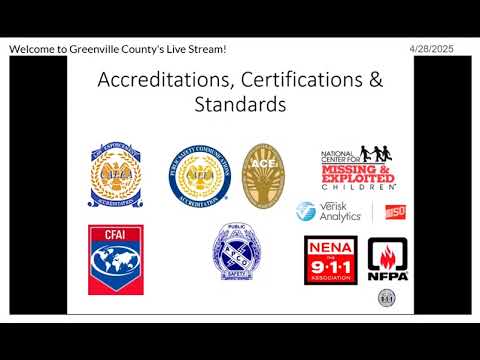
Lake described direct operational benefits Charleston reported after consolidation: standardization of operating procedures overseen by a consolidated dispatch board (which includes chiefs, the sheriff and the EMS director), a common computer-aided dispatch (CAD) platform across agencies, improved resource allocation during multiagency incidents and support for partner agencies' accreditation. He noted Charleston is accredited by CALEA (communications accreditation), uses International Academies of Emergency Dispatch protocols for medical/fire dispatch and supports some local agencies' CFAI accreditation and ISO scoring. "If your house is on fire...I don't think you really care what the name is on the side of the truck," Lake said to illustrate the argument for automatic aid and sending the closest resource.
Lake also described service arrangements Charleston maintains with nontraditional partners: Folly Beach initially moved its dispatch to the consolidated center but later returned its front-desk/dispatch functions after residents objected to losing a 24/7 staffed station; Joint Base Charleston contracts Charleston for 911 call taking and data entry while the base performs its own dispatch; and the county provides dispatch services to the National Park Service. Lake said those contract and sharing arrangements can produce revenue or cost-sharing but require explicit planning for functions such as front-desk customer service, permit processing or building access that some local dispatchers previously handled.
He listed common advantages and disadvantages of consolidation his team found. Advantages he gave included improved call-answering speed and information sharing, combined training and career advancement for dispatch staff, technology integration (shared CAD, mobile data and AVL), and simplified incident management in large events. Disadvantages included high up-front capital and facility costs, the potential loss of some incumbent staff who decline to relocate, loss of local voice-based knowledge that some small communities value, resistance to organizational change, geographic hiring challenges, dependence on redundant technologies and the need to preserve certain local services outside of 911 work.
On performance, Lake said measurable answering-time improvements existed where pre-consolidation baselines were available: "Probably easily 30% faster than 1 particular agency," he said, noting that many agencies did not keep comparable historical call-time records so 1:1 comparisons were not always possible. He said Charleston predicted a financial breakeven around year 10 but actually reached it in year 11.
Board members asked implementation questions. A board member identified as "Joe" asked about inclusion of The Citadel and learned Charleston currently limits some nontraditional partners to information sharing rather than full dispatch. Councilor Russo asked about changes to call response times; Lake gave the 30% example and cautioned that baseline recordkeeping varies. Board member Mister Shaw asked what to do before hiring consultants; Lake recommended first confirming local chiefs and the sheriff are willing to explore consolidation before spending on external assessments.
Lake emphasized operational design points Greenville leaders would need to address: where the consolidated center would be located, how to handle incumbent staff who decline to move, how to preserve local customer-facing services, governance and intergovernmental agreements (IGAs), staffing levels and a dedicated public-safety IT team. He also stressed the need for early hiring, redundancy in technology, and inviting all potential partners (universities, the base, park service) to the table early.
The meeting recorded two procedural actions: a motion to approve last month's minutes passed by voice vote, and a motion to adjourn passed at the end of the session. The presentation did not produce a formal decision to study or adopt consolidation; board members asked questions and received information.
Lake concluded by offering to answer follow-up questions and to share lessons learned; the board thanked him and moved to the next agenda item.
Ending: No formal policy action on consolidation was recorded at the meeting; the presentation served as an informational briefing for Greenville County leaders considering options for emergency communications.