Get Full Government Meeting Transcripts, Videos, & Alerts Forever!
Get email alerts on the County Budget topic
No spam. Unsubscribe anytime.
Greenville County administrator unveils two‑year budget proposal with millage cut, added public‑safety hires and $40M annual road program
Summary
Administrator Knoep presented proposed Greenville County budgets for fiscal years 2026 and 2027 totaling $488,483,000 and $495,738,000, proposing a 1.5‑mill reduction in county millage while adding public‑safety positions, funding a $40 million per year road program, and scheduling first readings and subsequent workshops.
Administrator Knoep presented Greenville County's proposed budgets for fiscal years 2026 and 2027 and described the plan as fiscally responsible while prioritizing public safety, infrastructure and economic development.
Knoep told the Committee of the Whole the proposed budget for fiscal year 2026 totals $488,483,000 and the proposed budget for fiscal year 2027 totals $495,738,000; those totals include the general fund, special revenue funds, debt service funds and enterprise funds but exclude internal service funds, which he listed separately at $56,900,000 for the first year and $58,800,000 for the second year. He said the proposal reduces total county millage by 1.5 mills and projects an average general‑fund balance of about $68,700,000.
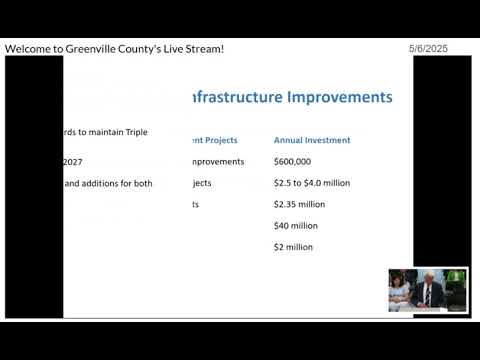
Knoep stressed maintaining the county's triple‑A bond ratings and cited priorities that include public safety, fiscal responsibility, infrastructure and strategic growth. "We do have 12 deputies each of the next 2 years. We have 2 deputy coroners each of the next 2 years, 5 paramedics each of the next 2 years," Knoep said, and he also listed investments in forensics, records and emergency management. The budget includes a $2,000,000 per year radio replacement program and a multiyear purchase plan for body‑worn and in‑car cameras for the sheriff's office. He said the radios and cameras are part of a multiyear, capitalized procurement that will be paid over roughly 10 years.
Knoep described a proposed major increase in road funding: "We have a $40,000,000 amount budgeted for road improvements for the next each of the next 2 fiscal years," he said, explaining that the increase comes from reallocating FELO funds (the county's share proposed to rise from 30% to 60%). He said council will decide whether to use the full amount for paving or to allocate it across projects.
The proposal also contains capital project allocations (about $25,450,000 in year one and $18,200,000 in year two), economic development funding of roughly $3,100,000 per year, and stormwater investments. Knoep proposed a 3% salary adjustment for both fiscal years and said health‑insurance costs are estimated to rise about 20 percent. He said enterprise funds for solid waste and stormwater are projected at roughly $33,000,000 in year one and $34,000,000 in year two.
On program cuts and reallocations, Knoep said affordable housing funding would be reduced from $3,000,000 to $1,000,000 and land preservation funding from $2,000,000 to $1,000,000. He also mentioned a land sale under contract — "1.6 acres under contract right now for $8,800,000" — and an estimated additional $30,000,000 in prospective land‑sale revenue, which he said influences the budget totals.
Councilors pressed for clarifications. Councilor Tripp asked which areas were cut to support the $40,000,000 road proposal; Knoep replied that the increase is primarily a reallocation of FELO funds and that some existing bond payments (for example, the Woodruff Road Bypass) would be paid from other sources. Councilor Tripp also asked whether the jurisdictions that previously received the other 30% of FELO funds had been notified; Knoep said he had not yet shared the proposal with those jurisdictions and wanted to present it first to county council.
Councilor Seaman asked whether radio replacement will require continuing cycles of upgrades; Knoep described vendor‑driven obsolescence and the need for interoperability: "The key with public safety is interoperability. Make sure they can talk to each other," he said, and added that the county will likely purchase radios on a rolling 10‑year schedule paid over time. Councilor Sharp asked what share of the total budget health insurance represents; Knoep said it is roughly 10 percent of the budget.
Knoep said the budget process timeline includes first readings for both fiscal years on May 20, workshops as needed, second readings on June 3 and third readings on June 17 (FY26) and July 15 (FY27), and he invited councilors to submit written questions to staff for precise answers.
The presentation was a discussion and did not constitute adoption of the budgets; Council must act in future readings. The committee also scheduled a special call meeting next week to address an executive‑session request from Councilor Shaw about legal matters; that was a procedural direction, not a budget vote.