Get Full Government Meeting Transcripts, Videos, & Alerts Forever!
Get email alerts on the Sanitation District topic
No spam. Unsubscribe anytime.
Greater Greenville Sanitation directors and commissioners defend out-of-district service and transfer station plans
Summary
Greater Greenville Sanitation District officials told the Greenville County Oversight Committee they can serve customers outside the district under their enabling legislation, that state legislation and litigation have delayed a GO bond for a transfer station site on Highway 124, and that the district reported about $50,000 net revenue from Travelers Rest last year.
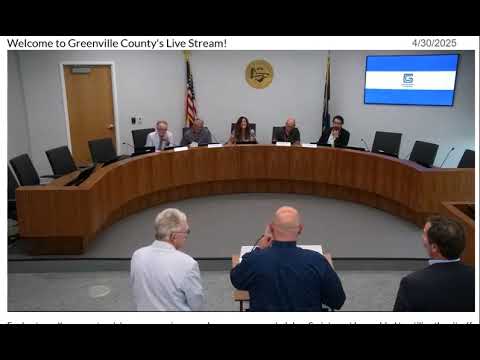
Greater Greenville Sanitation District officials appeared before the Greenville County Oversight Committee to update the committee on pending state legislation, a proposed transfer station on Highway 124 and the district’s ongoing out-of-district service.
Steve Cole, identified in the meeting as Greater Greenville’s director, and commissioners including Will Stewart and Tony Ernst described the status of two bills at the statehouse and said one amendment under consideration would keep operations within the district, raise the annexation threshold to 66%, prohibit noncontiguous annexations for four years, and limit the transfer station to district customers and intergovernmental agreements. “We stay within our district, operate within the confines of our district… it changes our annexation structure… and we agreed not to do any noncontiguous annexations for period of 4 years,” Commissioner Will Stewart said while summarizing changes on the floor of the Legislature.
Cole told the committee the district cannot move forward with a general-obligation bond for a transfer station while litigation and legislation remain pending. “They said they cannot move forward with the GO bond because of, all the litigations going on at the,” one of the commissioners said in reporting the situation. Committee members pressed staff on the transfer station site and on the district’s 156-acre purchase on Highway 124. Cole said the district previously owned another troubled property and sold it to retire debt; the Highway 124 purchase was intended to provide a larger buffer and a new operations and administration campus, and the property required cleanup and site work before it could be developed.
Financials and fees. Committee members asked about profits and billing. A district representative said the system earned about $50,000 last year from customers in Travelers Rest, on roughly 1,800 homes served there. Committee members asked how those outside revenues affected rates in the district; a commissioner said outside revenues help avoid raising millage and fees inside the district. “If we didn't have that outside money coming in, we would end up having to raise our millage and millage or fees to cover costs,” a commissioner said.
On the question of how the district charges customers, staff described a mix of a flat sanitation fee (noted as $210 in one committee exchange) plus a millage tied to property value; staff said higher-value properties typically pay more. Commissioners acknowledged the distributional effect — that wealthier areas end up subsidizing service for lower-income neighborhoods under the current system — and said they had discussed a flat-fee alternative with state legislators but that moving to a flat fee would raise costs for some lower-income residents.
Annexations and marketing. Committee members asked whether the district actively solicits business outside its boundaries and whether its website promotes service to prospects; district representatives repeatedly said customers and neighborhoods often approach Greater Greenville and that the district does not proactively solicit. “We absolutely do not solicit people outside the district,” a commissioner said, adding that sometimes neighborhoods approach the district seeking service. Committee members presented media and marketing concerns and asked for financial analyses showing whether out-of-district service reduces rates for district taxpayers; district officials said they could provide pro forma analyses and other financial documentation upon request.
Governance, gifts and stipends. Committee members pressed the commissioners about past gifts to departing commissioners and about retreats; commissioners said a prior practice of gifts and out-of-area retreats has stopped. Committee members also questioned a stipend for commissioners to purchase health insurance; a commissioner said the board receives a stipend of about $1,100 per month for insurance because board members are not eligible for state insurance plans. “We weren't allowed to go on the state insurance. When we went on state insurance, you had to be a full time employee,” a commissioner said, and later, “we are offered a stipend” of “about 1,100” dollars a month for insurance.
Public comments. Dozens of questions and public comments in the meeting and the public-comment period addressed Greater Greenville. Local hauler Josh Painter of Kirby Sanitation told the committee his business competes against Greater Greenville and asked the county to “level the playing field,” saying the district’s taxpayer-backed millage gives it a competitive advantage over private haulers. Resident Kathleen (last name varies in the transcript) asked the county to rescind a proposed $20 million bond for the transfer station and to allow taxpayers a vote; she also asked who audits the district’s funds. Ed Paxton, another public commenter, said he did not trust the district.
What the committee asked staff to provide: committee members requested more detailed financial analyses — including pro forma income statements and documentation supporting cost-to-serve calculations — and copies of presentations and audits cited in discussion. No formal motions or votes were taken during the committee’s update; the session was an informational briefing and Q&A.
What remains unresolved: pending state legislation (identified in the meeting as a bill referenced as H4003 and a separate defeated item 4002), active litigation that staff said prevented bond financing, the final scope and funding of a transfer station on Highway 124, and the long-term policy question of whether a taxpayer-funded sanitation district should provide service outside its statutory boundaries.
Officials and committee members agreed to follow up with the requested financial documents and analyses; staff said they would provide spreadsheets and other background materials to committee members.