Get Full Government Meeting Transcripts, Videos, & Alerts Forever!
Get email alerts on the Conservation Open Space topic
No spam. Unsubscribe anytime.
County poll shows strong support for using tax dollars to protect open space, trust tells council
Summary
The Greenville County Council Committee of the Whole heard results of a countywide poll presented by the Greenville County Historic Natural Resources Trust showing broad public support for using tax dollars to protect open space and parks, Trust representative Carlton Owen said.
The Greenville County Council Committee of the Whole heard results of a countywide poll presented by the Greenville County Historic Natural Resources Trust showing broad public support for using tax dollars to protect open space and parks, Trust representative Carlton Owen said.
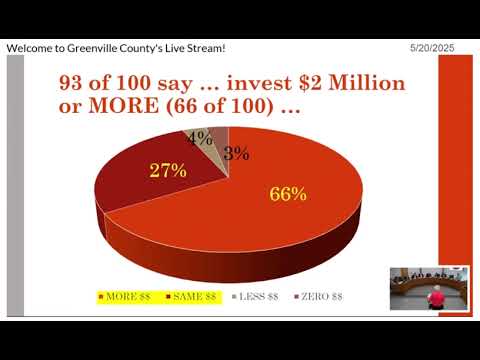
The poll, conducted for the trust by the Trafalgar Group in partnership with the Community Foundation of Greenville, found that roughly 72%–80% of respondents supported using public dollars to add to state parks, county parks and to protect historic sites, Owen said. A “super majority” — nearly 80% — said they were supportive or strongly supportive of using a portion of their property taxes for open-space protection, and about two-thirds of respondents favored increased funding above the trust’s current level.
The poll matters because it may shape how the trust and the county discuss funding options for conservation. “Nine out of 10 people are very concerned about loss of green space in Greenville County,” Owen said, summarizing one of the poll’s headline findings. The trust noted that respondents did not see the survey as only an “open-space” poll at first and that opinions crystallized as respondents read specific questions.
Owen said the trust paid the Trafalgar Group to conduct a statistically valid poll that sampled demographics across age and race in Greenville County. He added that a separate, self-selecting online version of the survey drew about 330 written comments and that the trust released both versions to the county council first. “Robert Kahaly is more than willing to speak with any of you at any time to dig deeper into the data,” Owen said, referring to Trafalgar’s pollster.
Key poll details presented to the council: • Support range on preservation questions: about 72%–80% in favor of specific preservation actions (adding to state or county parks, protecting historic sites). • Concern about green-space loss: about 90% of respondents were either “very concerned” or “not concerned” (few undecided), producing an unusually polarized result on that question. • Funding appetite: about 66% of respondents said they would support increasing the trust’s funding above its current level; the trust’s first biennium funding was $1,000,000 per year and the second biennium was $2,000,000 per year. When asked if funding should be kept at $2,000,000, 27% said yes while 66% said they would support more. • Alternative revenue preferences: respondents identified impact fees and a 1-cent tax with a designated green component as the most acceptable alternative revenue options.
Council members pressed for clarity on conservation easements and public access. Owen said many respondents did not understand the term “conservation easement”; about 27% were undecided on the easement question because of that lack of familiarity. He described typical conservation-easement arrangements for working farms and forests: landowners can reserve a small number of home sites while keeping the balance of the land in agricultural or forestry use, and the trust’s contribution toward such easements has “typically been 10% or less of the appraised value,” stretching trust dollars while preserving working lands.
On public access, Owen said rural landowners often do not want unlimited public access for liability and privacy reasons; public-access easements are possible but require paying for that right. Owen used a recent Piedmont Mill Village project as an exception where a conservation easement included unlimited public access.
Owen also compared Greenville’s poll results and options to other South Carolina counties that have combined transportation or bonds with green components. He said Charleston County has a longstanding program that will provide about $440 million over time, with roughly $13.5 million a year allocated to green space, and Berkeley County has a large program of roughly $140 million.
The trust said it provided the poll results to the council first and will release the full data publicly; the pollster is available to answer council members’ questions. Carlton Owen closed by telling council members the trust has a four-year record and now seeks public guidance on direction and funding.