Get Full Government Meeting Transcripts, Videos, & Alerts Forever!
Get email alerts on the Stormwater Ordinance topic
No spam. Unsubscribe anytime.
Greenville County panel sends stormwater ordinance revisions to full council after farmers object to agritourism language
Summary
The Roads, Infrastructure and Public Works Committee forwarded proposed stormwater ordinance changes to the County Council on June 3, 2025, after farmers and staff debated a provision clarifying when agricultural properties hosting retail or event activities must obtain land-disturbance permits.
Greenville County’s Roads, Infrastructure and Public Works Committee voted June 3 to send proposed revisions to the county stormwater ordinance to the full County Council for final action after public comments from farmers and a staff explanation of permitting thresholds.
The changes clarified when agricultural properties used for retail sales or agritourism — such as wedding venues or wineries — must obtain county land-disturbance permits. Committee members and stormwater staff said the language was intended to distinguish ordinary agricultural production from commercial activities that create larger impervious surfaces and parking areas.
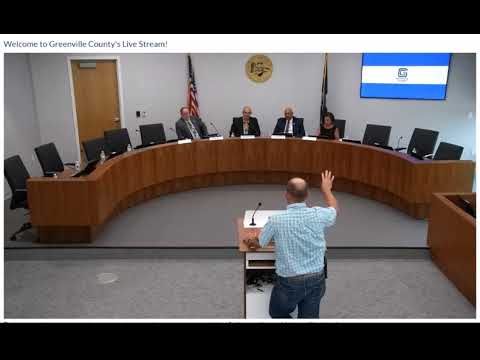
The issue drew several public commenters. Joe Deal, a Landrum resident, urged the committee to remove a line that would treat some farm activity as retail, saying, “Take that out. Don’t over regulate farms.” Austin Neely, a partner in Underground Farm, asked that his operation be “treated or remove agritourism from our farm label, as it should be considered the same as other agricultural zoning.” Farmer Aiden Green said, “we shouldn't be treated differently. We should be treated the same as every other agricultural farm,” and Alan Kellett, owner-operator of Kellett Farms, told the committee, “We don't need any more of that. We got enough of that from the USDA.”
A county stormwater staff member told the committee the proposed wording responds to a rise in commercial-style development on agricultural parcels. “Greenville County in 1993 reduced that from 1 acre to 5,000 square feet of land disturbance activity requires permitting,” the staff member said, explaining the county’s current threshold (5,000 square feet) is stricter than the state standard (one acre) and that the county has been enforcing permits when farms build structures or parking to support retail sales or events.
Staff described common examples that trigger permitting: wedding venues, tasting rooms at wineries, and retail buildings with large parking lots — not small farm stands or routine production activity. The staff member also said the county frequently fields complaints about commercial uses appearing on agricultural parcels and wanted the ordinance language to make enforcement and permitting expectations clearer.
Speakers also raised long-running drainage and maintenance problems. Kellett and other residents described new runoff cutting a ditch through farmland after a nearby subdivision and requested county pipe installation; Roads and Bridges staff said a repair project had been planned and would be scheduled. Stormwater staff described “orphan ponds” — private detention ponds installed decades ago that lack an HOA or identifiable owner — and said the county’s MS4 permit requires the county to ensure these private facilities are maintained. Staff said the county is reviewing options, including contracting maintenance and using lien authority to recover costs from subdivision residents where legal responsibility exists.
After discussion, one committee member proposed holding the item in committee, but the committee ultimately voted to forward the ordinance revisions to full County Council with a commitment to refine the language. The committee chair said there was no intent to place new burdens on bona fide farms, but to prevent developers from using agricultural zoning to evade permitting requirements for commercial activity. The committee’s motion to send the item to County Council passed.
Staff said they will return with additional background on the county’s 1990s decision to adopt the 5,000-square-foot threshold and with language edits for County Council consideration.