Get Full Government Meeting Transcripts, Videos, & Alerts Forever!
Get email alerts on the Housing And Community Development topic
No spam. Unsubscribe anytime.
Greenville County Redevelopment Authority presents 2025–29 consolidated plan, opens public comment
Summary
Greenville County Redevelopment Authority (GCRA) staff presented the draft 2025–2029 consolidated plan and 2025 annual action plan, outlined HUD program allocations and local priorities, and said the plan is in public comment with a June 17 public hearing before submission to HUD in July.
Francis Gornaiz, program manager for the Greenville County Redevelopment Authority, presented the draft 2025–2029 consolidated plan and the 2025 annual action plan and asked the committee to note that the documents are in a public comment period.
The consolidated plan, Gornaiz said, is “a prerequisite to receive HUD funding” and covers five years; the annual action plan covers the upcoming program year. He told the committee Greenville County is an entitlement community that receives Community Development Block Grant (CDBG), Emergency Solutions Grant (ESG) and HOME Investment Partnerships Program (HOME) funds directly from HUD and must submit a plan explaining how federal and local resources will be used.
Why this matters: the consolidated plan and action plan allocate federal housing and community-development dollars across homelessness services, affordable housing, infrastructure and public services. Gornaiz said the documents guide which projects the county will fund and how grant dollars are spent.
Gornaiz summarized the draft’s priorities: improving or expanding public facilities and infrastructure; funding public services for low-to-moderate‑income households and special‑need populations; housing rehabilitation and new housing development for owners and renters; removal of slums and blight; economic development and façade improvement programs; and homeless and housing services, including shelter operating costs, rental assistance and rapid rehousing.
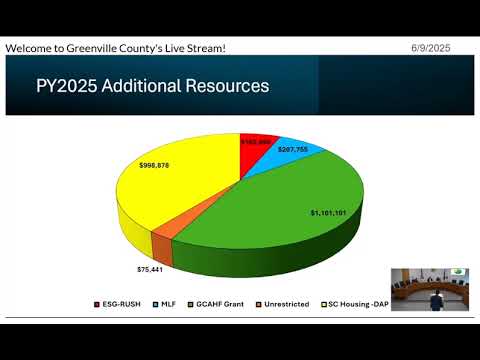
He provided HUD allocation estimates for program year 2025 (July–June): about $240,000 for ESG (homeless services, rapid rehousing, prevention and street outreach), about $1,000,000 for HOME (affordable housing creation/rehab), and roughly $4.1 million for community development block grant activities. Gornaiz said the plan also accounts for prior‑year unspent funds and one‑time sources such as SC Housing disaster assistance.
Gornaiz described outreach over the last six months: a kickoff meeting for municipalities and unincorporated areas, three program focus groups with subrecipients and housing partners, public input meetings at municipal libraries, and surveys. “We’re in the middle of a public comment period,” he said, and the authority will hold a public hearing on June 17, submit the consolidated plan to HUD in July and expect HUD grant agreements in August or September.
Council members pressed staff on public outreach and program outcomes. A councilor asked how many people attended public input meetings; Gornaiz said attendance averaged “probably 3 to 5.” He acknowledged grantees commonly struggle to attract public meeting participants and said GCRA is working to make input more actionable for residents. On monitoring, he said HUD requires monitoring of projects for at least 15 years and GCRA tracks affordability, occupancy demographics and rent limits, and performs an annual evaluation.
Several councilors asked about the role of local funding in securing Low‑Income Housing Tax Credits administered by SC Housing. Gornaiz explained local funding helps applicants score better for tax credits and that typical local asks range from about $250,000 to $500,000 per project; he said a common request size is about $600,000 but GCRA cannot always meet full requests. He summarized recent production: roughly 297 affordable units completed since the fund’s management began and about 422 units currently in progress.
Gornaiz warned of federal uncertainty: he noted the White House budget at that time listed zero for the three HUD programs, and said GCRA still prepares the five‑year plan because the plan must be submitted even if next year’s federal amounts are uncertain.
The presentation closed with Gornaiz noting that HUD has identified Greenville County as a strong grantee for timely expenditure of funds.
Next steps: the draft consolidated plan remains in public comment, a public hearing is set for June 17, staff will submit the plan to HUD in July and proceed with grant management once HUD grant agreements arrive.