Get Full Government Meeting Transcripts, Videos, & Alerts Forever!
Get email alerts on the Salary Negotiations topic
No spam. Unsubscribe anytime.
Union proposes step-and-lane salary schedule and $19 million, district offers smaller pot; parties agree to continue talks and set interim dates
Summary
The Ithaca Teachers Association proposed a three-year step-and-lane salary grid and requested roughly $19 million in additional salary allocation to fix compression and create predictable career progression; the district said it has authorization for a smaller pot and cautioned about funding recurring raises with one-time reserves.
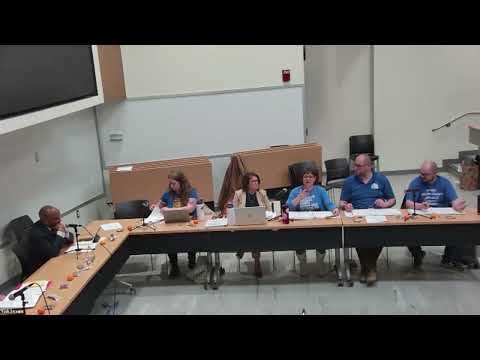
The Ithaca Teachers Association (ITA) presented a detailed three-year “step-and-lane” salary proposal intended to address salary compression and make district pay predictable and competitive; the ICSD said it was prepared to offer a smaller, more constrained package and both sides set interim dates to exchange documents and continue negotiation.
What the union proposed: ITA negotiators described a built-out grid that would place all teachers on a unified set of steps (years of service) and lanes (graduate credits/professional credentials) so that salary progression would be predictable over the course of an educator’s career. The union’s negotiators said the plan would be implemented over three years and would raise the total salary allocation by roughly $19,000,000 across those three years. The union framed the change as fixing long-standing compression that left mid-career and veteran teachers behind: “We wanted to invite a couple people to speak about this,” the union presenter said while introducing teacher testimony.
Teacher testimony: Several teachers addressed the table with personal experience about housing affordability and pay. Molly Fernier Ames, a special-education teacher at Caroline Elementary, described being “priced out of living here” and urged district leaders to consider the effect of local housing costs on retention. Meg Burke, librarian at Northeast, said she works several side jobs to make ends meet and described the personal consequences of low relative pay: “I’m an educator who's been here for 10 years … the total raise I’ve gotten in comparison with inflation over the last six years has a grand total of 2.16%,” she said.
How the step-and-lane system would work: The ITA’s presentation included illustrative grids showing new hires placed on steps and lanes by experience and credits at hire; employees would move down rows as experience increased (steps) and across lanes for graduate credits. The union said the grid would be phased in over three years so some members would immediately move onto the grid (possibly receiving large first-year increases), while others would retain a 4% raise if the grid did not produce a larger increase for them in year one. In subsequent years, the larger of 4% or the grid position would apply; by year three most more teachers would be on the grid.
District response and budget constraints: ICSD leaders acknowledged the problem but said the district’s current authorization and budget outlook support a smaller increase: they described an initial offer around a 4% “pot” for bargaining rather than the union’s 8% ask. District officials also cautioned against funding recurring salary increases with one-time reserves because doing so could create an unsustainable structural deficit. The district said its current budget work anticipates using roughly $8.7 million of fund balance to balance the 2024–25 budget and noted that certain state aid increases (foundation aid) are unusually high this year and cannot be assumed recurring.
Funding sources discussed: Both sides identified several possible revenue sources if the district were to fund larger increases: the union cited projected growth in state foundation aid (union estimate $2.5 million), modest property tax growth under the tax cap, and portions of the district’s operating surplus and unexpended fund balance; the district cited its own ST-3 financial filing and estimated a smaller net state-aid gain (approximately $1.7 million) usable for recurring costs. The union requested that the district consider reallocating a small portion of reserves each year (the union suggested a recurring half‑million reallocation in the presentation) while district leaders warned repeated use of reserves to fund recurring raises would be risky.
Process and timing: The parties agreed to continue work before the next full session. They set interim exchange and meeting dates: the district asked for time to brief its board and financial staff; both sides agreed to exchange counter-documents and to meet again (documents to be exchanged by March 12; a bargaining session to occur March 13 and a fuller meeting on March 20 were discussed and tentatively scheduled). The district said it needed to see specific budget documentation behind union numbers before it could move beyond the 4% authorization it has communicated to bargaining.
What was not decided: There was no agreement on the overall size of the pot (union asked ~8% average pot; district said 4% authorized), no final decision on adoption of the step-and-lane system and no agreement to fund recurring raises with reserves. No formal votes were recorded at the table.
Quotes from the session: - “We wanted to create a step lane salary system … predictable, attractive, and incentivizing,” a union presenter said while showing examples from the proposed grid. - “Living paycheck to paycheck stayed the reality no matter how hard I tried to budget my money,” said Molly Fernier Ames, special-education teacher at Caroline Elementary, describing housing pressures. - “The total raise I’ve gotten in comparison with inflation … is a grand total of 2.16%,” Meg Burke, librarian at Northeast, told negotiators of her personal calculations.
Next steps: Parties agreed to exchange written counterproposals (district requested the union’s budget spreadsheet and clarifying documentation by March 12), to meet on March 13 for a working session and to continue full-table negotiations on March 20.