Get Full Government Meeting Transcripts, Videos, & Alerts Forever!
Get email alerts on the Workday Scheduling topic
No spam. Unsubscribe anytime.
Negotiators tentatively agree on new Wednesday meeting structure; broader talks on common planning, inclusion scheduling, caregiver conferences and work‑life ‘—
Summary
Negotiators reached tentative agreement on a revised Wednesday‑meeting schedule and discussed multiple working‑conditions proposals — including common planning for inclusion partnerships, caregiver conference scheduling and a "right to disconnect" protection — but several items need more data or drafting.
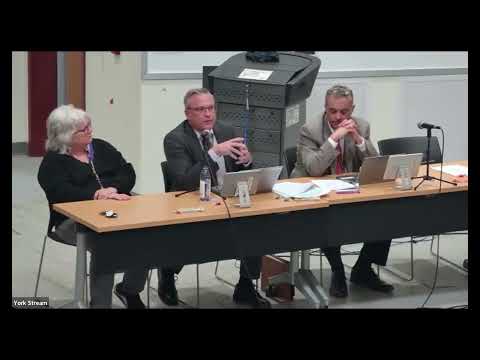
Negotiators at the April 30 session reached tentative agreement on a rewrite of the district’s Wednesday‑meeting structure and held extended discussions on related working‑conditions items, from common planning time for inclusive co‑teaching to a proposed “right to disconnect” protection for teachers.
Why it matters: teachers’ daily and weekly schedules determine planning time, how the district organizes inclusion supports, and whether staff must meet families outside contracted hours. Those details affect teacher workload, student services and the district’s budget and master scheduling.
What the parties agreed: the district and the union recorded a tentative agreement on Proposal 39 (Wednesday meetings). The parties agreed that staff meetings will start no later than 10 minutes after the end of the student day, will run 60 minutes, and that 10 minutes of each meeting will be designated for ITA business (time may be at beginning or end by mutual agreement). The agreement also creates a category of “professional responsibility days” to be used as extra preparation time; the wording agreed allows that time to be used for either professional responsibilities or professional collaboration, so schools and teams can use it flexibly for prep, assessments, planning or opt‑in collaborative PLC work.
Common planning for inclusion: union members asked for contract language that would require aligned prep/common planning time for integrated co‑teaching partnerships (the "marriage" model) and limits on how many deep inclusion partnerships a single special educator should be expected to sustain. District leaders said the proposal surfaced important scheduling constraints (lunch windows, specials, transportation) and asked time to audit building master schedules. Both sides agreed to continue working: the district will audit elementary FTE and section counts and the union will bring suggestions from its inclusion listening circles; the two sides plan to return with more specific language and possible MOA options.
Right to disconnect / communications protocol: the union offered contract language to protect teachers from discipline if they choose not to respond to communications outside the contractual day. District leaders supported the principle of reasonable boundaries but flagged exceptions for safety and student‑welfare emergencies. The parties agreed to rework the draft to tie protections to the district’s communications protocol and to define “emergency” (for example, a student missing or a clear safety threat). District staff agreed to propose language and bring it back for consideration.
Caregiver conferences and scheduling platform: union negotiators proposed that the district designate caregiver conference days on the academic calendar and adopt a single district scheduling platform to produce secure, centralized signups and reduce scheduling burden on individual teachers. District negotiators said the idea could improve family access but carries budget and training implications; both sides agreed tentative steps, including piloting a platform and clarifying whether ancillary conference time outside the contractual day would be compensated.
Teacher‑librarian scheduling and TOSA clarification: the union proposed a new contract article that would require each building to have a librarian and specify duty‑free lunch, a preparation period and 40 duty‑free minutes for library administration. District negotiators said they value librarian work but were not prepared to codify a single role’s scheduling differences without wider discussion on how that would affect other positions; both sides agreed to continue the conversation. Separately, the parties reached tentative agreement on revised language clarifying Teacher on Special Assignment (TOSA) responsibilities: mutual annual job descriptions, written notice by June 1 on continuation, and a process for authorizing nontraditional work schedules and overtime.
What was decided: Proposal 39 (Wednesday meetings) and Proposal 44 (TOSA responsibilities) were recorded as tentative agreement. Several other items — inclusion scheduling, librarian schedule language, and communications protocol language on the right to disconnect — remain under negotiation and were sent back for drafting and data work.
Ending: negotiators scheduled follow up sessions and asked district staff to bring cost estimates for proposals that have budget implications and to produce audits or schedule data needed for the inclusion and librarian conversations.