Get Full Government Meeting Transcripts, Videos, & Alerts Forever!
Get email alerts on the Cannabis Regulation topic
No spam. Unsubscribe anytime.
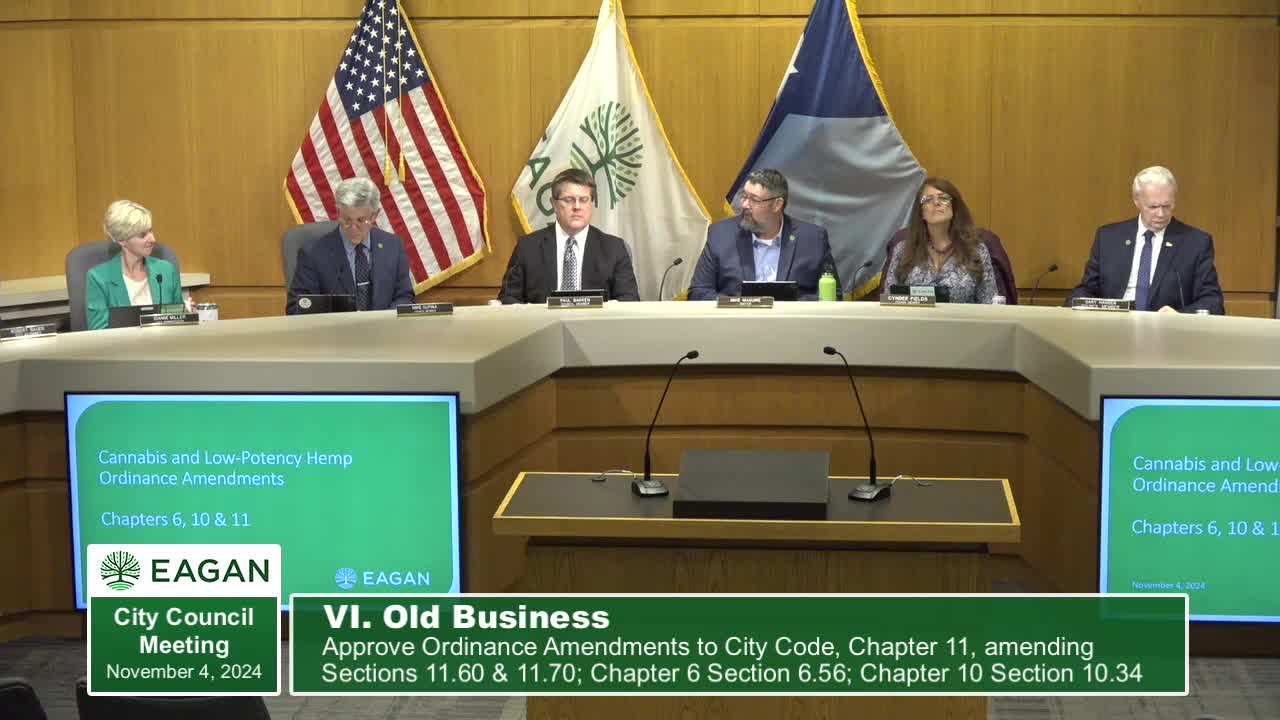
Eagan adopts zoning, registration rules for adult-use cannabis and low‑potency hemp
Summary
The Eagan City Council on a unanimous voice vote adopted ordinance amendments establishing zoning, registration and performance rules for adult‑use cannabis and low‑potency hemp businesses, including a local cap and separation rules, and directed staff to include attorney‑recommended clarifications.
The Eagan City Council on a unanimous voice vote adopted multiple ordinance amendments that establish zoning, registration and performance standards for adult‑use cannabis and low‑potency hemp retail businesses, production uses and temporary cannabis events.
City staff said the changes implement state law enacted after the statewide legalization of adult‑use cannabis and give the city local controls for time, place and manner of operations. The adopted package amends chapter 11 (sections 11.6 and 11.7), adds section 6.56 to chapter 6 to set registration requirements, and revises chapter 10 (section 10.34) related to drug paraphernalia.
City staff and the planning commission spent months drafting the language to follow the Office of Cannabis Management rules and state statute, said city planner Schultz. "The State allows, for cities to, limit the time, place, and manner with reasonable restrictions," he said, describing the legal framework that guided the ordinance.
Under the ordinance the city will: - Allow retail adult‑use cannabis businesses as permitted uses in general retail commercial zones and permit cultivation, production, manufacturing, testing, wholesaling and transport in specified industrial zones (I‑1, I‑2, Research & Development and Business Park or appropriate planned developments). - Set a local cap on standalone retail operations consistent with state guidance but at a higher initial local cap than the statutory 1 per 12,500 residents: the ordinance authorizes five standalone retail licenses in commercial zones plus three retail endorsements tied to micro/meso/medical combination businesses for a total of eight retail endorsements initially. - Require registration (and renewal) of both cannabis and hemp retailers with local fees, verification, compliance checks and suspension provisions under chapter 6. - Require 350 feet separation between one adult‑use retail cannabis business and another (measured wall‑to‑wall) but not impose new buffer distances from schools, day cares, park attractions or residential treatment facilities because the city currently does not impose equivalent buffers for alcohol or tobacco. - Permit temporary cannabis events in commercial and industrial zones consistent with state limits (up to four days), require organizers to submit a time/location/layout plan and prohibit outdoor consumption areas in commercial zones (limited to I‑1 and I‑2 if permitted locally). - Allow outdoor commercial cultivation only where permitted by zoning (agricultural or by conditional use permit in I‑1/I‑2) and require security, screening, odor control consistent with MPCA guidance and other state/OCP rules where applicable.
The ordinance package also includes updates recognizing low‑potency hemp products and aligns the city definition of paraphernalia with state law. City staff also provided a supplemental memo with attorney‑recommended clarifications; the council included that memo language in its motion.
Mayor and council members repeatedly framed the ordinance as an initial regulatory framework that the city will revisit as the local market develops and the Office of Cannabis Management (OCM) issues licenses. The council noted the city moratorium on accepting certain cannabis applications will expire Jan. 1; the ordinance takes effect upon publication and will coordinate with that timeline.
Councilors and staff said the rules attempt to balance business activity, public safety and neighborhood impacts while leaving room to adjust caps and details after the first local licensees operate. The motion to adopt the ordinance passed on a voice vote.
Looking ahead, city staff said it will post an FAQ for the public, implement the registration process and monitor OCM license timing and state rule clarifications.