
Wonder Group seeks amended site-plan approval in Cranford for cold storage, MAP gas tanks and refuse enclosure
Get AI-powered insights, summaries, and transcripts
Subscribe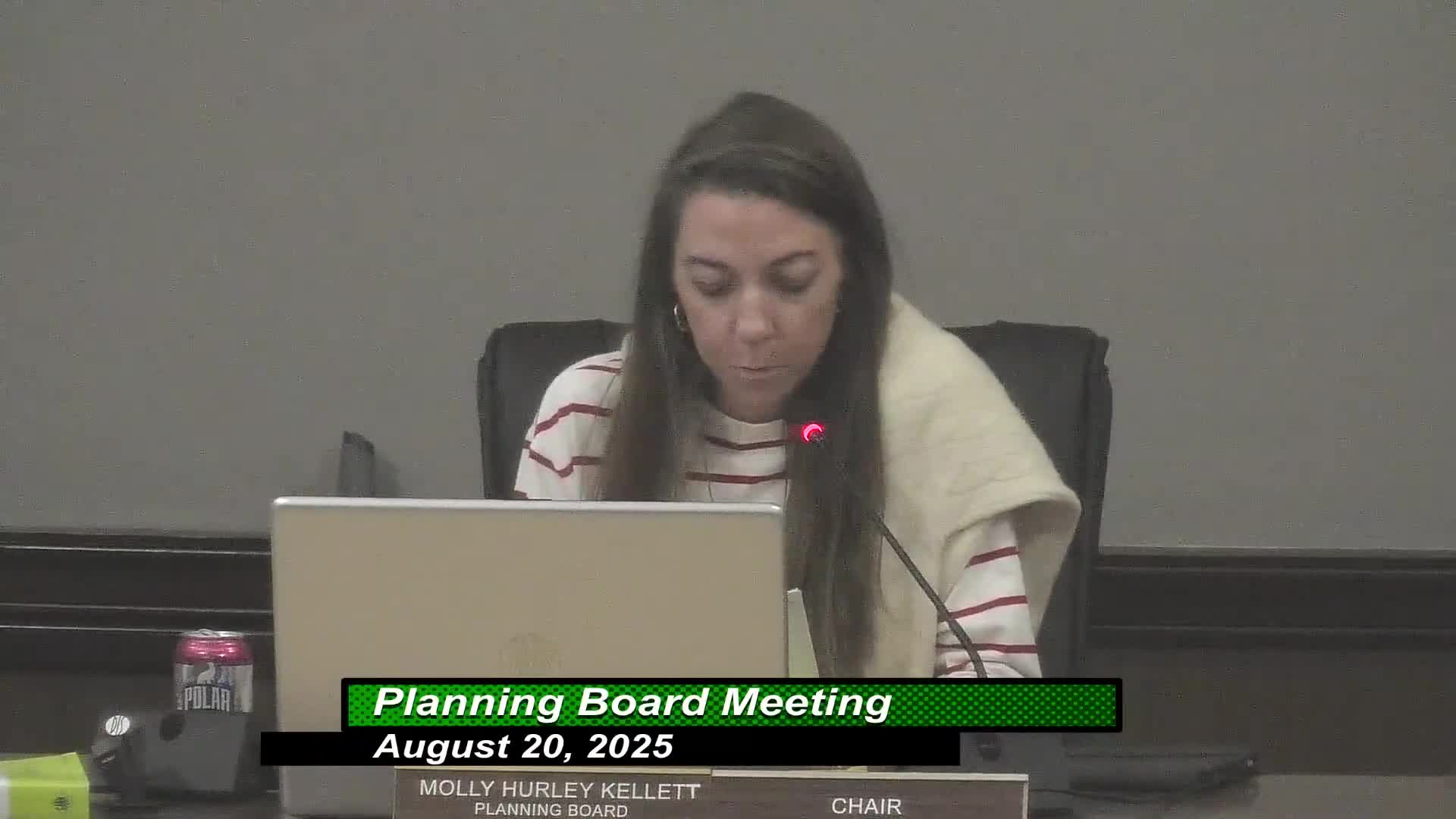
Summary
At a Planning Board hearing Aug. 20, Wonder Group Inc. presented amendments to its 2019/2020 approval for the former Nuts.com site, proposing permanent cold-storage trailers, two modified-atmosphere packaging (MAP) gas tanks and a new refuse enclosure; no vote was taken.
At a Planning Board hearing Aug. 20 in Cranford, N.J., Wonder Group Inc. sought amended site-plan approval for its facility at 442 Jackson Drive and 670 Riordan Road (Block 640, Lots 6, 0.012 and 3 in the C-1 zone), proposing a refuse enclosure, three permanent cold-storage trailers and two modified-atmosphere packaging gas tanks. The board took testimony but did not vote.
The application — listed in the meeting materials as PB24-2 — was introduced by Steven Hale, attorney for the applicant, who summarized the changes before the board. Hale said the proposed changes are intended to support Wonder’s shift in operations and to address issues raised by residents during prior meetings.
Jason Bottcher, associate director at Wonder, described how the company’s business model has changed since the board first approved the site in 2019 and again in 2020. “We scrapped that model, in its entirety, and we moved to traditional brick and mortar,” Bottcher said, and added that the site was originally configured to support delivery vehicles and on-site staging for food trucks. He told the board that Wonder has grown from no brick-and-mortar locations to about 58 locations to date and expects roughly 90 by the end of October.
Bottcher told the board the proposed work has three main components: the installation of two MAP gas tanks used for reduced-oxygen packaging for shelf-life extension; a refuse enclosure and conversion to compactors serving the facility; and added cold-storage capacity in the form of three permanent trailers. “Map gas is modified atmosphere packaging. Essentially, it’s for reduced oxygen packaging. It extends shelf life, and reduces bacterial growth in, for food products,” Bottcher said. He also said switching from multiple 8-yard dumpsters to compactors should reduce some of the noise complaints the board heard at a prior meeting.
Victor Venegra, principal with Harbour Consultants, and William Tyler Sandlass, architect of record with Mancini Duffy, were presented as the applicant’s engineering/planning and architectural witnesses, respectively. Both were sworn and identified for the record; board professionals including Nicholas Dickerson (board planning expert) and Kevin Boyer (board engineer) were present to question witnesses later in the hearing.
Hale and witnesses described how the site was originally laid out with oversized parking stalls and low loading bays designed to accommodate Mercedes Sprinter vans used for the earlier delivery model. Bottcher said those low bays are not conventional loading docks for box trucks or trailers and that the operation at the site is now “purely a food manufacturing facility,” with most activity moved indoors.
The application materials presented at the start of the hearing describe a 30-by-60-foot refuse enclosure, three permanent cold-storage trailers, two MAP gas tanks on a concrete pad with chain-link fencing and 11 bollards. During testimony, a witness also referred to a “30-by-30” structure to partially enclose three 40-foot freezer trailers; the board’s professionals will need to reconcile and confirm actual dimensions as the hearing proceeds.
No formal motions or votes were recorded in the portion of the hearing captured in the transcript. The chair outlined the hearing process at the outset: applicant testimony, questioning by board professionals and board members, public questioning limited to five minutes per person, applicant summation (if any), public comment, then board deliberation and a vote when the hearing is closed.
The board scheduled additional questioning by its professionals; the record in the transcript ends during the applicant’s initial testimony. Additional public testimony, professional review and board deliberations were indicated as the next steps in the hearing process.