Get Full Government Meeting Transcripts, Videos, & Alerts Forever!
Get email alerts on the Education Charter Schools topic
No spam. Unsubscribe anytime.
Proposed Unidos Soccer Leadership Academy pitches 50/50 dual-language, soccer-focused school to TEA
Summary
Applicants told the Texas Education Agency panel their Unidos Soccer Leadership Academy would combine a 50/50 Spanish–English dual-language academic model with daily soccer training, extended instructional minutes and an emphasis on student wellness; TEA staff probed assessments, instructional minutes and special-population supports.
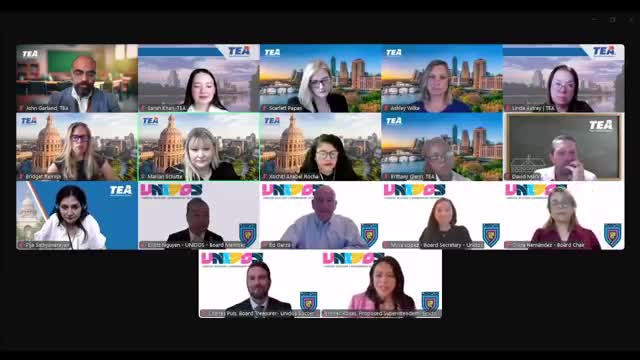
The Texas Education Agency interviewed Unidos Soccer Leadership Academy on May 15 as the applicant team outlined a 50/50 Spanish–English dual-language secondary school that integrates daily soccer sessions with academics.
Proposed superintendent Jennifer Rosas told the panel the school is “first and foremost a school, a place to educate children and prepare them for life beyond K‑twelve education,” and said soccer would be used as a vehicle to increase engagement and leadership.
The application seeks to serve grades 6–12 on one campus and proposes a year‑round calendar designed to meet the agency’s operational‑minute requirements. Rosas said the model “exceeds the state's minimum requirements of 75,600 instructional minutes through a modified academic calendar, a daily schedule emphasizing physical activity to enhance focus and stimulate learning, and instruction in mental and physical health and wellness.”
Unidos’ academic plan centers on a “50/50 dual language model” that the board chair, Olivia Hernandez, described as alternating language instruction by unit for core subjects and auditing implementation annually with the Texas Effective Dual Language Immersion framework. The team said math, science and social studies would alternate language by unit and that every student would take both Spanish language arts and English language arts each year.
On assessments, the applicant said state and internal measures would be used: standard state assessments and TELPAS for English-language proficiency plus Spanish literacy measures (referred to in the interview as LAS links) to track biliteracy. Rosas said teachers would use curriculum‑aligned formative checks and quarterly benchmarks to monitor progress and to guide interventions.
The applicants said professional development would begin with a Strong Start and weekly 90‑minute PLCs to internalize high‑quality instructional materials in both languages. The team named Bluebonnet (Spanish) and supplemental Spanish materials aligned to the chosen HKIMs as part of their planned resources.
Student wellness and daily “prime time” were emphasized as intentional design elements. Jennifer Rosas said the morning block would combine nutrition, leadership and movement to support attendance and engagement; the applicants told TEA they intend regular student surveys and quarterly data reviews to adjust supports.
TEA staff asked how the board would monitor performance; board members said they would review KPIs and student‑performance data monthly and increase monitoring, professional support or coaching if interim goals were not met.
The interview closed with TEA staff and State Board of Education members noting next steps: TEA will forward a commissioner recommendation to the State Board of Education, and applicants will be notified of the commissioner's proposal by May 28.