Get Full Government Meeting Transcripts, Videos, & Alerts Forever!
Get email alerts on the Secondary Curriculum topic
No spam. Unsubscribe anytime.
Board amends required secondary curriculum: adds CTE and advanced options as selectable science credits, directs staff to clarify formatting
Summary
The board revised 19 TAC §74.3 to clarify science‑credit options and to add engineering CTE courses (e.g., fluid mechanics and mechanics of materials) to the list of selectable advanced science credits districts may use to satisfy two additional required science credits.
The board revised the description of the required secondary curriculum (19 TAC §74.3) to make clear how districts satisfy high‑school science offerings. Under the adopted language, all districts must continue to make IPC (integrated physics and chemistry) or biology, chemistry and physics available, and districts must offer at least two additional advanced‑science options that are chosen from an approved list. The board took steps to make the rule read as a set of selectable options rather than a single, monolithic list that a district would be interpreted to have to offer in its entirety.
Key changes adopted in the meeting: the chair and members agreed a formatting change was needed to make the list more readable and to remove ambiguity that prompted public comment. The board added — as selectable options that districts may use to satisfy the two additional science credits — engineering‑related CTE courses discussed earlier in the agenda (staff added fluid mechanics and mechanics of materials and related course language discussed as part of the engineering TEKS package). A motion also replaced an explicit list of AP course titles with broader language referencing “advanced‑level” science offerings and allowed dual‑credit courses that meet the relevant TEA dual‑credit guidance to satisfy the requirement; staff said districts must ensure dual‑credit offerings align to the TEKS the district claims for credit.
Why it matters: the change clarifies that districts have options when completing the two additional advanced science credits that are part of the state’s required curriculum. Board members said the revision should reduce misinterpretation and reduce the appearance that the board was mandating every listed AP or other advanced course. Several board members had raised public comments: teachers and small‑district leaders had asked for clarity that the section does not impose an undue offering burden on small districts.
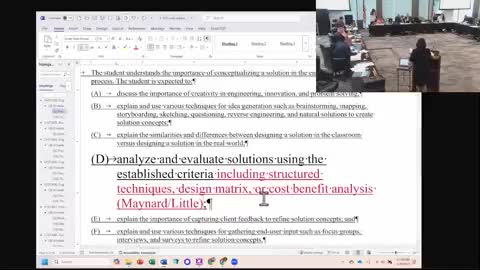
Board direction to staff: board members asked TEA to reformat the rule text into clearer sub‑items (romanettes) and to return consolidated text for final printing. Staff also agreed to provide members with the statutory cross‑references for dual‑credit and AP/IB acceptance so districts and counselors can interpret the rule for scheduling and graduation checks.
Votes and next steps: the committee’s recommendation and the conforming amendments were adopted during the meeting. TEA staff will provide the reformatted rule language and publish the final adopted language to be effective for the 2025‑26 school year.