Get Full Government Meeting Transcripts, Videos, & Alerts Forever!
Commissioner Morath details TEA process for educator-misconduct complaints, do-not-hire registry and limits on action for uncertified staff
Summary
Commissioner Morath briefed the State Board on how the Texas Education Agency (TEA) and the State Board for Educator Certification (SBEC) handle complaints, criminal-history hits, investigations and the do-not-hire registry. He stressed legal limits on state action for non‑certified employees and described intake, review and enforcement steps.
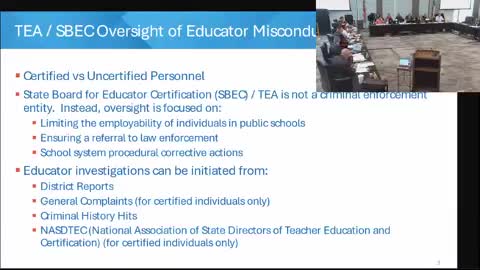
Commissioner Morath told the board that TEA receives thousands of reports and criminal-history “hits” concerning public-school employees and that the agency’s role is regulatory — to decide whether a person should be allowed to work in Texas public schools. He said TEA has received an elevated volume of inbound information from districts, DPS criminal-data feeds and public complaints and has a new parent-complaint navigator on its website to help people route concerns to the right place.
Morath, speaking during the committee of the full board, emphasized a legal bifurcation that matters for how allegations are handled: certified educators fall under the State Board for Educator Certification (SBEC) and TEA enforcement processes; non‑certified employees (including many bus drivers, custodial staff and an increasing share of first‑year classroom hires) are not subject to SBEC’s full disciplinary authority. “There’s SBEC that oversees all certified personnel in the state of Texas and then there’s non‑certified employees who are not under the oversight of SBEC,” Morath said. He described the practical consequence: non‑certified employees are not automatically removable from statewide employment lists unless narrow statutory triggers are met (for example, convictions that fall within specific…
Already have an account? Log in
Subscribe to keep reading
Unlock the rest of this article — and every article on Citizen Portal.
- Unlimited articles
- AI-powered breakdowns of topics, speakers, decisions, and budgets
- Instant alerts when your location has a new meeting
- Follow topics and more locations
- 1,000 AI Insights / month, plus AI Chat