
State Board adopts new social‑studies strand structure and a two‑year capstone after heated public debate
Get AI-powered insights, summaries, and transcripts
Subscribe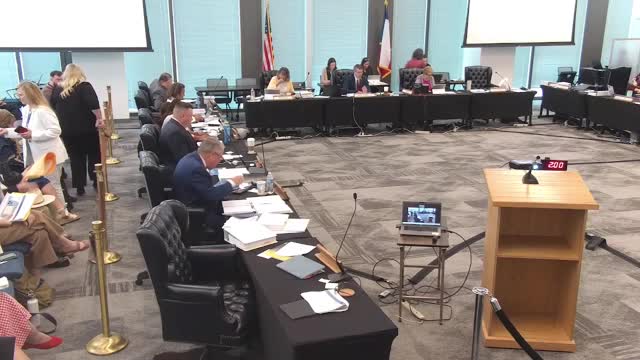
Summary
The State Board of Education adopted a reworked strand structure (Proposal C) and a separate K–8 course sequence (Option D2) on Sept. 10 after hours of public testimony and debate over chronology, Texas history and whether a stand‑alone sixth‑grade world cultures course should remain.
The State Board of Education adopted a reworked set of social‑studies strands and a separate course sequence on Sept. 10 after an extensive public hearing that drew scholars, teachers, parents and students.
The board approved the ad hoc committee’s Strands Proposal C — a streamlined set of social‑studies strands — and separately adopted a course sequence later described at the meeting as Option D2. Members voted to substitute Proposal C for the committee’s earlier recommendation and then approved the D2 sequence by roll call.
Why it matters: The strands decision narrows and reorganizes the major social‑studies categories the state will use while the adopted course sequence determines when students study Texas, U.S. and world history in K–8. That sequence and the strand labels will guide the next phase of work: drafting grade‑level student expectations (TEKS) and the curriculum districts will teach in classrooms.
Most important facts first — what the board did and how it voted
- Strands: The board substituted Strands Proposal C in place of the committee’s earlier list and approved it by voice/hand vote (final recorded support shown in the meeting record). Vice Chair Little offered the substitute. The board vote approved the substitute after debate.
- Course sequence: After hours of public testimony and deliberation the board adopted a course sequence labeled at the meeting as Option D2 (a variant discussed in the hearing). Member Brooks offered the substitute that became D2; the motion passed on the floor by recorded vote.
Context and the dispute
Board members and public testifiers split over two central issues: (1) chronology and whether a single continuous historical arc (a “comprehensive” model presented as Option C by many speakers) gives students stronger background knowledge, and (2) whether Texas history should be taught as a dedicated, stand‑alone experience at a single grade (the traditional capstone approach) or should recur across multiple grades.
Supporters of the comprehensive, chronological approach argued it builds “layered” knowledge over time. Jonathan Butcher of the Heritage Foundation told the board the proposal “accomplishes the crucial task of training young minds to be civil and fluent in civics.” Claudia McMillan, of the McMillan Institute, said a chronological, story‑based sequence “cultivates sturdy souls for the ongoing work of building and sustaining a culture in Texas.” Dawn Frazier, a member of the 1836 Project, argued the plan “culminates in a capstone year that gives a Texas lens to the entire human story.”
Opponents — including many classroom teachers and representatives of the Texas Council for the Social Studies — said the largest risk is pushing complex world history topics into early elementary grades and eroding a dedicated geography/world cultures course for sixth grade. In a written and oral submission, the Texas Council for the Social Studies said 77 percent of educators who responded to the council’s internal comparison surveys preferred a sequence it labeled Option D because it preserved standalone world cultures and a clearer, developmentally appropriate flow.
What the adopted strands and sequence mean for classrooms
- Strands (Proposal C): The board narrowed the official state strands to a compact set that will guide the TEKS drafting teams. The new list focuses the state’s learning domains and is intended to reduce overlap across grade levels; it also retains culture and civic strands in forms the board approved.
- Course sequence (D2): The adopted sequence keeps a prominent role for Texas history in elementary grades and places a multi‑year, integrated treatment of U.S. and Texas history in later middle school grades (the legal text and the TEKS that instructors use will be drafted and returned for first‑ and second‑reading votes). Board members described the D2 choice as a compromise meant to preserve a stand‑alone Texas presence while addressing concerns about developmental readiness and geography.
Public testimony and who pushed what
More than 40 invited and public witnesses testified. They included scholars, advocacy groups and parents. Representative excerpts included: - "The proposed comprehensive curricular framework accomplishes the crucial task of training young minds to be civil and fluent in civics," Jonathan Butcher (heritage researcher). - "The logic of the chronological historical sequencing…makes option C the best way to provide all public school students in Texas with a quality of learning," Claudia McMillan (McMillan Institute). - "We must oppose any framework that dilutes or diminishes Texas and American history," testified Amy Bungeus (parent and former school trustee). - A seventh‑grade student testified, “Please do not take [world cultures] away. Learning about other cultures teaches me what life is like elsewhere and makes me grateful.”
Next steps and what to watch for
- Draft TEKS: Boards’ decisions on strands and sequence set the guardrails for multi‑month rule writing. Work groups and content advisers will draft the grade‑level TEKS next; those TEKS will be offered for public comment and returned to the board for formal first‑ and second‑reading votes.
- Materials and implementation: Local districts choose curricula and materials to implement the TEKS. The board’s choices will affect what districts include in future adoption cycles and may reshape teacher professional development priorities.
Ending note: The board made two distinct choices — a new, streamlined set of strands and a different K–8 sequence — after an unusually long day of testimony by academics, parents and students. Those decisions now shift the debate to rule writers and teachers who will translate the frame into grade‑by‑grade student expectations and classroom practice.