Get Full Government Meeting Transcripts, Videos, & Alerts Forever!
Get email alerts on the Student Policies topic
No spam. Unsubscribe anytime.
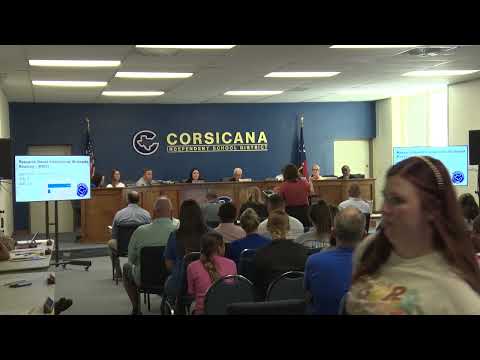
Corsicana ISD adopts districtwide ban on personal communication devices; updates code of conduct and employee handbook
Summary
The board approved an FNCE policy banning student personal devices during instructional hours to comply with Texas House Bill 1481, updated the student code of conduct and employee handbook, and approved T-TESS appraisers and an athletic policy affecting private- and home‑schooled students.
Corsicana ISD trustees on Aug. 4 adopted a district policy (FNCE) prohibiting student use of personal communication devices during the instructional day and on school property, effective Aug. 13, 2025, to ensure compliance with Texas House Bill 1481. At the same meeting the board approved updates to the student code of conduct and the 2025–26 employee handbook, and voted to accept the 2025–26 T-TESS appraiser list and a new athletic policy regarding private‑ and home‑school participation.
The cell‑phone policy defines "personal communication devices" broadly to include cell phones, smartwatches, tablets, laptops, earbuds and similar items and requires students to keep devices secured in backpacks and not on their person during the instructional day. Use is prohibited during passing periods and lunch and the restriction applies from the morning school bell until the final bell. Students may use devices before school and after the last instructional bell. The policy includes exceptions for students with IEPs or 504 plans that specify device access, for medical needs with physician documentation, and for situations in which a school administrator grants permission for safety or legal reasons; school-issued devices used for instruction are permitted.
The district presented a three‑step response for violations: first violation — device confiscated and returned to student after school; second violation — device held and returned only to a parent at a meeting with administration; third violation — continued confiscation with individualized disciplinary placement (district staff described the third‑offense discipline as individualized rather than a fixed sequence). The board approved the policy by voice vote.
Board members also approved updates to the student code of conduct. Key changes the administration highlighted include the removal of a three‑day limit on consecutive ISS (in-school suspension) placements; new discretionary authority to use out‑of‑school suspension for students in third grade and younger where applicable; a 10‑day minimum ISS requirement tied to nicotine-related violations while DAEP (disciplinary alternative education program) placement remains mandatory for vapes containing THC or for certain other offenses; and explicit authorization to offer the district virtual program (Edgenuity) while a student is expelled. During discussion a trustee asked whether off‑campus arrests could lead to discipline; the administration answered that Title 5 disciplinary provisions can apply to off‑campus conduct.
The board approved the 2025–26 employee handbook, which the administration said incorporates changes including shortening the public notice requirement for board meetings from 72 hours to "three business days," additions related to mental‑health training required under House Bill 3, optional language on artificial‑intelligence use and updates tied to Senate Bill 571 addressing misconduct reporting and the "do not hire" registry.
Trustees also approved the annual T‑TESS appraiser list for 2025–26 and adopted an athletic policy that states students enrolled in a private school or homeschool shall not be eligible for concurrent enrollment in the district or for participation in district curricular or extracurricular activities.
"Students may bring their device to school with them; we're going to ask that those devices be stored away securely in backpacks, not on their person," the district presenter said while explaining the FNCE policy and exceptions.
All policy votes were approved by voice vote; the public transcript does not show a roll-call tally by individual trustee names for these motions.