Get Full Government Meeting Transcripts, Videos, & Alerts Forever!
Get email alerts on the Public Land Access topic
No spam. Unsubscribe anytime.
Corner‑crossing debate deepens as committee hears opposing views; Supreme Court petition pending
Summary
The TRW committee heard hours of pro and con testimony on a draft that would make corner crossing between adjacent public parcels not criminal trespass if done without damaging adjacent private land.
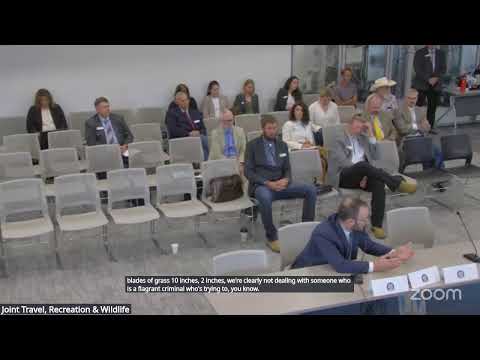
CHEYENNE, Aug. 19 — The Joint Travel, Recreation, Wildlife & Cultural Resources Committee spent the afternoon on a contentious issue that has captured national attention: whether a person who moves from one government‑owned parcel to an adjacent government parcel at the point where the boundaries meet — a “corner cross” — should be exempt from criminal trespass.
LSO staff summarized the draft bill as a narrowly framed change to state law: the draft would add a provision to the criminal trespass statute (Title 6) and the Game and Fish trespass statute (Title 23) providing that travel from one public parcel to an adjacent public parcel at the corner where they meet, without causing damage to any privately owned land adjacent to those parcels, would not constitute criminal trespass. Brian Fuller explained the proposal during the meeting and noted that a related federal case is pending before the U.S. Supreme Court.
“On July 16 the landowner filed a petition for a writ of certiorari to the U.S. Supreme Court,” Fuller said. He added the hunters who prevailed in the Tenth Circuit had until Sept. 17, 2025, to file a response to that petition; if the court grants review, the schedule could extend into the next term.
Backcountry Hunters and Anglers and other outdoor groups urged the committee to adopt a statutory safe harbor so that hunters and recreators following modern mapping tools do not face criminal prosecution when they cross a corner to access public lands. “The lack of a monument should not be used to prevent access to public land,” Sabrina King of Backcountry Hunters and Anglers told lawmakers.
Attorney Ryan Semerad, who represented the hunters in prior litigation, told the committee the main benefit of the draft is practical: removing the prospect of criminal prosecution and the high cost to local law enforcement for resolving minute boundary questions. Semerad described the local enforcement burden in one case that resulted in multiple calls, a multi‑day investigation and a three‑day jury trial.
Opponents, including the Wyoming Farm Bureau and Wyoming Stock Growers, urged caution. Brett Moline of Farm Bureau said a narrow criminal‑trespass carve‑out risks escalating damage over time if many people access small corners on private property to reach public parcels. Wyoming Stock Growers counsel said the issue is premature while the Supreme Court considers whether federal law (the Unlawful Enclosures Act) preempts state trespass enforcement in these circumstances.
Key sticking points in committee discussion included these legal details: how to define the relevant “corner” (a historic survey monument installed by the USGS vs. a modern GPS estimate), whether the bill’s word “authorized” requires affirmative permission or simply that no prohibition exists, and whether the statute should say “without touching” private land (a phrase used in court opinions) rather than “without causing damage.” Several members asked for clearer definitions and flagged heavy enforcement burdens for sheriffs and wardens if the language remained ambiguous.
Committee members did not vote on the draft. Instead they held extended testimony and recessed for an hour for lunch; they said they will revisit the issue in November after further legal analysis and possible redrafting. Several stakeholders asked the committee to wait for the Supreme Court’s action, which could clarify the federal‑law background and narrow the statutory choices the legislature faces.
What’s next: The committee paused consideration and scheduled further work. The timing of the U.S. Supreme Court’s decision on whether to accept review will affect any Wyoming statutory approach.
Sources: Brian Fuller (LSO); testimony from Sabrina King (Backcountry Hunters and Anglers), Ryan Semerad (attorney for hunters), Brett Moline (Wyoming Farm Bureau) and counsel for Wyoming Stock Growers.