Get Full Government Meeting Transcripts, Videos, & Alerts Forever!
Get email alerts on the Sbcc Economic Impact Process topic
No spam. Unsubscribe anytime.
Builders and trade groups tell SBCC economic-impact statements lack consistent data; staff outlines deadlines and third-party analysis timeline
Summary
At a State Building Code Council listening session, trade groups and subject-matter experts told staff that many proposals lack complete small-business economic impact statements and consistent cost-benefit inputs; staff outlined CR-102 and comment deadlines and a third-party analysis schedule.
Multiple participants at the State Building Code Council hearing urged staff to strengthen the council’s economic-impact work and to obtain consistent, third-party modeling to support the forthcoming CR-102 filing. Greg Johnson and Patrick Hanks (Building Industry Association of Washington) told the council they had reviewed proposal materials and found many petitions and the integrated draft lacking comprehensive small-business economic-impact information and consistent cost-benefit inputs.
Patrick Hanks said the quality of estimates provided with proposals varied widely; some proponents hired third-party modelers while others provided limited or no modeling. Hanks and other builders asked the council to collect quantitative data from affected businesses, noting that qualitative listening-session testimony is helpful but insufficient for formal impact statements. Hanks also warned that changes affecting heating-fuel choice could raise construction and operational costs at a time when housing affordability is already constrained.
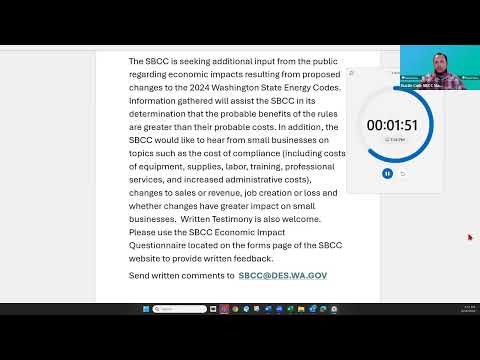
Staff and council members described the schedule and next steps. Todd Bradford and Dustin (staff) said the CR-102 filing is planned and that staff would like written comments in advance of a work-group economic-impact meeting: requested by end of business Friday to inform a September meeting and with the formal comment period remaining open through November 7 at 5 p.m. Council staff stated a contracted third-party cost-benefit analysis would provide preliminary results in mid-November and a final report prior to the council’s anticipated final-adoption action in early December (CR-103 filing and adoption timeline). Council members noted the practical constraints of short notice and multiple code changes and invited stakeholders to submit written questionnaires and data.
No agency decisions were made at the listening session. Staff said they will compile submitted written testimony and the third-party analysis and present those materials to the economic-impact work group and the council for deliberation during the CR-102/CR-103 rulemaking steps.