Get Full Government Meeting Transcripts, Videos, & Alerts Forever!
Get email alerts on the Masonry Mass Wall topic
No spam. Unsubscribe anytime.
Masonry trade urges council to reject proposal that would remove CMU mass-wall exception
Summary
Representatives of the Masonry Institute of Washington told the State Building Code Council listening session the proposed removal of the integrally insulated concrete masonry unit (CMU) mass-wall exception (proposal 264) would harm small masonry contractors and not deliver promised energy benefits.
Chair Todd Bradford called the State Building Code Council listening session to collect oral testimony on economic impacts of proposed changes to the 2024 Washington State energy code. Adam Hutchinson of the Masonry Institute of Washington and contractor Jed Olofson told council members they oppose proposal 264, which would eliminate the CMU (concrete masonry unit) mass-wall exception.
Hutchinson said the institute’s members are small masonry contractors and union labor who build concrete masonry wall systems for commercial buildings statewide, and he told the council “we are here today to oppose proposal 264.” He said removing the exception would “badly hurt our industry, and it wouldn't deliver the energy benefits that it's claiming to.” He added that the existing Washington-specific amendment — in place through multiple code cycles since 2005 — recognizes masonry’s thermal mass, durability and fire resistance and remains cost effective in Washington’s climate.
The testimony stressed economic impacts for small businesses: Hutchinson said the Masonry Institute of Washington itself employs three people and represents many small masonry contractors in western Washington. Olofson, owner of Johnston Construction Company and a board member of the Masonry Institute of Washington, told the council the change would “drive up construction costs without delivering measurable energy savings to the building owner,” force added framing and finishes, and reduce work for masons on the limited building types that currently qualify for the exception (retail, warehouses, gymnasiums, water treatment facilities, motor vehicle service centers).
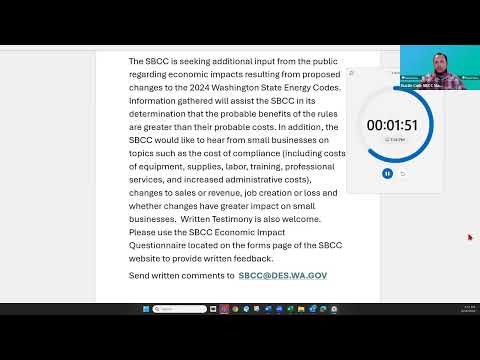
Council members asked for clarification about small-business impacts and the specific proposal number. Hutchinson and Olofson repeated that they could not provide precise job-loss numbers on the spot and offered to provide additional data if requested. The council’s staff and members said written testimony and the SBCC economic impact questionnaire could be used to add details for the cost-benefit and small-business economic impact statements the council must compile under the Administrative Procedure Act and the Regulatory Fairness Act.
This hearing was a listening session, not a vote. No formal action was taken on proposal 264 during the meeting. Council members and staff repeatedly described the process steps ahead: staff will accept written comments, compile impact information and use it to inform the council’s CR-102 filing and subsequent rulemaking deliberations.
Those who testified urged the council to preserve the existing, Washington-specific CMU mass-wall language, arguing both technical building-performance reasons and potential harms to small masonry businesses if the prescriptive path were removed. The speakers noted the continued lack of some compliance tools in Washington and said the prescriptive path is relied on by designers to move projects forward. The council encouraged submitters to provide written and quantified data to inform the required economic analyses.