
Paysomatic representatives tell Pampa commission devices are games of skill; some commissioners call them gambling
Get AI-powered insights, summaries, and transcripts
Subscribe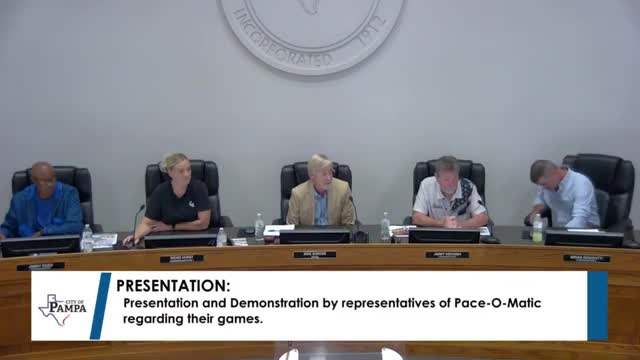
Summary
Company representatives told the Pampa City Commission that their gaming terminals are “games of skill,” cited court rulings and described compliance steps and revenue splits. Commissioners asked about payouts, community impacts and whether machines attract crime; no formal policy decision was made.
PAMPA, Texas — Representatives of Paysomatic told the Pampa City Commission on Aug. 11 that the company’s coin-operated gaming terminals are legal “games of skill,” not gambling devices, and asked the city to permit vetted machines at willing local businesses.
The company said the devices include accounting software, age-verification features and an internal compliance team of retired Texas peace officers; they described a franchise-style contract that splits net revenue roughly three ways among the location, the operator and the manufacturer.
Why it matters: The city’s decision about whether to allow the terminals affects convenience stores, truck stops and other small businesses that might host them, and touches on crime, consumer protection and local tax revenue.
Edward Campbell, identifying himself as Paysomatic’s chief compliance officer, described the machines to the commission and said the company vets both operators and locations and will remove games if law enforcement raises concerns. “We have a dedicated compliance team that goes around and makes sure the games are operating like they’re supposed to be operating,” Campbell said.
Campbell and other company witnesses, including Matt Powell (a former elected district attorney), repeatedly told commissioners the machines are legally distinct from so-called “8-liner” operations because, they said, the terminals allow skilled players to inspect puzzles before betting, the software records every dollar in and out, and a portion of plays can be converted to a follow-up sequence that the company described as guaranteeing a 105% win of what the player paid on that sequence if played optimally. Campbell described a top prize example on one play level as $2,000.
Powell, who identified himself as a prosecutor for nearly 30 years and later as the elected district attorney in Lubbock, said he had reviewed the device and legal challenges. “If I thought this was illegal gambling, then we would not be here,” Powell said.
Company officials gave additional operational details: a three-way contract split (35% to the location, 35% to the operator who services machines, and about 30% to the manufacturer), operators that are independently contracted and vetted by the company, typical limits of five machines per standard convenience location (more in some large truck stops), and five-year location agreements. They said operators do not have access to internal accounting or payout programming inside the terminals.
Commissioners pressed the presenters on community impacts, payout mechanics and whether the terminals draw criminal activity. One commissioner said, “to me, I think you can have terminology that separates the two, but the moral of the story is, at the end of the day, it’s a gambling game. My opinion.” Another commissioner asked whether the company would respect a local decision not to accept machines; presenters said they would convey local concerns to the company owner and that historically they have respected local refusals.
Company witnesses pointed to a contested forfeiture hearing in Fannin County and an appellate decision they described as favorable, saying courts had found these terminals to be games of skill in at least one contested case. They also said independent mathematicians and engineers had analyzed the devices’ mechanics.
No ordinance, license or local policy was proposed or approved at the meeting. The presentation concluded with company representatives taking questions and saying they would not place machines in a city that affirmatively rejects them; presenters also said there were no Paysomatic machines currently operating in Pampa at the time of the meeting.
The commission did not take formal action on the devices at the Aug. 11 meeting; company representatives were told the city would consider any future requests and that staff and commissioners would continue to ask questions and gather information.