
NVCOG launches regional Vision Zero action plan tied to federal Safe Streets funding
Get AI-powered insights, summaries, and transcripts
Subscribe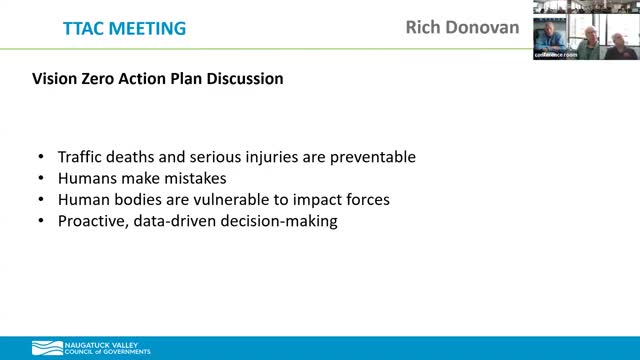
Summary
Naugatuck Valley Council of Governments staff briefed TTAC members on a regional Vision Zero safety action plan funded through USDOT’s Safe Streets for All (SS4A) grant; outreach, data-driven crash analysis and automated enforcement will be part of the five-year strategy.
Rich Donovan, transportation planning director at the Naugatuck Valley Council of Governments (NVCOG), told the Transportation Technical Advisory Committee that NVCOG is developing a regional Vision Zero transportation safety action plan funded through a U.S. Department of Transportation Safe Streets for All (SS4A) planning grant.
The plan will be developed in-house, Donovan said, with draft materials shared at the next TTAC meeting, a full draft expected by December, a public comment period in early spring, and a final plan targeted for completion by March. "Very importantly about this plan, it is the document that will allow you all to submit for any future Safe Streets implementation rounds," Donovan said, noting projects not included in the plan are technically ineligible for that federal implementation funding.
NVCOG staff emphasized the plan will be data-driven and action-oriented. It will identify the region’s top crash locations through crash history and additional local data — including near-miss locations reported by police and municipal staff — and will add implementation elements even where specific projects are not yet defined. Donovan said the strategy looks at roughly a five-year implementation window, with periodic updates and a process to adopt and report safety performance targets for the MPO region. He reminded members that the Vision Zero goal adopted in September 2022 set an aspirational target of eliminating fatalities and serious injuries by 2060, and the plan will calculate the annual reductions needed to reach that long-term goal.
Nicole Sullivan, sustainable communities planner at NVCOG, said NVCOG is scheduling interviews with local traffic authorities and others who know community hotspots; "At this time, 13 of 19 municipalities have interviews scheduled," she said, and staff will contact the remaining towns this month to complete the baseline outreach. Sullivan said NVCOG will carry forward projects from the 2022 regional transportation safety action plan that remain unimplemented.
Committee members discussed community acceptance and the political challenges of some countermeasures. A public-works director from Bristol described the local experience communicating incremental bike-lane and roadway narrowing projects on social media and pledged to continue outreach and data collection. Donovan and other staff noted automated enforcement (speed and red-light cameras), signal timing changes, sidewalk-gap programs, signage updates, and systemic countermeasures will be included in the plan. Donovan said automated enforcement is likely necessary to meet the Vision Zero goal and that federal and state funding mechanisms can help towns implement cameras and related systems.
NVCOG staff also offered support services tied to the plan: pedestrian and traffic data collection upon request, road safety audits (RSAs) and training, and an interview process to gather police, public works and other local input. Donovan asked municipalities to identify local priorities early so they can be included in the implementation list.
The committee did not take a formal action on the plan at the meeting; staff requested continued input and scheduled follow-up materials for the next TTAC meeting.
NVCOG staff contact information and a link for municipalities to request data collection will be circulated to TTAC members ahead of upcoming outreach meetings.