
Oak Harbor advisory board backs pallet-shelter plan, recovery-cafe model to ease downtown homelessness
Get AI-powered insights, summaries, and transcripts
Subscribe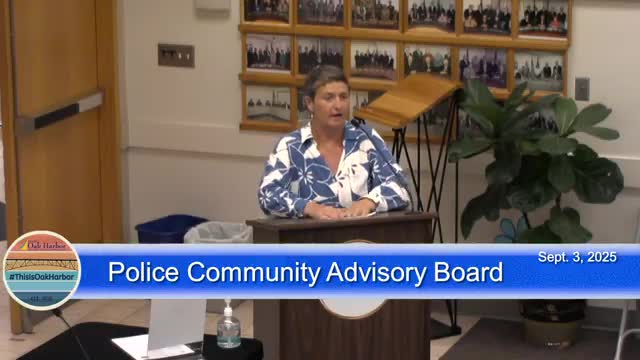
Summary
After public comments from property owners and business leaders about concentrated homelessness and related crimes near Southwest Barlow Street, the Oak Harbor Police Community Advisory Board voted to draft a report recommending a pallet-shelter community and recovery-cafe supports and to present that plan to city council in December.
The Oak Harbor Police Community Advisory Board on Sept. 3 voted to prepare a report recommending that the city pursue a pallet-shelter community and a recovery-cafe model to address homelessness concentrated in the Southwest Barlow Street business district and to present that recommendation to city council, with a preferred council hearing date of Dec. 16.
The matter drew extended public comment from property owners and business operators who said the presence of people congregating near 1241 Southwest Barlow Street — and the services provided there — has driven customers away and impaired property sales. “We started out at a very competitive price,” said Corinne Lerch, a Windermere realtor who represents the owners of 1421 Southwest Barlow Street. “The main concern that they did not continue with the purchase of the property was because of the ongoing issues with the homeless population that congregates around 1241 Southwest Barlow Street… open drug use, loitering, panhandling, intimidation, public urination and defecation, and increased crime rates.”
Why it matters: speakers said that the business district — which includes national and local anchors such as Walmart, Safeway and Starbucks — supplies a large share of the city’s sales-tax base, and that losing anchors could reduce city revenue and harm small businesses. Property owner Jeff Mack said long-term tenants have left and described repeated calls to police and to public-health offices to remove needles and camps, adding that the situation has produced vacancies and lost revenue.
Chief Slowik of the Oak Harbor Police Department told the advisory board that law enforcement and county partners are active in the district. “Oak Harbor does work with our co-responder, which does about 10 to 11 hours a week at SPIN,” he said, and the county’s human-services tally for SPIN is about “35 hours per week,” a figure Chief Slowik said does not include law-enforcement hours. The department also conducts early-morning proactive patrols “between 6 and 7” in the downtown business district to move people from doorways and alleyways.
Speakers pressing for local action urged relocation of services away from the core retail strip. Lerch said the nonprofit at 1241 Southwest Barlow Street offers laundry, meals and referrals but “does not house people here,” and she cited state rules she said were raised in a city press release (she referenced RCW 30 five-twenty one-six 83 and WAC 4 58 16 3 20). Lerch told the board that the nonprofit’s lease has “about a year and a half” remaining and urged council to require a relocation before that lease expires.
Board direction and next steps: Chair Paul moved that the board’s report to city council focus on creating a pallet-shelter community as a way to centralize services and reduce downtown impacts; a CAB member seconded the motion and Chair Paul announced the board would prepare the report and seek a council hearing (the board indicated Dec. 16 as a preferred date). The board said it will gather draft recommendations from CAB members and community partners, and the chair said he would circulate materials in advance to avoid violating state open-meeting rules.
Several CAB members suggested pairing a pallet-shelter community with a downtown recovery-cafe model — a staffed center where clients can access case management, meals and referrals — and noted the potential to solicit business sponsorships to offset operating costs. River Powers noted a pallet-site in Everett where business sponsorships helped fund colorful exterior artwork and community buy-in.
Implementation questions and constraints: CAB members and public commenters stressed that operations and security are the major recurring costs for any shelter model. Chief Slowik said the five-year homeless-housing plan being drafted at the county level is required by state law and is intended to coordinate jurisdictional contributions; he cautioned that siting decisions are the purview of individual jurisdictions and that funding and operations will require county, municipal and nonprofit partnerships. Several members said they plan to push for concrete, actionable items the CAB can recommend to city council to speed local efforts.
What was not decided: No formal, roll-call vote was recorded on adopting specific siting, budget or operational plans. The board agreed to draft and forward a recommendation to city council; details such as the selected site, operator and budget will be developed in subsequent CAB work and in consultation with county and nonprofit partners.
Ending: Chair Paul said he will meet with CAB members over the next month to draft the report and will submit an agenda request for city council. CAB members encouraged recruitment of additional business owners and residents to the advisory board to strengthen outreach and representation.