
Oak Harbor adopts five-year utility rate increases to shore up water, sewer, solid-waste and storm-drain funds
Get AI-powered insights, summaries, and transcripts
Subscribe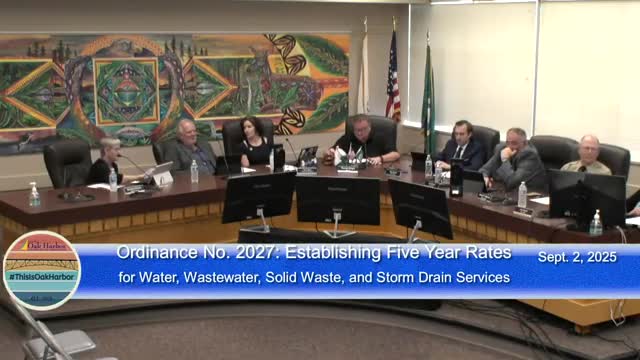
Summary
The Oak Harbor City Council adopted Ordinance 2027 after a public hearing and staff presentation showing rising costs — notably a major increase in water purchase charges from Anacortes and higher solid-waste tipping fees — that would push utility fund balances negative without rate adjustments.
Oak Harbor city officials adopted a five‑year utility rate plan on Sept. 2 after staff warned current charges would drive the city’s enterprise fund balances toward negative without changes.
Finance Director and Deputy City Administrator David Goldman told council the city faces multiple cost pressures: Island County waste‑transfer (tipping) fees rose about 21% for 2025 plus inflation; the city’s wholesale water purchase from the City of Anacortes increased roughly 25% over budgeted levels; and general inflation is raising operating and replacement‑reserve needs. Goldman said the proposed schedule would raise the average residential utility bill by roughly $10 a month each year over the next five years, an average annual increase of about 5.4% across water, sewer, solid waste and storm‑drain services.
The council was shown charts comparing Oak Harbor’s total utility bill to peer cities and projections of the utilities’ net position with and without the increases. Goldman told the council that without the increases the budgeted ending net position for the utility funds would turn negative within the planning period; with the proposed increases the funds remain solvent.
Council members questioned the degree to which the city can rely on outside rate schedules for water and disposal. Goldman said the city has a multi‑year contract with Anacortes that covers the near term and that solid‑waste and water charges beyond the next one to two years are estimated in the model; he emphasized the farther the projection horizon the greater the uncertainty and said staff would return to council if changes are needed. Public works and finance staff also explained that some operating and capital assumptions — including a multi‑year CIP and replacement reserves — are built into the rate model.
Council debate covered whether a three‑year plan would be preferable to a five‑year plan; staff said a five‑year plan provides more revenue certainty for multi‑year capital planning but acknowledged projections beyond two years rely on estimates. Council members also asked about outreach; staff said the city would publish the change, include it with utility bills, and do public outreach after adoption.
Mayor Pro Tem moved to adopt Ordinance 2027 and the motion was seconded; the ordinance passed unanimously. The rate schedule in the ordinance becomes effective as specified in the document, with the first adjustment timed to take effect in late 2025 and subsequent annual adjustments through the five‑year window. The council and staff said they will monitor outside charges and revisit the plan if conditions change.