
Metropolitan Council Chair Charlie Zelle reflects on culture, tribal relations and stewardship ahead of retirement
Get AI-powered insights, summaries, and transcripts
Subscribe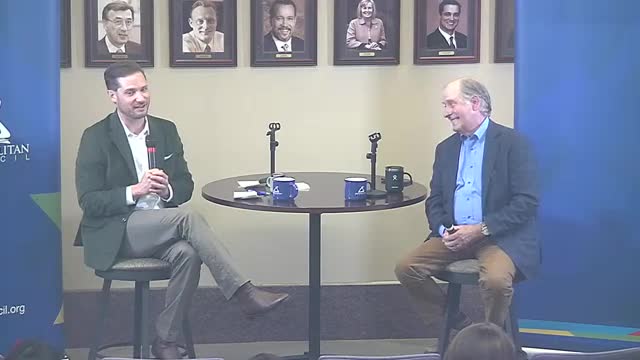
Summary
Chair Charlie Zelle used a Met Council town hall to reflect on his tenure, emphasize organizational culture and tribal-state relations, and urge continued capital maintenance for transit; the event included staff questions about art, parks and the chair’s post-retirement plans.
Ryan O'Connor, regional administrator at the Metropolitan Council, opened a Sept. town-hall session by asking staff to join a reflection on the council’s outgoing leader and noting the event would be recorded for MetNet and shared on Sept. 16.
Charlie Zelle, chair of the Metropolitan Council, who said he is retiring after "five and a half years as the Met Council chair, 13 years total in public service," spent the hour summarizing highlights, describing cultural changes inside the agency and answering staff questions about governance, tribal relations, arts and his personal plans.
Zelle framed his tenure around collaboration and long-term stewardship. "It's about community development. It's about livability," he said, adding that successful projects often came when "government and nonprofit bridal [sectors] agencies come together and do great things." He cited recent transit openings and the region’s capital position as sources of pride.
The chair urged a focus on maintenance funding for the transit system. "We have to make that commitment to keep it in good repair," Zelle said, arguing that agencies should not take on new assets unless they can sustain them over time.
On organizational culture, Zelle described the council’s recent Met Culture work as a multi-year effort that must be driven "from the inside out." He said the program is not a top-down edict and credited staff leadership and outside consultants for helping the agency make progress. "You can't just turn a switch," he said. "It has to come from the inside meaning from those that have the greatest awareness and expertise."
Zelle discussed tribal-state relations as a formative part of his public-service career, noting work begun at MnDOT to train state managers on government-to-government relationships and recalling a tribal-flag exchange process that he said was symbolically meaningful. He urged staff to attend tribal consultations and described the perspective of thinking "seven generations behind, seven generations forward" when planning infrastructure and water projects.
On governance and accountability, Zelle contrasted the role of a chair with that of a commissioner and said the Met Council’s hybrid status — a 17-member appointed board within the governor’s cabinet — requires balancing alignment with the governor while retaining board judgment. "A chair is a chair, a chair of a board," he said, and emphasized accountability "to each other mostly, firstly, and then of course, to the governor."
During a staff question-and-answer segment, employees asked about Zelle's post-retirement plans, the role of art and public spaces, and the council’s organizational structure. Leah Mathis, an intern in Parks and Trails, asked a lighthearted question about snacks; other staff raised operational and governance issues. Zelle said he expects to spend more time with family, travel, ski and be involved at a lower intensity with Jefferson Lines, a private bus company he mentioned.
When asked whether the council should be reorganized, Zelle said he supports more internal coordination rather than structural separation: "I totally believe in a non, and it's no secret that we should be one council, not separate, you know, divisions," adding that stitching divisions together should happen organically and with guidance.
On art, Zelle described transit-related art and partnerships, including work tied to repainting a pedestrian bridge and collections displayed within Metro Transit. He called art "essential to how we think about the places we live and work and play."
The hour closed with Zelle offering advice to incoming leadership: trust staff, lead with empathy and respect differing perspectives. Ryan O'Connor and other leaders thanked Zelle and asked staff to give him a final round of applause at the session’s end.
The town hall included a recorded question-and-answer period and an audience Q&A; the recording will be available on MetNet and was scheduled to be shared on Sept. 16, according to Ryan O'Connor.