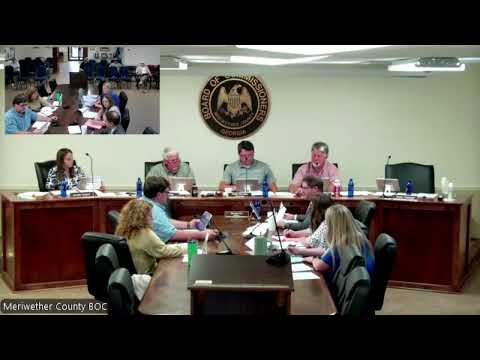
Meriwether County approves purchase of Harris radios, tables some site work for later
Loading...
Summary
The Board approved buying 54 Harris Veil 200 P25-capable portable radios using investment interest as a funding source and delayed decisions on several site and tower upgrades to allow more permitting and planning.
Meriwether County commissioners voted to buy 54 Harris Veil 200 P25-capable portable radios and to use interest earned in the county's Local Government Investment Pool (LGIP) as a funding source.
The board approved a motion to authorize the purchase of 54 portable Harris radios with FirstNet LTE capability from Dean's Commercial 2 Way for a not-to-exceed amount of $451,841, with funding drawn from LGIP interest earnings. Commissioners also agreed to use LGIP interest more broadly as a funding source for current-year projects.
The purchase followed a lengthy public discussion about radio performance, interoperability and system redundancy. Dean Ginn of Dean's Commercial 2 Way told commissioners the radios provide LTE (FirstNet) coverage, are compatible with the county's VHF equipment and include 800 MHz capability, saying, "this radio is compatible with your current VHF equipment" and that the product would "get you coverage in areas you do not have it now." Ginn also said the radios could be tested in the field before final acceptance.
Commissioners and vendors discussed how the radios would work with planned conventional-system upgrades. County staff and the vendor described a parallel approach: purchase radios that use FirstNet to fill current dead spots while upgrading county-owned towers and simulcast sites (Forest Road, PSC Wireless and Warm Springs) to rebuild the county's backbone. The board voted to table a separate proposal to relocate equipment to the PSC tower and other site-service decisions until Nov. 10 to allow permitting and engineering work to proceed.
Commissioners asked about warranties, life expectancy and whether the radios would be "intrinsically safe" for fire personnel. Ginn said the fire set of 20 radios includes intrinsically safe housings and extra batteries; he described the platform as a national, public-safety standard and said the radios would likely serve the county for decades.
Discussion also covered pricing comparisons with Motorola and other manufacturers, donor radio/gateway options in alternate quotes, and grant eligibility if the county adopts P25-capable gear.
The board's formal actions were limited to the approved radio purchase, the decision to allow LGIP interest to be used for projects, and tabling of several site-related proposals for further engineering and permitting.
Commissioners directed staff to bring back the PSC-tower site quote, and to continue the system design and coverage mapping work before additional site or tower approvals.
The vendor and staff emphasized that the radios would improve coverage immediately while the county's own tower simulcast upgrades are completed.