
Residents urge council to block Concord Farms as sewer allocation request is withdrawn
Get AI-powered insights, summaries, and transcripts
Subscribe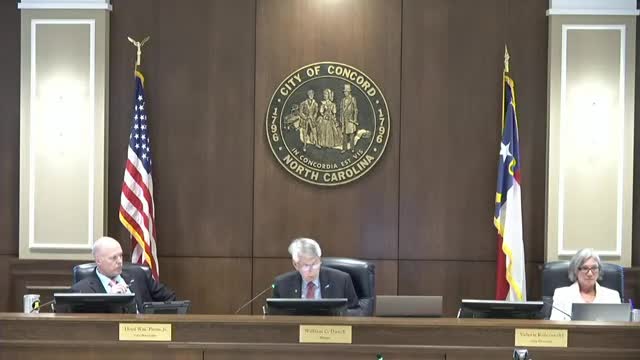
Summary
Public commenters urged the Concord City Council to oppose the Concord Farms development, citing traffic, school capacity and neighborhood character. Staff announced Dr. Horton has withdrawn a pending sewer allocation request for September.
Several residents and neighborhood leaders urged the Concord City Council on Aug. 12 to oppose the proposed Concord Farms development and to uphold the city’s water and sewer allocation policy after city staff announced the developer had withdrawn a pending sewer allocation request.
The petitioners say the planned project — which opponents say could total as many as 1,800 housing units in some presentations — would strain roads, schools and emergency services and change the character of nearby neighborhoods.
The concern surfaced during the council’s public comment period after a staff announcement that Dr. Horton had withdrawn a sewer allocation request scheduled for the September meeting. Mayor Deutsch read that withdrawal to the council before public comment began.
"The city's water and sewer allocation policy makes it clear that capacity is a limited public resource," David Conrad, president of the Sheffield Manor Homeowners Association, told the council. "To be allocated only to projects that are ready to proceed, align with the city's adopted plans, and serve the public interest." Conrad said the existing plan under discussion could include "up to 1,800 housing units." His remarks repeated the council’s policy language: "It's a limited public resource."
John Paul, a resident who said he is a candidate for the City Council in District 4, said he opposed the plan as presented and urged councilors "not to go forward with the development as proposed." He and other speakers said they do not want a more urban-style development adjacent to established suburban neighborhoods.
Other commenters raised related concerns. Johnny Shreeves, a Concord resident, questioned affordability and economic justification and said he would prefer other uses such as homeless shelters rather than the proposed development. Gina Earhart thanked Councilwoman Lori Clay for asking "tough questions" about Concord Farms and urged residents to oppose the project if it returns to the council. County Commissioner Larry Pittman and resident Norman McCallum both voiced broader opposition to rapid, incentivized growth in the area.
No formal council action on Concord Farms was taken at the meeting. Staff’s announcement that Dr. Horton withdrew the sewer allocation request for September was a procedural development; council members did not vote on the withdrawal itself, nor did the council approve or deny any entitlement for Concord Farms that night.
Council members and staff did discuss the city’s allocation policy during later consent items that considered individual water or sewer applications outside the city limits, and several councilors asked that the broader approach to such outside-the-city requests be scheduled for a work session to seek greater consistency.
For residents and neighborhood leaders, the immediate takeaway was process: David Conrad urged the council to "uphold both the spirit and intent of your own policy" and to avoid allocating utilities before zoning approvals, state studies and full community engagement are completed.
If and when Concord Farms returns, the council and city staff indicated the proposal would be considered through the standard public-notice and review processes and any future utility allocation would be decided separately from public comment.