
Wilsonville presents draft Climate Action Plan with modeled emissions scenarios, council warned transportation sector most challenging
Get AI-powered insights, summaries, and transcripts
Subscribe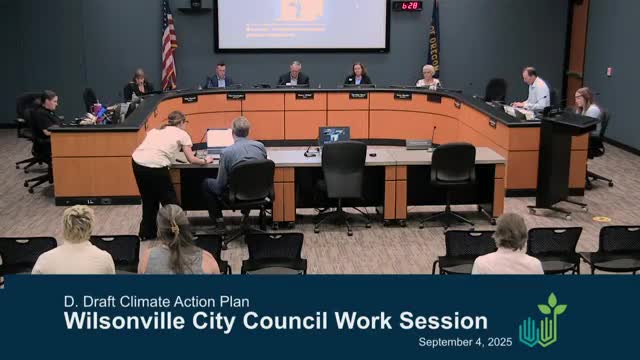
Summary
The City presented a draft Climate Action Plan Sept. 4 modeling future climate impacts and a low‑carbon action set; the plan shows the city could meet modeled long‑term reduction goals but that transportation emissions will be the hardest sector to reduce locally.
Wilsonville staff presented a draft Climate Action Plan to the City Council on Sept. 4 that models future climate conditions, community survey results and scenarios showing how local actions could reduce greenhouse gas emissions through 2050.
Natural Resources Manager Carrie Rapold and consultant Moria Brown (Sustainability Solutions Group) summarized expected climate changes for Wilsonville — notably a projected rise in the number of “hot days” (>90°F) from an historical average of four days per year to roughly 17 in mid‑century — and underscored several community survey rounds that yielded more than 200 responses. Residents identified wildfire risk, heat and other climate impacts as high priorities.
The plan modeled a business‑as‑usual scenario (emissions increase with growth) and a “low‑carbon scenario” that combines ten targeted local actions in five categories: buildings and industry, transportation, renewable energy, solid waste and green infrastructure. The consultants showed the low‑carbon package could meet Oregon’s long‑term reduction goals (approximately an 80% reduction by 2050 relative to baseline in modeling), but they emphasized transportation remains the sector with the largest remaining emissions under modeled actions.
Councilors questioned feasibility at the local scale. Councilor Dunwell said Wilsonville’s land‑use pattern and “last‑mile” constraints make shifting trips from cars to transit or active transportation especially difficult, and he noted financial barriers to vehicle electrification for lower‑income households. Other councilors and staff pointed to municipal measures that provide near‑term wins — city building retrofits, municipal fleet electrification, and coordination with SMART — and to statewide measures (building code updates, grid decarbonization) that the plan assumes in its baseline.
Staff framed the plan as a policy framework rather than a prescriptive engineering specification; the consultant read a disclaimer noting modeled projections are appropriate for planning and not for detailed design or project-specific engineering decisions. The plan includes a menu of implementation measures and identifies future steps: quantifying costs and savings, defining governance and staffing, and aligning funding and incentives.
Ending: Councilors broadly supported moving forward but emphasized fiscal and equity constraints; staff said next steps will include more detailed implementation-level work, budget implications and continued public and business engagement.