Get Full Government Meeting Transcripts, Videos, & Alerts Forever!
Get email alerts on the Public Safety Technology topic
No spam. Unsubscribe anytime.
Police present FUSIS live-streaming, license-plate and camera registry plan; public and commissioners press for pause and oversight
Summary
Lawrence Police briefed the City Commission Sept. 9 on plans to aggregate body-worn and in-car video, traffic cameras and license-plate readers in an Axon FUSIS platform that enables live streaming and AI-assisted searches; police said the tool improves officer safety and investigation speed, while many speakers demanded a pause and a public ordinance to govern its use.
Lawrence Police Department leaders on Sept. 9 briefed the City Commission and an extended public audience on the departments new Axon FUSIS platform, which aggregates live feeds from body-worn cameras, in-car cameras, traffic cameras and automated license-plate readers (ALPRs) into a single "pane-of-glass" map for dispatch and real-time operational use. Chiefs said the platform is needed to access live streaming from newly purchased body and dash cameras and to improve officer safety and investigatory efficiency; community members and advocates raised privacy, oversight and civil-rights concerns and pushed the commission to pause further integrations until a community-developed oversight framework is in place.
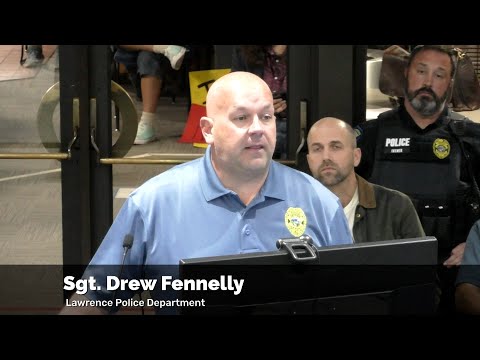
What police said: Chief Rich Lockhart introduced the presentation and said the department has consolidated several Axon contracts for body-worn cameras, in-car systems, evidence storage and the FUSIS platform; the FUSIS module is the mechanism that allows live streaming of Axon body and dash cameras. Deputy Chief Adam Heffley outlined the departments camera history (earlier systems from other vendors, fixed traffic cameras, ALPR acquisition in 2011) and explained how ALPRs produce plate captures checked against national wants/warrants databases. Sergeant Drew Fenley demonstrated the FUSIS map and search features, described how integrated camera feeds and dispatch data can be used during active incidents, and showed examples where camera playback or live feeds aided officers responding to disturbances, assault calls and vehicle pursuits.
Police policy and safeguards: Staff pointed to existing city and LPD policies governing public-safety video systems, ALPRs and body-worn/in-car cameras, and said those policies include provisions on privacy, limitations on surveillance, and audit logs for access. Police also said Axon does not provide or use facial recognition in the citys implementation and that integration of private residential cameras would require device owners to install a "core" device and sign an MOU; staff said they will not permit automatic residential livestreaming and will prohibit integration of residents' private cameras without explicit controls.
Public comment and concerns: More than 40 members of the public spoke and many emailed written comments. Speakers included civil-rights and defense attorneys, domestic-violence advocates, Grant Township and neighborhood representatives, health-care and shelter operators, and organized groups such as the Lawrence Transparency Project and Kansas Holistic Defenders. Common themes: requests that the city pause further FUSIS integrations and advanced analytics (AI searches) until an ordinance or codified oversight structure is adopted; concerns about federal or other agency access to aggregated data; worry about how AI-based people or vehicle searches might misidentify subjects and disproportionately harm marginalized groups; and requests for clarity on retention schedules, audit access and whether external agencies could be given live access.
Commission reaction and next steps: Commissioners heard a lengthy Q&A after the presentation. Several commissioners and the mayor acknowledged the operational benefits police described but said the depth of public concern warrants a broader process. One commissioner proposed directing staff to pause further integrations and to develop a city-led oversight process with community stakeholders: commissioners agreed to direct staff to begin a process to draft oversight options and report back. Staff told the commission that Axon-hosted evidence storage and body/dash-camera livestream capability cannot be easily severed from the departments ongoing evidence-management needs, and that many integrations (for example city building cameras) will take months of technical work to complete; staff said existing camera and ALPR systems remain usable while the city designs oversight mechanisms.
Why it matters: The FUSIS platform would centralize multiple video and plate-reading sources, change how the department accesses live feeds and add new search tools based on image detection. Community advocates and some commissioners said that a binding, publicly transparent ordinance and an oversight framework are needed before expanded use of the platform and any advanced analytics are implemented.