
Jackson County legislators view Amplifund demo for 9‑1‑1 grant management; no contract yet
Get AI-powered insights, summaries, and transcripts
Subscribe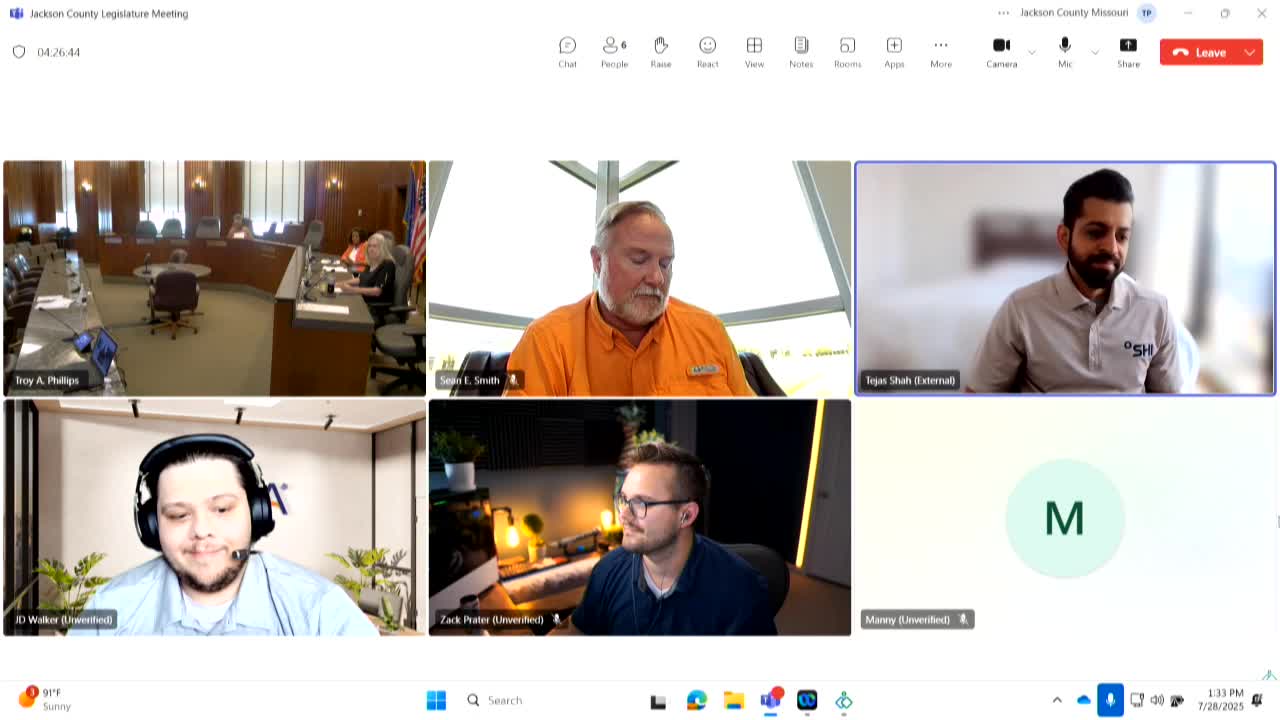
Summary
Jackson County legislators on a joint meeting of the 9‑1‑1 Oversight Committee and the Rules Committee viewed a demonstration of Amplifund on Oct. 10, 2025, as a potential tool to manage 9‑1‑1 grant applications and post‑award processes, and were told no county contract for the system had been finalized.
Jackson County legislators on a joint meeting of the 9‑1‑1 Oversight Committee and the Rules Committee viewed a demonstration of Amplifund on Oct. 10, 2025, as a potential tool to manage 9‑1‑1 grant applications and post‑award processes, and were told no county contract for the system had been finalized.
Chair Lauer opened the session and turned the presentation over to Legislator Sean Smith, who described the current situation: “The vendor was selected by the county prosecutor for the administration of grants,” Smith said, and the legislature was considering whether it could “piggyback” on that implementation so both offices would use a single instance while preserving appropriate segregation of duties.
The vendor presentation was given by JD Walker of Unisolutions, who said the company has been working with Amplifund and partners including SHI and emphasized the product’s use by state and local governments. Walker said, “there’s nothing signed in place just yet,” when asked whether a contract with the prosecutor’s office was already completed.
Zach Prater, identified as a solutions engineer on the call, walked committee members through Amplifund’s applicant portal, opportunity configuration, budgeting fields and post‑award features. Prater said the system supports federal and state grant rules, including Uniform Grant Guidance (2 CFR 200), and allows administrators to configure award ceilings, application windows, eligibility criteria and reusable templates.
On data security, Walker said Amplifund “carries a SOC 2 type 2 security certificate,” and that the platform is hosted on domestic Microsoft Azure servers: “all of the data that you’d be storing in Amplifund stays within The United States,” he said, describing disaster‑recovery hosting across Azure regions.
Committee members asked about user management and access. Prater and Walker explained that the license includes unlimited users and document storage and that access is rights‑ and roles‑based. “You can’t keep people from creating an account, actually,” Prater said, adding that administrators have visibility into accounts and can remove access when appropriate. He also described fine‑grained permissions that can limit what specific users or departments can see.
The presenters addressed practical questions raised by legislators about convenience for small agencies, budget templates and workload. Prater said budget entry can be configured to match existing templates and that Excel budgets can be imported in the post‑award phase. On timeline, Walker described a typical implementation: “typical grama maker timeline would be, from from 3 to 6 months,” with the fastest implementations taking as little as two months when stakeholders are highly engaged.
Committee members raised program‑specific concerns: the 9‑1‑1 fund has a prescribed list of allowable purchases, so members asked whether application forms could be limited to only relevant line items. Prater confirmed the system can be configured to expose only the categories the county chooses. Members also discussed which local office or staff would serve as primary administrators and whether legislative audit staff should be involved in applicant assistance.
No formal procurement decision or vote took place; the session was a vendor briefing and question‑and‑answer period. At the close, the committee thanked the presenters and moved to adjourn. A motion to adjourn was made and the meeting ended without any further action on purchase or contract approval.