
King County delays vote on solid-waste fee increases after haulers cite transfer-station closures
Get AI-powered insights, summaries, and transcripts
Subscribe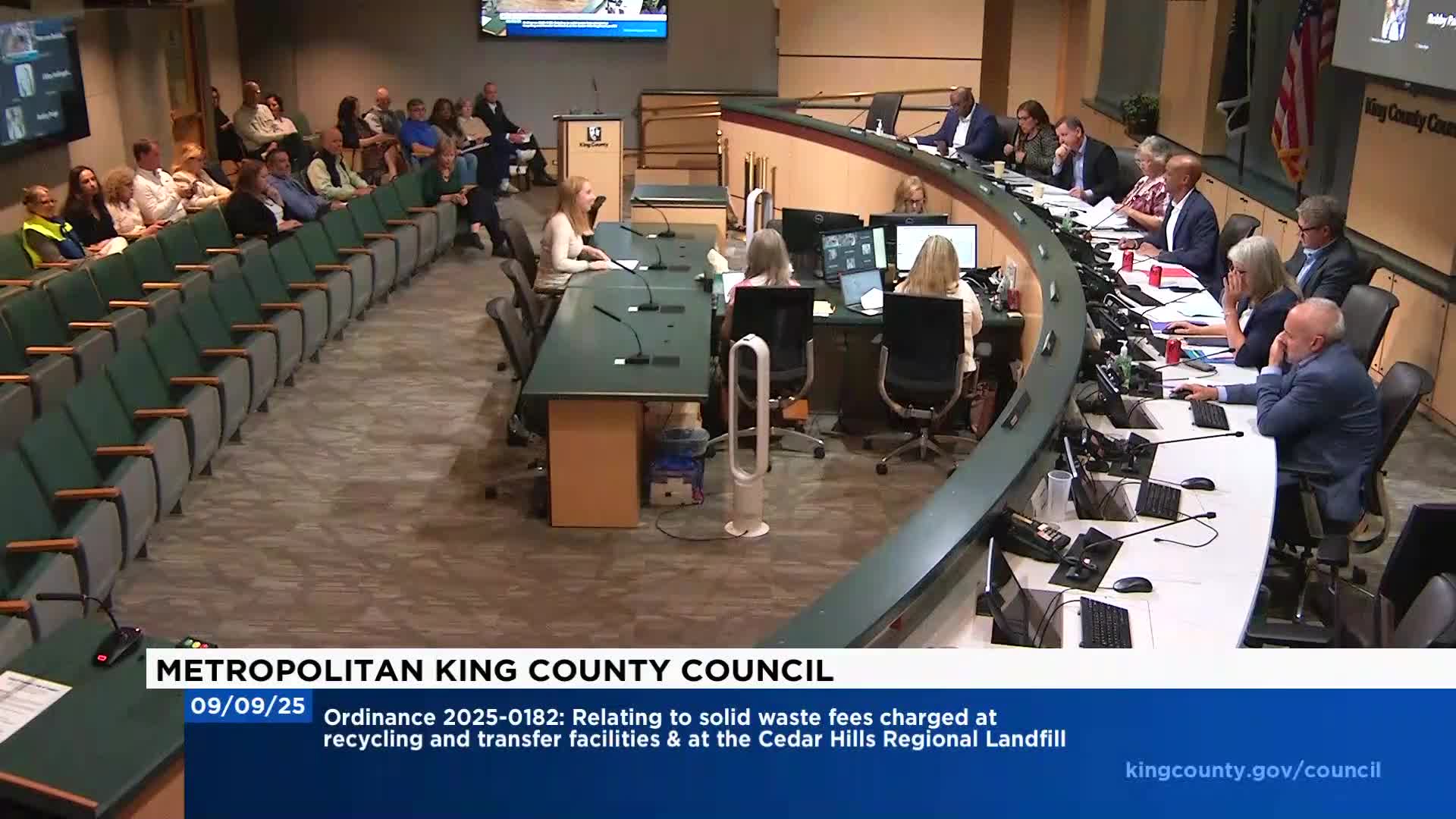
Summary
Councilmembers delayed a vote on proposed 2026 solid-waste fee increases after haulers and contractors testified that repeated transfer-station closures and equipment failures have forced costly diversions to Cedar Hills Regional Landfill. Department staff said capital program costs drive much of the proposed increase and agreed to supply further,
The Metropolitan King County Council on Tuesday postponed a final vote for one week on a proposed single-year increase to disposal and related solid-waste fees after haulers raised concerns about recent transfer-station closures and the financial impacts of direct-haul diversions to Cedar Hills Regional Landfill.
The proposed substitute ordinance (No. 2025-0182.2) would raise many disposal fees — most by about 12.5% — increase the self-haul per-ton vehicle fee (from $203.81 to $229.29), raise the fixed annual charge from roughly $23.3 million to $26.8 million, and hike some discounts and yard/clean-wood rates, department staff said. The solid-waste division presented the package as a one-year measure to stabilize revenue while staff review capital and operating plans.
Why it matters: Haulers told the council that repeated short-notice closures and delays at King County transfer stations since mid-2024 have forced trucks to divert long distances to the regional landfill, increasing time, fuel use, emissions and labor costs. Haulers and their contractors asked the county either to adjust the regional direct-disposal fee that applies when haulers take loads to Cedar Hills, or to fix operational reliability so diversions cease.
"These disruptions, oftentimes with little or no notice, have significant consequences," said Alyssa Campbell, who identified herself as a representative of Ecology and said she was speaking alongside WM and Republic Services. She told the council that between August 2024 and February 2025 there were 132 instances of transfer-station closures or significant delays that affected 87% of operating days and that Algona had been closed for at least a week the previous month. "When the normal transfer station system must be bypassed, haulers bear the cost of longer transport, additional labor and operational delays," Campbell said.
Solid-waste staff acknowledged the disruptions and told the council that some closures were caused by aging equipment. "I believe the packer is broken and down and that is what's causing the closure at Algona," Enterprise Services section manager David Pierce said, adding that Algona is old and a replacement is under construction. Department director John Taylor said the division has been working to reduce closures and would continue to do so.
April Sanders of council policy staff summarized the ordinance materials and the division's rationale: "Most fees to dispose of solid waste are proposed to increase by 12.5%." Sanders also said the division modeled customer impacts and estimated a $0.30 to $1.15 monthly change for a curbside customer with a 32-gallon can in some cities.
Council members pressed staff for detail about cost drivers. Director Taylor and solid-waste finance staff told the council the capital improvement program is the largest single driver of the proposed increases. Taylor said Harbor Island forecast amounts appear in longer-term planning; staff clarified that a forecast figure discussed in the meeting had been a planning-level estimate rather than an immediate budget line item.
Haulers urged a larger adjustment to the regional direct-disposal discount than the county currently offers. Campbell said the current regional direct disposal fee discount is about $2.86 per ton (roughly a 2% reduction relative to other fees), but argued the true cost impact of diversion is much higher and said the discount should be closer to 67% to reflect actual added costs to haulers.
After discussion, Councilmember Dombowski asked for more information about how much of the revenue base the regional-direct receipts represent and whether a short delay would allow staff to provide additional analysis. Department staff agreed to return additional data and to continue working with haulers and the Solid Waste Advisory Committee and Metropolitan Solid Waste Management Committee. The council agreed to table the matter for one week to allow staff to provide requested details before the council takes final action.
The decision: The motion to adopt the ordinance was put before the council but was effectively tabled for one week by unanimous consent to permit follow-up briefings and further analysis. Staff said they could accommodate the delay and would provide the requested information before the item returns.
What happens next: Solid-waste division staff committed to continue meetings with haulers and to provide a briefing on revenue distribution, the magnitude of regional-direct receipts, and capital-program drivers behind the proposed increases. The council signaled it expects a revised, data-backed presentation before final adoption.
Provenance: Transcript testimony and staff presentations on the proposed substitute ordinance and the subsequent tabling appear in the council transcript beginning with April Sanders' presentation of the fee package and continuing through the one-week tabling of the item.