
Commissioners debate housing barriers, incentives, ADUs and cluster options in draft housing policies
Get AI-powered insights, summaries, and transcripts
Subscribe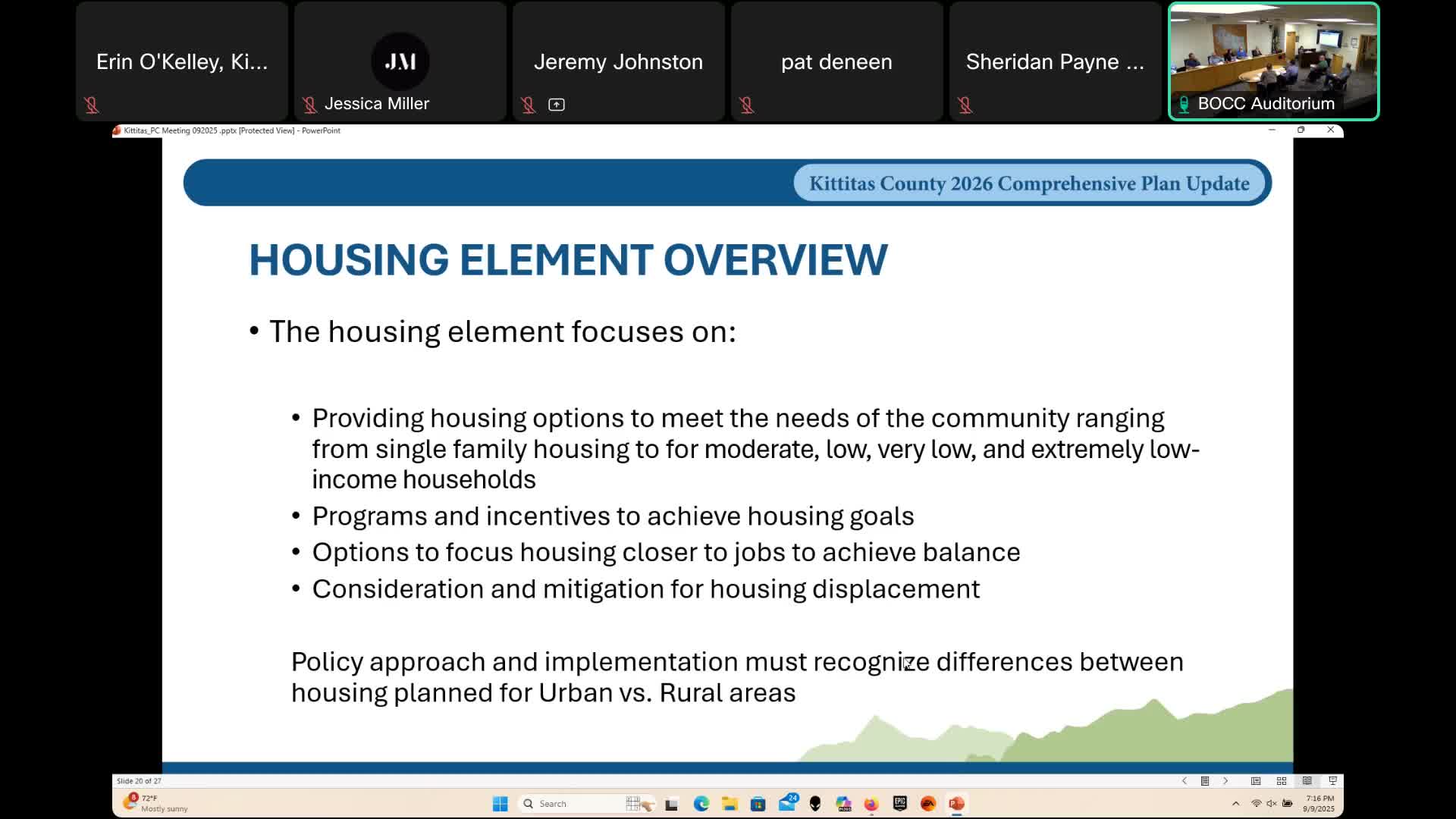
Summary
Commissioners and staff discussed housing affordability, barriers to building in Kittitas County and possible incentives including accessory dwelling units, permit‑ready plans, clustering and density bonuses for rural development.
Kittitas County planning commissioners and staff spent a substantial portion of the meeting discussing housing affordability, the county’s housing element and potential tools to increase housing supply and affordability.
Planning consultant Clay White described the state’s updated housing requirements and the need to align zoning and land‑capacity analysis with income bands used by the state. “Once you understand the incomes the different incomes that people make and the housing needs for people,” White said, local governments can target housing capacity and incentives to meet those needs.
Commissioners expressed concern about the high cost of construction and land, particularly in the Upper County, and discussed tools staff could pursue including accessory dwelling unit (ADU) policies, permit‑ready plan sets, clustering and density bonuses, and coordinated incentives for childcare and infrastructure. One commissioner said simply: “If you have jobs, you need child care.”
Staff described options that could reduce barriers: permit‑ready building plans or an ADU program that offers pre‑approved designs to speed approvals; coordination with cities and partners on fees and utility connections to reduce upfront costs; and implementation actions that could be added to the comprehensive plan’s implementation chapter. White and staff emphasized some policies may be implemented through code changes after the plan is adopted.
Why it matters: commissioners said the county lacks enough higher‑paying local jobs and diversified industry to support affordable ownership and rental housing. They discussed tailoring policy tools for urban growth areas where infrastructure exists and exploring cluster development approaches and density bonuses for rural contexts to preserve open space while allowing more housing.
Clarifying detail: during the discussion staff referenced an income figure for the county (average/mean income of $107,700) and said the county’s update must address multiple Area Median Income (AMI) bands when planning housing capacity.
Ending: Staff asked commissioners to submit written ideas; staff will incorporate feasible measures into the draft housing element and the implementation chapter for future code and program changes. No formal ordinance or zoning change was adopted at the meeting.