
Council committee approves climate-related code changes on EV charging, green building and carbon goals
Get AI-powered insights, summaries, and transcripts
Subscribe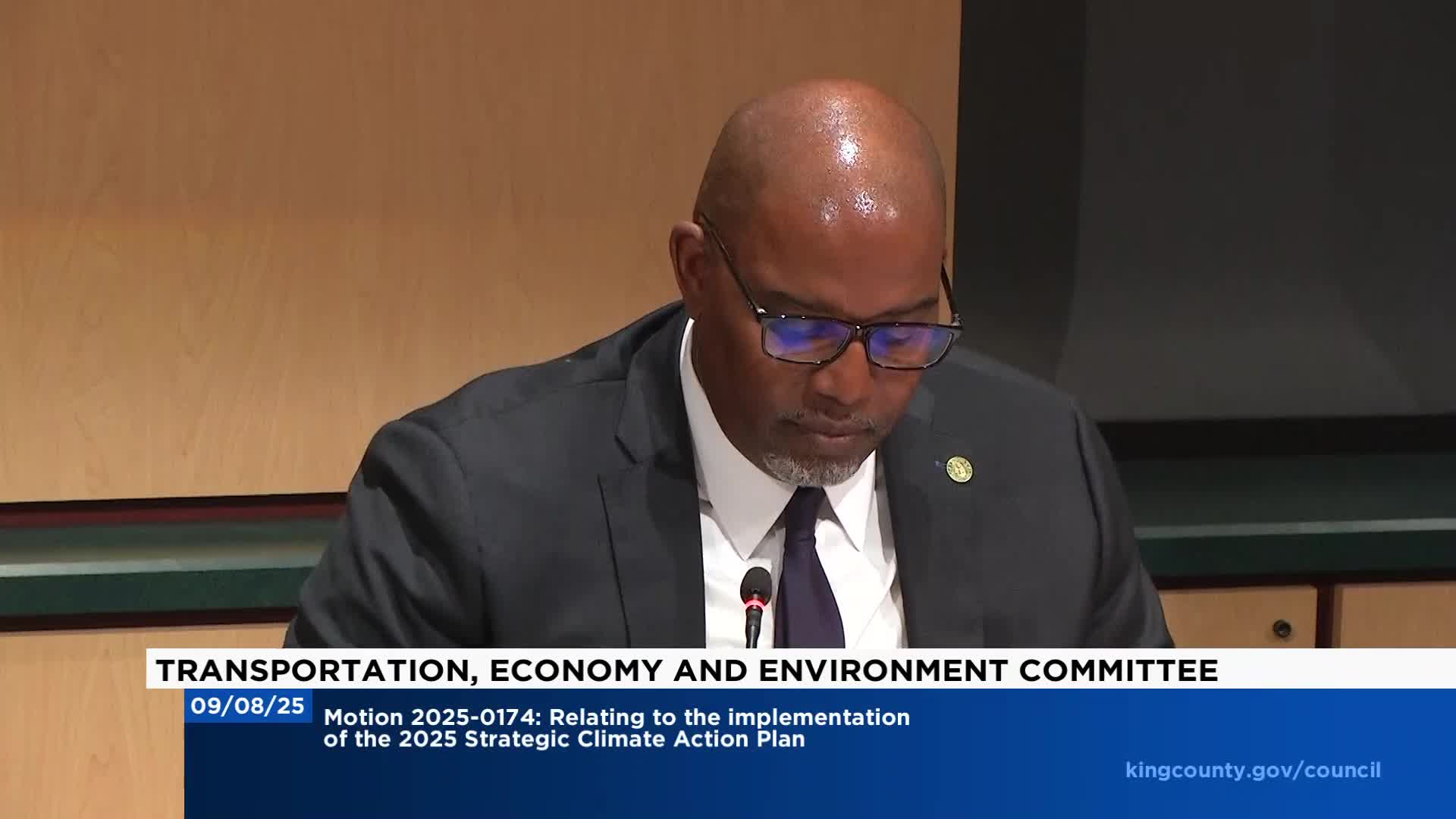
Summary
The committee approved an ordinance that updates King County code on electric vehicle charging, county green-building standards and carbon neutrality expectations for DNRP divisions; the committee adopted striking and title amendments and restored a labor advisory council requirement.
The Transportation, Economy and Environment Committee approved a multi-part ordinance amending King County Code to align county regulations with climate objectives, including changes to electric vehicle (EV) charging governance and fees, green‑building requirements for county projects, and carbon‑neutrality expectations for the Department of Natural Resources and Parks (DNRP) and its divisions. The committee adopted a striking amendment and a title amendment and voted to forward the ordinance to full council; clerk roll call recorded four ayes and one excused member for the item.
Key changes in the ordinance as amended include restoring code language that requires user fees collected at EV charging stations to be used for maintaining those stations and defining “custodial agency” as the responsible entity for chargers; codifying LEED Platinum or Living Building Challenge Core certification for market‑rate transit‑oriented development on county property; clarifying that zero‑energy and zero‑carbon requirements apply to projects initiated on or after Jan. 1, 2026; and standardizing EV charging targets to refer to charging ports rather than individual chargers. The striking amendment also restored language requiring a labor advisory council and consultation with named labor organizations for SCAP development and similar processes.
On the carbon neutrality question, the ordinance as transmitted had removed a requirement that DNRP and its wastewater and solid waste divisions achieve carbon‑neutral operations by 2025; the committee’s striking amendment restored a provision for DNRP, wastewater and solid waste divisions to achieve carbon neutrality, and the ordinance makes other technical clarifications.
Council staff emphasized that the ordinance spans many technical areas and that, because the executive issued a SEPA determination of non‑significance for the proposal, any substantive amendment concepts should be provided to council staff by Friday, Sept. 12 to allow SEPA review and avoid delaying full council consideration. The committee adopted the amended ordinance and will transmit it to full council for action on the posted schedule.
Discussion vs. decision: the committee’s amendments modified several policy details (timing of energy requirements, the role of custodial agencies for EV chargers, and the labor advisory council requirement), while staff cautioned that some changes affect capital and operating budgets and may require further budget discussion.
Next steps: the ordinance as amended will proceed to full council after the required notice period; staff asked members to submit any further amendment proposals promptly so SEPA review can be completed before full‑council action.